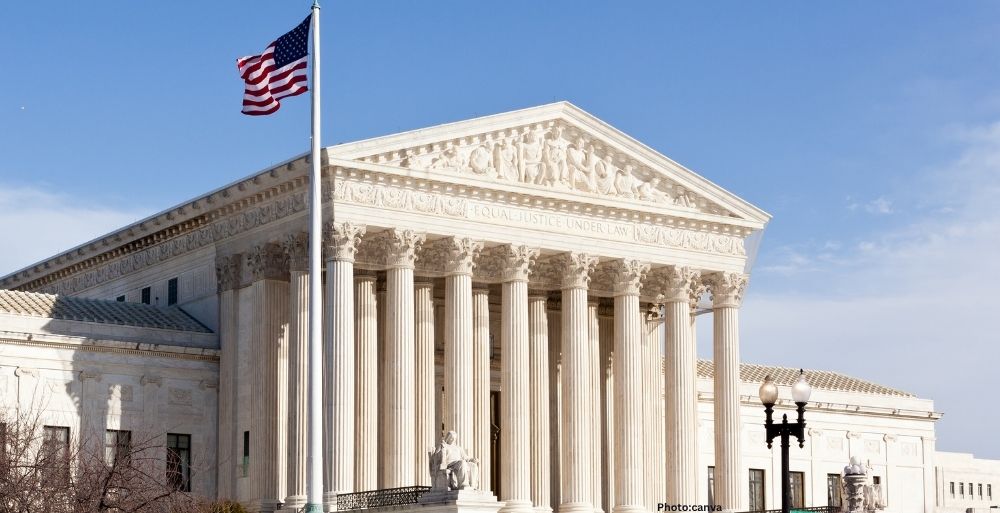
The modern U.S. Supreme Court stands at a moment of profound institutional reckoning. Once regarded as the nation’s stabilizing constitutional backstop, the Court’s recent trajectory has raised urgent questions about its democratic legitimacy, its susceptibility to ideological capture, and its widening distance from the public it is meant to serve. A recent letter to Congress from dozens of civil‑rights and pro‑democracy organizations captures this concern with unusual clarity, warning that the Court’s “rolling back [of] voting rights, reproductive freedoms, environmental protections and commonsense gun laws, and dramatically expanding presidential immunity” has placed it “out of step with the American people while enriching wealthy right‑wing political donors and corporate interests.”
This critique is not hyperbole. It reflects a decade‑long pattern in which the Court’s conservative supermajority—cemented by three appointments during the Trump administration—has aggressively reshaped constitutional doctrine in ways that contract long‑standing rights and expand executive power. The Court’s recent decision in Louisiana v. Callais, completing what Justice Elena Kagan described as the “now completed demolition” of the Voting Rights Act, is emblematic. In her dissent, Kagan reminded the nation that the Act “was born of the literal blood of Union soldiers and civil rights marchers,” and that dismantling it threatens “a half‑century’s worth of gains in voting equality.”
The Court’s defenders argue that it is merely returning constitutional interpretation to its original meaning. But this framing obscures the deeper structural problem: the Court is increasingly functioning as an ideological instrument rather than a neutral arbiter. Its decisions on voting rights, reproductive autonomy, environmental regulation, and gun safety reflect a consistent pattern of narrowing federal authority, weakening civil‑rights protections, and elevating individual or corporate claims over collective democratic interests.
The expansion of presidential immunity is perhaps the most alarming development. By broadening the shield around executive actions, the Court risks undermining the very principle of accountability that distinguishes a constitutional republic from an elected monarchy. As the civil‑rights coalition notes, these rulings have “encouraged and enabled Trump’s most authoritarian instincts,” often through the Court’s opaque and increasingly criticized shadow docket.
The shadow docket—where major decisions are issued without full briefing, oral argument, or transparent reasoning—has become a powerful tool for reshaping national policy without public scrutiny. This procedural shift is not merely a technical concern; it erodes democratic norms by allowing consequential rulings to occur outside the traditional deliberative process. The Court’s intervention in Louisiana’s redistricting, despite ongoing primary elections and its own previously stated reluctance to disrupt active campaigns, illustrates how procedural norms are being bent to achieve ideological outcomes. Justice Ketanji Brown Jackson’s dissent underscored this inconsistency, warning that the Court’s abrupt reversal of its own principles signals a “naked partisan power grab.”
Critics also highlight the Court’s ethical vulnerabilities. Reports of undisclosed gifts, luxury travel, and donor‑funded access involving certain justices have intensified public skepticism. Without an enforceable code of ethics—something every other federal judge is bound by—the Court remains uniquely unaccountable. This lack of transparency fuels the perception that wealthy donors and political networks wield disproportionate influence over judicial outcomes.
The cumulative effect is a legitimacy crisis. Public trust in the Court has fallen to historic lows, and the perception that it is aligned with partisan interests threatens the stability of constitutional governance. A judiciary that is seen as politically captured cannot effectively serve as a check on executive or legislative overreach.
Structural reform is therefore not a radical proposition but a democratic necessity. Proposals such as 18‑year term limits for justices, a binding code of ethics, and—under a future pro‑democracy administration—expanding the size of the Court, aim to restore ideological balance and institutional accountability. Legislative efforts like the John Lewis Voting Rights Advancement Act and the Freedom to Vote Act are equally essential to counteract the Court’s retrenchment on voting rights.
Ultimately, the crisis facing the Supreme Court is not merely legal but constitutional and civic. A Court that consistently narrows democratic participation while expanding executive power risks destabilizing the very system it is sworn to protect. The responsibility now lies with Congress, civil society, and the electorate to ensure that the Court does not drift further from the democratic principles that legitimize its authority.