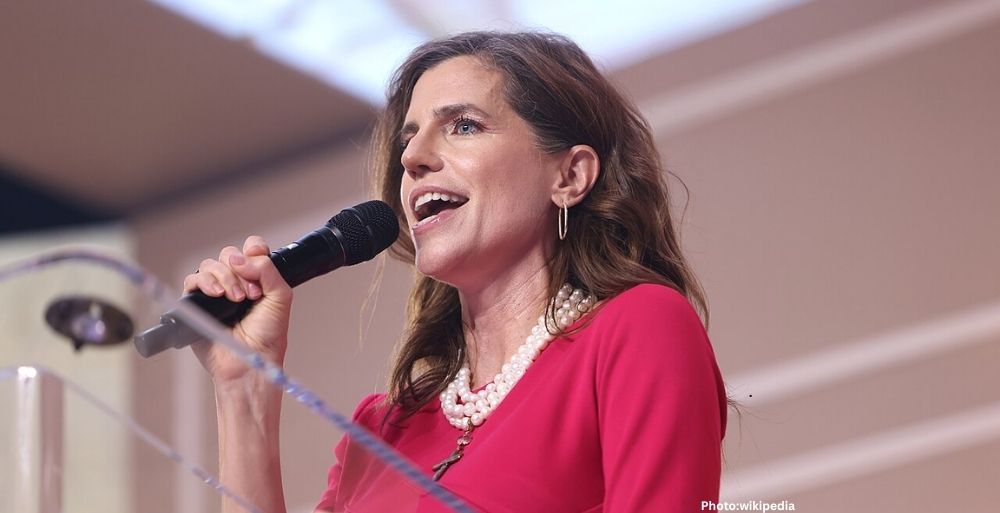
Rep. Nancy Mace, a Republican from South Carolina, has introduced a constitutional amendment aimed at prohibiting naturalized U.S. citizens from serving in Congress or holding Senate-confirmed positions, citing concerns over divided loyalties.
On Wednesday, Rep. Nancy Mace announced her proposal for a constitutional amendment that seeks to bar naturalized U.S. citizens from holding positions in Congress, serving as federal judges, or assuming any role that requires Senate confirmation. The South Carolina lawmaker framed this initiative as a necessary measure to ensure that U.S. officials demonstrate undivided loyalty to the nation.
In her statement shared on the social media platform X, Mace referred to the proposal as a “long overdue joint resolution,” emphasizing that it reflects the same eligibility standards that apply to the President and Vice President of the United States. She asserted, “The people writing America’s laws, confirming America’s judges, and representing America on the world stage should have one loyalty: America. Not any other country.” Mace’s comments resonate with a growing sentiment among some political factions that question the loyalty of naturalized citizens in high governmental positions.
Context of the Proposal
Mace’s proposal arrives amid her gubernatorial campaign in South Carolina, where she aims to secure the Republican nomination. The amendment targets naturalized citizens, a group that includes 26 members of Congress, comprised of 19 Democrats and seven Republicans. Mace specifically highlighted three Democratic representatives—Ilhan Omar (Minn.), Shri Thanedar (Mich.), and Pramila Jayapal (Wash.)—all of whom were born outside the United States and became citizens through naturalization.
In her remarks, Mace stated, “Ilhan Omar. Shri Thanedar. Pramila Jayapal. All born in foreign countries, none were citizens by birth. All sitting in the United States Congress. All making clear every single day their loyalty is not to America.” This assertion raises questions about the implications of Mace’s amendment on the representation and rights of naturalized citizens, who have been a significant part of the American political landscape.
Reactions from Congressional Colleagues
The reaction to Mace’s proposed amendment has been swift and critical. Rep. Pramila Jayapal, one of the lawmakers targeted by Mace’s comments, denounced the proposal as “racist legislation that denies the very history of a country that has been proudly shaped by immigrants.” Jayapal, who was born in India and became a U.S. citizen, recalled the significance of her naturalization ceremony, stating, “My naturalization ceremony was one of the most meaningful days of my life. 26 years later, I have never forgotten that day as I stood with hundreds of people from across the world who had waited, in many cases decades, to become American citizens.” Jayapal’s response highlights concerns that Mace’s amendment threatens not only the rights of naturalized citizens but also the foundation of American diversity.
Rep. Shri Thanedar echoed Jayapal’s sentiments, describing Mace’s comments as “racist and xenophobic attacks” that distract from pressing issues facing constituents. He stated, “Gas prices have skyrocketed, people can’t afford healthcare, and housing is through the roof. Instead of working to solve people’s problems, Rep. Mace is making racist and xenophobic attacks against me and my colleagues. Her comments are reprehensible, but it’s clear this is what we can expect from MAGA: the party of protecting pedophiles, starting wars, and raising costs.” Thanedar’s remarks reflect a broader frustration among some lawmakers regarding the focus on identity politics rather than substantive policy discussions.
Historical Context and Implications
The proposal by Mace highlights a significant moment in the ongoing debate over immigration and citizenship in the United States. Throughout history, the American political landscape has seen various challenges related to the rights and roles of immigrants and naturalized citizens. The U.S. Constitution does not currently place restrictions on naturalized citizens serving in Congress or federal judicial positions, which raises questions about the legality and implications of Mace’s proposed amendment. If enacted, such a measure could set a precedent that may alter the political representation of naturalized citizens, potentially leading to a more homogenized political sphere that does not reflect the nation’s diverse demographic.
As the political discourse surrounding this issue continues to evolve, the implications of Mace’s proposal will likely be a focal point in discussions about citizenship, loyalty, and representation in American politics. The responses from her colleagues underscore a growing resistance against what many perceive as exclusionary practices that undermine the contributions of naturalized citizens in shaping the country’s laws and policies.