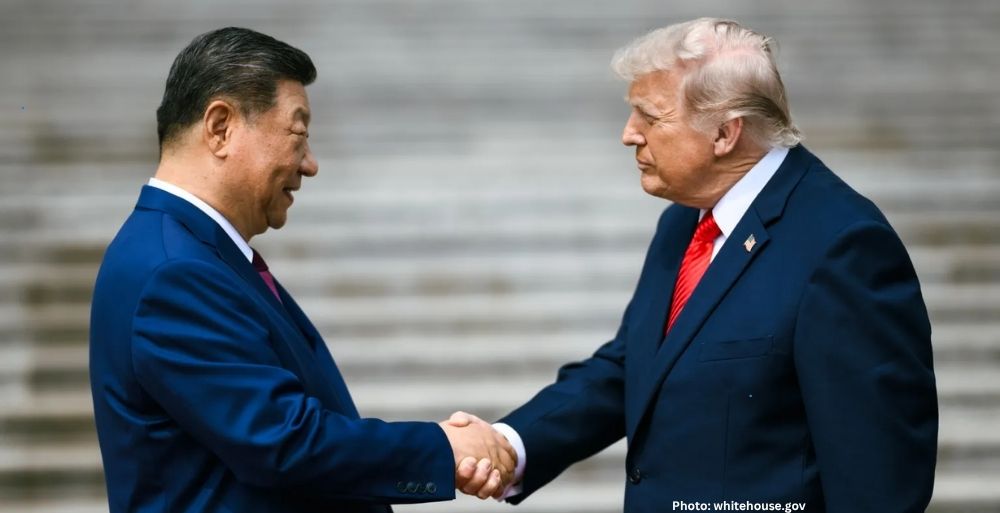
WASHINGTON — President Donald Trump returned to the White House on Friday following a high-stakes, five-day state visit to Beijing, concluding the most significant foreign trip of his second term to date. While the summit with Chinese President Xi Jinping featured elaborate diplomatic pageantry and a tentative agreement for China to purchase 200 Boeing commercial aircraft, it failed to produce substantive breakthroughs on critical global flashpoints. Deep structural tensions regarding the joint U.S.-Israeli military campaign in Iran, the geopolitical future of Taiwan, and long-standing trade imbalances heavily overshadowed the bilateral discussions, leaving the administration to navigate complex domestic approval liabilities and a rapidly shifting balance of global power.
A Summit Under the Shadow of War
WASHINGTON — President Donald Trump wrapped up his high-profile diplomatic summit with Chinese President Xi Jinping on Friday, flying back to the nation’s capital aboard Air Force One after a journey aimed at stabilizing relations between the world’s two largest economies. The visit, which was originally scheduled to take place six weeks ago, had been abruptly postponed following the outbreak of military hostilities launched against Iran by the United States and Israel on February 28, 2026.
The delay underscored how thoroughly the Middle Eastern conflict has disrupted American foreign policy and complicated Washington’s domestic landscape. President Trump arrived in Beijing facing sagging public approval ratings at home, driven primarily by voter anxiety over the economic and human costs of the ongoing war with Tehran. Observers noted that while the president visibly relished the grand optics of the state welcome in Beijing, the underlying atmosphere in the East Hall of the Great Hall of the People remained acutely strained as both leaders confronted competing national imperatives.
The Stalemate Over Iran and Global Shipping Lanes
The primary objective for the American delegation was to secure a commitment from Beijing to leverage its significant economic influence over Tehran. Washington wants China—a major buyer of Iranian petroleum—to pressure the Islamic Republic into reopening the blockaded Strait of Hormuz, a maritime chokepoint through which approximately 20% of the world’s petroleum liquids pass. Additionally, U.S. officials hoped China would nudge Iran toward a more conciliatory stance in nascent peace negotiations.
However, international relations experts had warned prior to the summit that Beijing would not offer such assistance out of a vague desire for bilateral goodwill. Instead, any cooperation would require a transactional quid pro quo, forcing the Trump administration to concede ground on alternative fronts such as technology tariffs or military postures in East Asia.
Official readouts and public statements indicate that very little structural bargaining occurred. The Chinese government’s official summaries of the meetings conspicuously omitted any substantive mention of Iran. Trump, meanwhile, limited his public remarks to broad assertions that both nations share a fundamental interest in keeping international shipping lanes open.
When pressed by reporters aboard Air Force One early Friday morning regarding the lack of an explicit Iranian breakthrough, Trump adopted a transactional yet defensive posture.
“I am not asking for any favors because when you ask for favors you have to do favors in return,” Trump said, raising his voice slightly above the hum of the aircraft engines. “We don’t need favors.”
The president further asserted that the Chinese leadership would “automatically” exert pressure on Tehran due to their own domestic energy dependencies, though he offered no empirical evidence or timelines to support the claim. The lack of an explicit, enforceable agreement leaves the administration without a signature foreign policy triumph to present to an increasingly skeptical domestic electorate.
Stern Warnings and Strategic Ambiguity Over Taiwan
The persistent friction regarding Taiwan emerged as a central point of contention during the closed-door sessions. Beijing views the self-governed island of 23 million people as a breakaway province that must eventually be reunified with the mainland, explicitly reserving the right to use military force. Conversely, Taipei’s democratically elected government firmly rejects Beijing’s sovereignty claims.
For decades, the United States has maintained a doctrine of “strategic ambiguity”—acknowledging Beijing’s “One China” position without formally endorsing its sovereignty over Taiwan, while simultaneously providing defensive arms to Taipei under the Taiwan Relations Act without explicitly guaranteeing direct U.S. military intervention in the event of an invasion.
The rhetoric from the Chinese Foreign Ministry during the visit was notably severe, signaling heightened anxiety over recent U.S. defense policy. Addressing a crowded press briefing room in Beijing, a ministry spokesperson emphasized that the status of Taiwan remains the absolute red line of bilateral diplomacy.
“The Taiwan topic is the most important issue in China-U.S. relations,” the spokesperson stated with measured deliberation. “If it is not handled properly, the two countries will have clashes and even conflicts, putting the entire relationship in great jeopardy.”
Throughout his public appearances on Chinese soil, Trump remained uncharacteristically quiet on the matter. However, during his return flight, he disclosed to reporters that he has not yet determined whether his administration will finalize a recently proposed U.S.-Taiwan arms package—a multi-billion-dollar deal that has drawn fierce condemnation from Beijing’s military apparatus.
Earlier in the week, Secretary of State Marco Rubio sought to downplay the diplomatic friction, exhibiting a detached demeanor during a televised interview.
“They always raise it on their side. We always make clear our position, and we move on to the other topics,” Rubio told NBC News, signaling that the administration views the stern rhetoric as standard diplomatic posturing rather than an immediate escalation.
Shifting Superpower Dynamics
A defining characteristic of the May 2026 summit was the explicit manner in which the Chinese delegation positioned itself as an absolute geopolitical equal to the United States. Trump, who historically prioritizes projecting personal dominance in bilateral relationships, frequently adopted an uncharacteristically deferential tone when discussing his counterpart.
“He is a great leader,” Trump noted during an address to American and Chinese business executives, acknowledging the political blowback such praise often generates domestically. “But I say it anyway because it’s true.”
Xi Jinping chose a more reserved, systemic framing during their opening remarks, pointedly observing that the international community is currently navigating a “once-in-a-century transformation.” In the lexicon of Chinese diplomacy, this phrase serves as a direct reference to the perceived decline of Western-led unipolar hegemony and the transition toward a multipolar global order.
The commentary prompted a swift response from Trump on social media. Writing from his accommodation in Beijing, the U.S. president claimed that Xi had “very elegantly referred to the United States as perhaps being a declining nation.” Trump sought to recontextualize the remark for his domestic audience, asserting that any structural damage to America’s global standing was a legacy of the previous Biden administration.
“In fact, President Xi congratulated me on so many tremendous successes in such a short period of time,” Trump posted, attempting to preserve his narrative of domestic economic and political revitalization.
Commercial Jet Orders and Corporate Presence
To bolster the economic narrative of the trip, the White House assembled a high-powered delegation of American corporate executives to accompany the president to Beijing. The group included Tesla CEO Elon Musk, Apple CEO Tim Cook, and Nvidia CEO Jensen Huang, highlighting the critical dependence of major U.S. technology and automotive supply chains on Chinese manufacturing infrastructure and consumer markets.
The primary tangible outcome of the summit emerged in the aviation sector. Speaking during an interview with Fox News host Sean Hannity, Trump announced that China had agreed to place an order for 200 commercial aircraft from Boeing, representing a substantial increase from an initially discussed baseline of 150 planes. The president further speculated that the arrangement could eventually scale up to 750 aircraft if the initial delivery tranches satisfy performance benchmarks.
The announcement represents a critical lifeline for Boeing, which has spent the last several years navigating intense regulatory scrutiny, manufacturing quality scandals, and stiff market competition from European rival Airbus. Before the COVID-19 pandemic, nearly one-third of Boeing’s narrowbody production was exported to the Chinese market, a trade flow that severely deteriorated as bilateral relations soured during Trump’s first term.
However, independent market analysts urged caution, noting that as of Friday morning, the Chinese state purchasing agencies had not released corresponding official confirmations validating the exact terms, financial valuations, or specific aircraft models included in the commitment.
The baseline diplomacy established during the trip is slated to continue later this year. Prior to departing Beijing, President Trump extended a formal invitation to Xi Jinping for a reciprocal state visit to the United States, tentatively scheduled on or around September 24, 2026.
“We will be reciprocal—like reciprocal trade, the visit will be reciprocal,” Trump stated, framing the future diplomatic engagement within his preferred rubric of bilateral fairness.