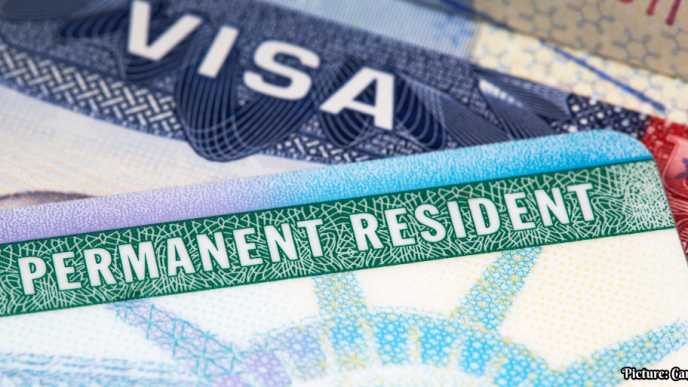

New regulations from the USCIS require certain Green Card applicants to return to their home countries during the application process, raising significant concerns among the 1.2 million legal immigrants currently awaiting permanent residency.
The United States Citizenship and Immigration Services (USCIS) has introduced a new rule that mandates certain Green Card applicants to leave the country and apply for an immigrant visa from their home country. This change has created considerable anxiety among the approximately 1.2 million legal immigrants who are currently in the process of obtaining permanent residency.
On [insert date], immigration attorney Rahul Reddy, who specializes in immigration law, discussed the implications of this new directive. Reddy emphasized that, while the legal framework surrounding Green Card applications has not fundamentally changed, the criteria used to evaluate these applications have shifted significantly.
USCIS Directive Overview
According to the USCIS, the procedure for individuals who enter the United States on temporary visas and subsequently apply for a change of status to permanent residency has been altered. Previously, applicants could remain in the U.S. while waiting for their Green Card approval. The USCIS now asserts that this practice should cease, stating that individuals should return to their home countries to apply for permanent residency.
Historical Context of Green Card Applications
For decades, individuals who entered the U.S. on work visas, such as H-1B, L-1, or O-1, and maintained their legal status were eligible to apply for a Green Card through a process known as ‘adjustment of status.’ Reddy noted that historically, as long as applicants followed the rules and maintained their status, their path to obtaining a Green Card was generally assured once their priority date became current. “For decades, the deal was this: if you followed the rules, kept your status, got your I-140 approved, and waited your turn, your green card through adjustment of status was essentially a sure thing,” he explained.
However, the new memo from USCIS appears to alter this long-standing understanding. It suggests that obtaining a Green Card while remaining in the U.S. is now viewed as a privilege rather than a right. Officers reviewing applications are now being reminded that they have discretion in approving Green Cards, which raises concerns about the consistency and fairness of the adjudication process.
Implications for H-1B Visa Holders
Reddy pointed out that the memo expresses a clear expectation that H-1B and L-1 visa holders should ultimately return to their home countries. This expectation is a departure from the previous understanding that allowed for a “dual intent,” where these visa holders could apply for permanent residency while remaining in the U.S. The memo indicates that staying in the U.S. to obtain a Green Card could be viewed negatively by immigration officials.
“The most worrying part is how the memo views people on work visas. The government’s expectation — according to this memo — is that you will eventually go home,” Reddy stated. “The memo admits that H-1Bs and L-1s are allowed to have ‘dual intent.’ But it then says that allowance alone is not enough to get you approved.”
Advisory for Current Applicants
In light of these developments, Reddy advised those who have already filed Green Card applications to consult with their immigration attorneys to bolster their cases. For individuals contemplating filing an application, the decision-making process has become more complex. They may face the prospect of returning to their home countries and applying for their Green Cards from abroad, a process that is often lengthy and fraught with uncertainty.
Unresolved Questions and Future Challenges
There remain many unanswered questions regarding the application of the new USCIS memo. Experts have interpreted the memo to primarily affect the ‘adjustment of status’ aspect of the Green Card process, which typically occurs when an applicant’s priority date becomes current, and they are ready to file Form I-485. While individuals who have just filed an I-140 petition for a Green Card may not be immediately impacted by the requirement to leave the U.S., there is still significant concern about the lack of clarity from USCIS regarding these specifics.
The implications of this new policy are particularly pronounced for applicants from countries such as India and China, where backlogs for priority dates can extend for years. As such, while the memo may not yield immediate changes for all applicants, the long-term consequences could be substantial, adding to the already complex landscape of U.S. immigration law.
As the immigration community awaits further clarification from the USCIS, legal experts and advocates continue to express concerns about the potential ramifications of this new rule and the impact it may have on immigrants seeking permanent residency in the United States.