
A notice from Mumbai Police mandates U.S. citizen and Bollywood actor Imran Khan to exit India by October 28 due to his involvement in a political protest, raising significant questions about the role of foreign nationals in domestic political activities.
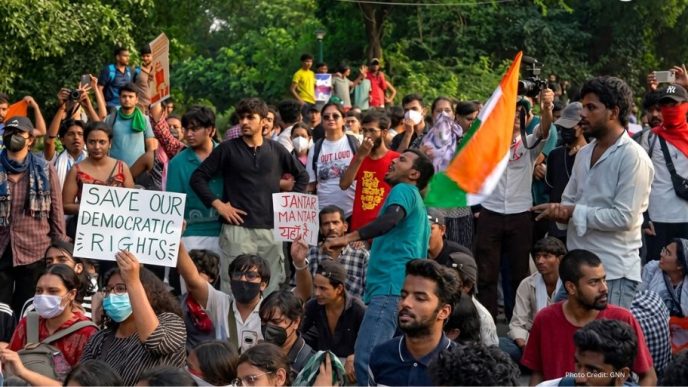
Mumbai, India – In a notable intersection of immigration law and political engagement, Mumbai Police have issued a formal notice to Imran Khan, a U.S. citizen and prominent Bollywood actor, requiring him to leave the country by October 28. This directive follows Khan’s participation in a political demonstration on October 10 at August Kranti Maidan, where protesters demanded the resignation of Chief Election Commissioner Gyanesh Kumar.
On October 15, authorities confirmed that the notice was issued under the provisions of the Immigration and Foreigners Act, citing Khan’s alleged violation of regulations concerning foreign nationals’ participation in political demonstrations. Khan, 43, is the nephew of renowned actor Aamir Khan and has appeared in several Bollywood films, but his recent involvement in a political protest has drawn considerable scrutiny.
Context of the Protest and Legal Actions
During the October 10 protest, Khan, along with other demonstrators, voiced concerns over electoral integrity and governance. His participation became contentious when he was briefly detained by police, signaling the government’s serious approach to such gatherings. Following the protest, Kirit Somaiya, a leader of the Bharatiya Janata Party (BJP) and former Member of Parliament, publicly condemned Khan’s actions. Somaiya argued that as a foreign citizen, Khan should refrain from engaging in Indian political matters.
Somaiya welcomed the police action against Khan, asserting that it sets a precedent for addressing the involvement of foreign nationals in domestic political activities. He described the decision as a necessary step to uphold the integrity of Indian governance, stating, “This action should serve as a warning to others engaged in similar activities.” He has also called for a thorough investigation into the participation of foreign nationals in political protests, emphasizing that such actions could undermine local political processes.
Implications for Foreign Nationals in Political Protests
The notice mandating Khan’s departure has sparked a broader dialogue regarding the legal frameworks governing foreign nationals’ involvement in political protests in India. Critics of the current regulations suggest that the ambiguities surrounding permissible participation could lead to conflicts and legal challenges, particularly as the global landscape increasingly witnesses cross-national political activism.
Khan has not publicly responded to the notice or addressed the implications of his involvement in the October 10 protest. His case raises substantial questions about the rights and responsibilities of foreign nationals within India’s political discourse. In an era characterized by globalization, the intersection of national borders and political activism is more pronounced, necessitating a reexamination of existing laws.
Historical Context and Ongoing Developments
This incident unfolds against the backdrop of intensifying political tensions in India, where protests have become a common avenue for expressing dissent on various issues, ranging from environmental concerns to governance and electoral integrity. In recent years, the participation of foreign nationals in such demonstrations has occasionally attracted attention, leading to discussions about the implications of their involvement in domestic political matters.
Somaiya’s proactive stance against Khan, which included complaints to immigration authorities and appeals for intervention from Maharashtra Chief Minister Devendra Fadnavis, exemplifies the ongoing politicization of immigration issues in India. As political leaders leverage instances like Khan’s protest participation to reinforce their positions, the conversation surrounding immigration, national identity, and political activism continues to evolve.
Potential Consequences and Future Considerations
The ramifications of this case extend beyond Imran Khan himself, as it could influence how future foreign nationals perceive their ability to engage in political activism within India. As protests remain a vital element of democratic expression worldwide, the legal frameworks governing such participation are likely to require reevaluation to ensure clarity and fairness for all individuals, regardless of nationality.
Legal experts and political analysts have begun to examine the implications of Khan’s situation, suggesting that greater clarity in immigration laws could be beneficial in defining the boundaries for foreign participation in political activities. The complexity of modern political engagement calls for a nuanced understanding of the relationship between citizenship, rights, and political expression.
As this situation develops, it will be critical to monitor how authorities navigate the balance between enforcing immigration laws and respecting the democratic rights of individuals to participate in political discourse. The outcome of this case may set important precedents for the involvement of foreign nationals in India’s political landscape, potentially shaping future policies and public sentiments regarding immigration and political activism.