Neha Bora, President of the All India Students’ Association, and Abhijeet Dipke, founder of the Cockroach Janta Party, were detained by Delhi police during protests demanding the resignation of Chief Election Commissioner Gyanesh Kumar. The detentions have drawn condemnation from various political leaders and sparked significant public outcry.
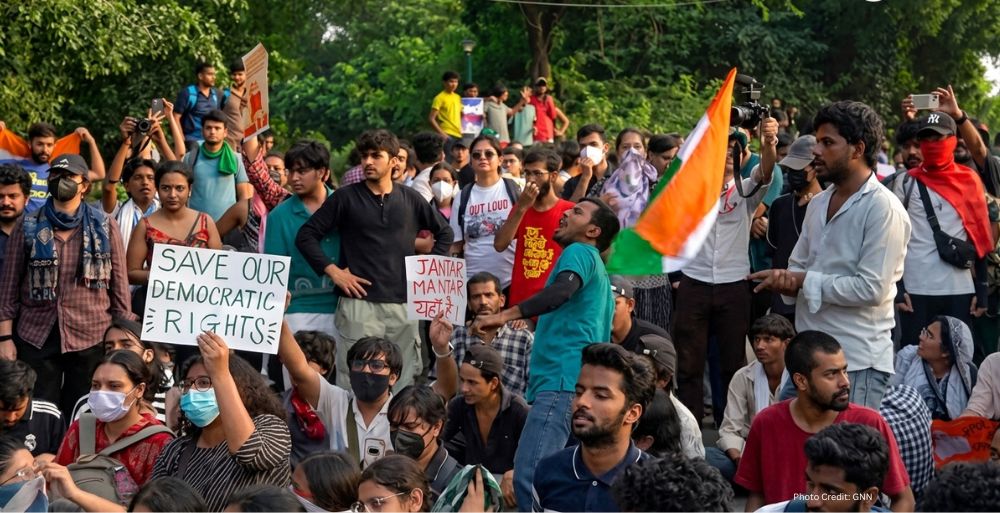
NEW DELHI, October 17, 2026 — In a significant escalation of tensions surrounding public protests in the Indian capital, Neha Bora, the President of the All India Students’ Association (AISA), and Abhijeet Dipke, the founder of the Cockroach Janta Party (CJP), were detained by Delhi police on October 16, 2026. The arrests occurred as they were en route to participate in a protest rally titled ‘Lehra Do Tiranga’ at Connaught Place, where they were advocating for the resignation of Chief Election Commissioner Gyanesh Kumar.
The detentions took place amidst a backdrop of prohibitory orders issued by the police, which were cited as the legal basis for preventing the protest. Bora was apprehended near Mandi House, while Dipke was taken into custody from his residence in Jhandewalan. The police’s actions have been sharply criticized, with many political leaders and civil society members condemning the move as an infringement on democratic rights.
Police Justifications and Public Response
Delhi Police stated that they had served Dipke with a notice barring him from holding the protest, citing concerns over public order in Connaught Place and surrounding areas. In an announcement, the New Delhi Municipal Council (NDMC) also declared the closure of Central Park for two days, further complicating the protest plans.
Critics of the police actions, including prominent politicians such as Mamata Banerjee and M.K. Stalin, have labeled the detentions as illegal and indicative of an authoritarian approach to dissent. Banerjee remarked on social media that detaining individuals for peacefully displaying the national flag is an affront to democratic principles. Stalin emphasized the need for immediate release, calling the detentions not only unlawful but also inhumane.
Allegations of Misconduct
The circumstances surrounding Bora’s detention have raised further concerns. AISA leaders reported that she has been unwell and in need of medication, which they claim police have denied her access to. Legal representatives have sought clarity on her whereabouts, stating that they have been unable to communicate with her since her detention.
Moreover, Dipke’s detention has been similarly fraught with allegations of misconduct. His supporters claim he was taken to an undisclosed location without being allowed to contact legal counsel. This has ignited a debate over the legality of the police’s actions, particularly regarding the treatment of detainees, especially women.
Political Ramifications and Broader Context
These events unfold against the backdrop of ongoing protests across India against the Special Intensive Revision (SIR) of electoral rolls, which many believe is aimed at disenfranchising voters. Over 13 crore names have reportedly been deleted from electoral rolls, triggering widespread demands for transparency and accountability from the Election Commission of India. The protests have seen an increasing number of political leaders rallying around the issue, framing it as a struggle for democratic rights and electoral integrity.
During a press briefing, Dipke remarked on the historical context of protests in India, emphasizing that the current government appears to have forgotten its own roots as a party that once thrived on dissent when in opposition. He stated, “Demanding answers from the government is not anarchy; it is democracy in action.” His comments highlight a broader frustration among opposition parties regarding the government’s handling of dissent.
Opposition’s Unification and Future Actions
The situation has also prompted a unification of various opposition parties, who see the current protests as an opportunity to challenge the ruling government’s narrative. Events are planned nationwide, with many leaders calling for solidarity in the face of perceived authoritarianism.
Rahul Gandhi of the Congress party has been active in voicing support for the protests, emphasizing the need for a collective stand against the government’s actions. He stated, “Our democracy is under threat, and we must rise to defend it.” This sentiment resonates with a growing number of citizens who are increasingly disillusioned with the current political climate.
As the situation develops, the focus remains on the fate of Bora and Dipke, with continued demands for their release and a call for accountability regarding the police’s handling of protests. The unfolding events may serve as a pivotal moment in the ongoing struggle for electoral rights and civil liberties in India.
As of the latest updates, the High Court has refused to restrain the scheduled protest, indicating that the legal battles surrounding these detentions may continue, further complicating the already tense atmosphere.