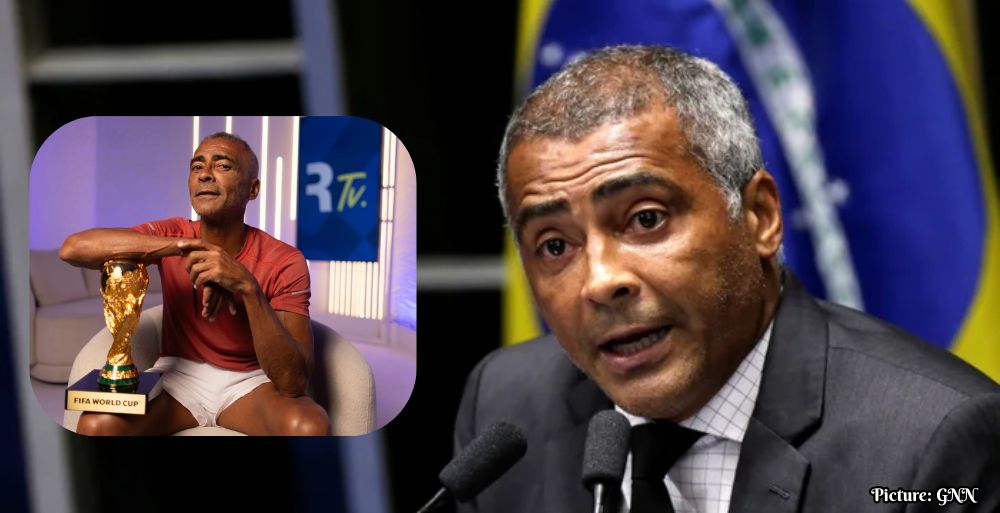
Romário, the legendary Brazilian footballer and current senator, discusses his illustrious career, the impact of social media on athletes, and his political aspirations as Brazil prepares for the upcoming World Cup.
In a recent interview, Romário de Souza Faria, widely regarded as one of the greatest football players in history, shared his thoughts on his illustrious career, the current state of Brazilian football, and his journey into politics. The former striker, who played a pivotal role in Brazil’s 1994 World Cup victory, discussed these topics as he promotes his YouTube project, “Face to Face with the Man,” where he interviews football legends.
Romário, who began this interviewing initiative approximately one year ago, expressed enthusiasm for the project, stating, “This whole Romário TV thing is a brand-new situation in my life. I’m really happy, enjoying it. It’s so cool.” The initiative has allowed him to reconnect with his past and engage with players from his generation, a group he considers to be at the pinnacle of football history.
When asked to evaluate his playing career, Romário confidently placed himself among the top five footballers of all time, alongside Pelé, Diego Maradona, Lionel Messi, and Cristiano Ronaldo. He stated, “I’d give myself an 11 out of 10 as a player,” a reference to the iconic number he wore during his career, including at the 1994 World Cup.
Career Reflections and Criticism
Despite his accolades, Romário has faced criticism regarding his work ethic during his playing days. He has often been labeled as “lazy” for his unconventional training habits. Romário addressed these claims head-on, remarking, “Romário was lazy… But I scored goals. I was a force to be reckoned with on the pitch and screw the rest.” He emphasized that the nature of his era, which lacked the pervasive influence of social media, allowed him more freedom to enjoy life outside of football without the scrutiny athletes face today.
Reflecting on the impact of social media, Romário expressed a mixed sentiment. He acknowledged that while the internet provides a platform for greater visibility, it also exposes athletes to heightened scrutiny. He remarked, “The internet really shows who you truly are… But there’s the other side. People didn’t know about the stupid shit I did. That would’ve been a nightmare, but it’s part of life.”
Political Aspirations
Romário’s transition from football to politics began 16 years ago when he joined Brazil’s Socialist Party (PSB). He was elected as a federal deputy in 2010 and a senator in 2014. His political career has since seen him switch parties multiple times, most recently joining the centrist party Podemos and then the ruling far-right party PL. His political stance has drawn mixed reactions, particularly as he navigates the polarized landscape following the presidency of Jair Bolsonaro, who is currently under house arrest for his role in an attempted coup.
In his political role, Romário has focused on issues related to education, health, and social inclusion, stating, “My focus is on education, health, social issues and sport. I fight for people with disabilities, for the inclusion of people.” He has drawn the line at supporting initiatives he does not believe in, such as liberalizing gun ownership or legalizing abortion.
Looking Ahead to the World Cup
As Brazil prepares for the 2026 World Cup, Romário expressed hope for the national team, acknowledging that the country is in a politically tumultuous period reminiscent of 1994. He remarked, “Politically speaking, the country is in a mess. There’s this polarization between left and right and violence is too high.” He believes that a World Cup victory could serve as a unifying force for the nation, stating, “A win for Brazil would bring relief and joy to our people who are suffering.”
Romário’s assessment of the current Brazilian squad is tempered by a critical perspective on their performances on the international stage. He noted, “Brazil has players who perform well for their clubs… But when they pull on the Brazil jersey they fail to deliver.” He hopes that the players can perform at least 80% of their club level if they are to contend for the title.
Legacy and Influence
The former striker remains a significant figure in Brazilian football, particularly in an era where he feels there are no standout players comparable to his generation. He remarked, “I think I’ve become even more important than I was before… Today there’s no one that represents.” He noted that while teams like England have talented players, they do not carry the same historical weight as Brazil, stating, “I see the other sides as better. I like Harry Kane, [Jude] Bellingham and [Bukayo] Saka, but I wouldn’t put them among the favorites.”
In closing, Romário reflected on his journey from the favelas of Rio de Janeiro to global football stardom, emphasizing the importance of self-belief and passion in his career. As he prepares for the upcoming World Cup and continues his dual roles in sports and politics, Romário remains a compelling figure whose legacy continues to evolve.