NEW DELHI — A comprehensive global climate assessment published by the World Meteorological Organization on Monday warns that global near-surface temperatures will remain at or near record-breaking thresholds for the remainder of the decade. The report, synthesized by climate scientists at the U.K. Met Office, establishes an 86% probability that at least one year between 2026 and 2030 will eclipse 2024 as the hottest year in recorded human history. Furthermore, researchers calculated a 91% likelihood that the planetary average temperature will temporarily breach 1.5 degrees Celsius above pre-industrial baselines during this five-year window. Driven by a projected return of El Niño conditions in late 2026, the intensifying warming trend is expected to hit the Arctic disproportionately hard, accelerating sea-ice loss and fundamentally complicating international compliance metrics established under the Paris Climate Accord.
Five-Year Meteorological Projections and Pre-Industrial Baselines
NEW DELHI, India — The World Meteorological Organization (WMO) released its flagship Annual to Decadal Climate Update on Monday, delivering a stark meteorological roadmap for the next five years. According to the data aggregated by the United Kingdom’s Met Office—which serves as the WMO’s lead center for such predictive modeling—annual global mean near-surface temperatures between 2026 and 2030 are structurally projected to hover between 1.3°C and 1.9°C above the 1850–1900 pre-industrial average baseline.
The statistical modeling indicates an alarming narrowing of the window available to avert temporary atmospheric breaches. The report assigns a dominant 91% probability that at least one annual cycle within the 2026–2030 window will witness global mean near-surface temperatures spiking past the 1.5°C marker.
Simultaneously, the planetary data shows an 86% chance that the absolute record set in 2024—widely recognized as the warmest year on record since systematic global monitoring began—will be shattered before the decade concludes. This continuous multi-year thermal elevation represents a substantial shift from historical twentieth-century averages, moving climate anomalies into a permanent baseline status.
The Mechanism of Shift: El Niño and Tropical Pacific Forecasts
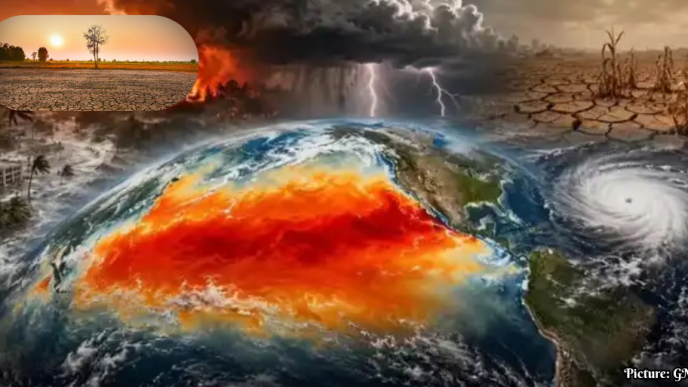
The principal atmospheric engine driving these heightened multi-year projections is a predicted disruption in the equatorial Pacific Ocean. After a brief period of neutral and La Niña conditions, advanced oceanic models point to a significant resurgence of the El Niño-Southern Oscillation (ENSO) phenomenon.
“There is an El Niño predicted for the end of 2026, which increases the chances of the following year, 2027, being the next record-breaking year,” stated Dr. Leon Hermanson, the lead author of the U.K. Met Office report, delivering the assessment during a structured briefing to international scientific correspondents.
The predictive models focus heavily on the central tropical Pacific, an area scientifically designated as the Niño 3.4 region. The five-year forecast for this zone indicates a structural tendency toward robust El Niño conditions, specifically intensifying throughout 2027 and enduring well into 2028. Because oceanic heat release during an El Niño event typically takes several months to fully interact with the troposphere, the peak atmospheric warming effect invariably manifests in the calendar year immediately following the initial oceanic anomaly. This delayed thermodynamic transfer is what positions 2027 as the primary candidate for unprecedented global warmth.
Technical Alignment with Paris Agreement Legal Protocols
The impending multi-year spike above the 1.5°C threshold has triggered intense discussions regarding the legal and operational status of international climate treaties. WMO officials were careful to contextualize that while a five-year average exceeding 1.5°C is highly probable, such an occurrence does not constitute a formal, legal breach of the 2015 Paris Agreement.
Under the framework of the Paris Accord, signatory nations legally committed to holding the increase in the global average surface temperature to “well below 2°C” above pre-industrial levels, while actively pursuing aggressive policies to limit the long-term temperature increase to 1.5°C. Crucially, the treaty’s compliance metrics rely on long-term climate averages rather than individual annual spikes or brief multi-year clusters.
International climate monitoring bodies typically utilize a rolling 20-year or 30-year average to determine whether a permanent atmospheric breach has occurred. This distinction separates transient meteorological variations, such as an exceptionally powerful ENSO cycle, from permanent, anthropogenically driven systemic shifts.
The planet has already experienced a brief glimpse of this threshold. In 2024, driven by a combination of greenhouse gas concentrations and a strong El Niño, the global average surface temperature temporarily peaked at approximately 1.55°C above the pre-industrial baseline. While that single-year spike served as an ecological warning, the overall 20-year rolling average currently sits lower, offering a thin buffer for global policy adjustments before the formal Paris Agreement boundaries are permanently crossed.
Geopolitical and Regional Risks: The Arctic Amplification Dynamic
A critical sub-component of the WMO report highlights the geographic asymmetry of the impending warmth. While the global average is projected to rise significantly, the Arctic circle is forecast to experience a warming rate more than three times higher than the global average over the next five years.
This phenomenon, known scientifically as Arctic Amplification, is driven by positive feedback loops. As rising temperatures melt highly reflective sea ice and snow cover, darker oceanic water and exposed tundra absorb more solar radiation instead of reflecting it back into space. This localized absorption further heats the regional environment, melting more ice and accelerating the cycle.
The rapid warming of the Arctic carries profound geopolitical and ecological consequences for the international community:
- Permafrost Degradation: Thawing sub-Arctic soils risk releasing massive, unaccounted-for volumes of trapped methane and carbon dioxide into the atmosphere, creating an un-engineered feedback loop that could bypass traditional emissions reduction models.
- Maritime Logistics and Shipping: The accelerating retreat of summer sea ice is opening the Northern Sea Route and Northwest Passage for longer seasonal windows, altering commercial shipping timelines and sparking territorial sovereignty disputes among Arctic Council nations.
- Resource Extraction Pressures: Increased accessibility to the Arctic seabed is intensifying exploratory pressures from nations seeking to map unexploited oil, natural gas, and rare earth mineral deposits beneath the continental shelves.
- Sea-Level Rise Contributions: The thermal destabilization of the Greenland Ice Sheet remains a primary contributor to global sea-level rise calculations, threatening low-lying coastal urban centers across Asia, Europe, and the Americas.
Extreme Weather and Adaptation Constraints
The WMO report concludes with an authoritative warning regarding the operational limitations of human adaptation infrastructure. Scientists have repeatedly documented that every fractional increase in global warming correlates directly with the frequency and severity of extreme weather events.
A permanent or even prolonged stabilization of temperatures above 1.5°C increases the probability of severe compound crises, including concurrent marine heatwaves, protracted agricultural droughts in major grain-producing regions, and hyper-intense tropical cyclones fueled by elevated sea-surface temperatures.
The report emphasizes that as these climate anomalies become more frequent, the financial and logistical options available for local communities to adapt—such as building sea walls, modifying agricultural crop cycles, or upgrading urban electrical grids to withstand prolonged heat stress—will diminish rapidly. The compressed timeline highlighted in the 2026–2030 forecast underscores the reality that the window for preventive infrastructure development is narrowing faster than the global policy apparatus is currently responding.