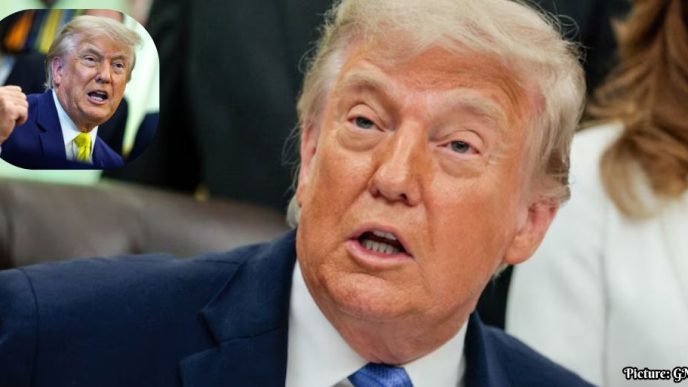

President Donald Trump has announced that the United States will strike Iran “very hard” as tensions escalate in the region, leading to a spike in oil prices and raising concerns about further military actions.
WASHINGTON, D.C. — In a provocative announcement made on Thursday, U.S. President Donald Trump declared that the United States would engage in significant military action against Iran, stating that the U.S. would “hit Iran very hard tonight.” This declaration, issued via Truth Social, Trump’s social media platform, has intensified apprehensions regarding escalating military conflict in the Middle East.
The president’s remarks come in the wake of recent violent exchanges between U.S. forces and Iranian military assets, creating an already tenuous atmosphere in the region. Trump specifically highlighted Kharg Island, Iran’s primary oil export terminal, asserting that the U.S. would aim to take control of the island and other critical oil infrastructure points. He drew a controversial parallel to U.S. operations in Venezuela, claiming that such actions had proven beneficial for both nations involved.
Oil Prices Surge Following Trump’s Threats
The immediate economic implications of Trump’s threats were felt almost instantly, as Brent crude oil prices rose by approximately $2 per barrel, reaching $94.16 shortly after his announcement. This uptick reflects the market’s sensitivity to geopolitical tensions, particularly in oil-rich regions like the Middle East. Earlier on Thursday, oil prices had been on a downward trend, fluctuating between $92 and $95 per barrel before spiking following Trump’s comments.
Military Developments and Regional Reactions
In conjunction with Trump’s announcement, reports emerged of explosions heard near the Strait of Hormuz, specifically in the Iranian city of Sirik. However, these reports have not been independently verified, and both U.S. and Iranian officials have yet to confirm any military actions in the area.
Kharg Island serves as a vital economic lifeline for Iran, processing a significant portion of its crude oil exports. Analysts have suggested that a U.S. takeover of the island could severely disrupt Iranian oil exports and provide a military staging ground for further operations against Iran’s mainland. However, such a move poses substantial logistical challenges, including the need for significant naval or airborne troop deployments.
The U.S. Central Command (Centcom) has been active in the Gulf region, having conducted strikes on multiple vessels it accused of violating a blockade against Iranian oil transport. This week alone, Centcom has confirmed the disabling of several vessels, including the Jalveer, a Guinea-Bissau-flagged ship, which was struck for attempting to transport Iranian oil. These actions have raised the stakes in the already volatile region and have drawn international scrutiny.
International Responses and Calls for De-escalation
In the aftermath of the U.S. military actions, several countries have expressed deep concern about the rising tensions. Pakistan’s foreign ministry emphasized the need for “diplomacy and dialogue” between the U.S. and Iran, urging both parties to avoid further escalation. India’s government has also taken diplomatic steps, summoning a senior U.S. diplomat to lodge a protest regarding the deaths of three Indian sailors in a recent U.S. strike on the Settebello, another vessel accused of violating the blockade.
Iran’s foreign ministry condemned the U.S. strikes as illegal and contrary to international law, asserting that the actions make the prospect of a ceasefire “practically meaningless.” The ministry warned that U.S. leaders would be held responsible for the consequences of further escalation. This sentiment reflects the broader concern among regional actors regarding the potential for an expanded military conflict.
As the situation continues to unfold, global powers, including Russia and China, have called for immediate de-escalation and renewed negotiations to prevent further conflict. The Strait of Hormuz remains a focal point of international concern, as it is a critical maritime passage for oil shipments, with approximately 20% of the world’s oil supply transiting through this narrow waterway.
U.S. Military Actions and Their Implications
The U.S. military’s recent actions have raised significant questions about the strategy and implications of a potential escalation in its engagement with Iran. The blockade of Iranian ports, initiated in early April, has involved intercepting or turning back vessels traveling to and from Iran’s coast. As of now, Centcom reports that nine vessels have been disabled during the blockade, and 134 ships have been redirected after complying with U.S. forces. The situation has resulted in extensive humanitarian and economic implications, affecting not only Iran but also the broader global oil market.
Critics of the U.S. approach argue that the strikes and blockades could lead to further instability in the region and exacerbate humanitarian crises, particularly as civilian casualties have already been reported. The deaths of three Indian sailors in the strike on the Settebello have drawn ire from India, prompting its government to demand accountability and clarity regarding U.S. military operations.
Conclusion: The Path Forward
President Trump’s assertive stance on Iran signifies a potential shift in U.S. foreign policy that could lead to more extensive military engagement in the region. As tensions rise, the implications for global oil markets and international diplomatic relations remain uncertain. The world watches closely as developments unfold in this critical geopolitical landscape, hoping for a resolution that avoids further military confrontation. Diplomatic efforts will be crucial in mitigating the risk of an all-out conflict, as the consequences of further escalation could have far-reaching effects not only for the U.S. and Iran but for global stability as a whole.