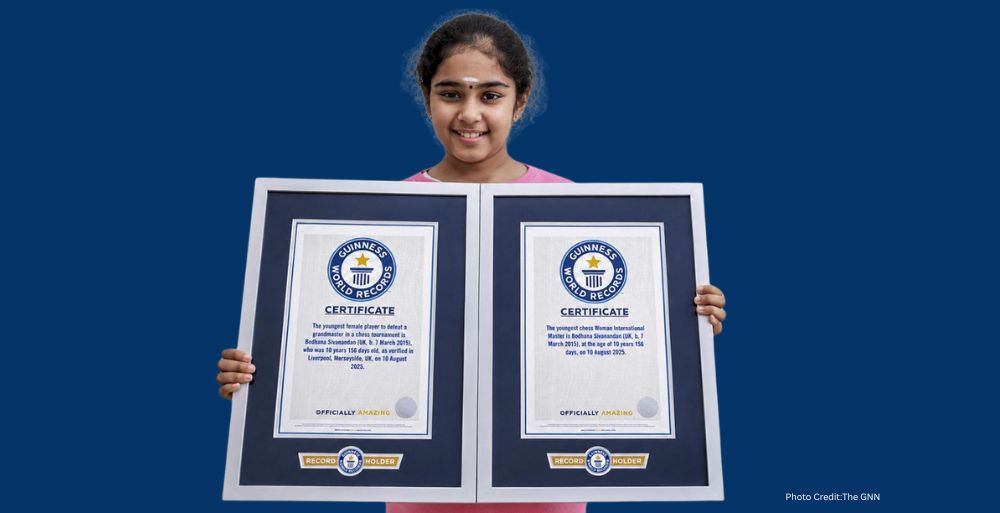
Bodhana Sivanandan, an 11-year-old chess prodigy from Harrow, London, has become the youngest female International Master in history, achieving this milestone at the European Women’s Chess Club Cup 2026 and breaking a 38-year-old record previously held by Judit Polgar.
Harrow, London – In a landmark achievement for both herself and the chess community, Bodhana Sivanandan, a British Indian chess player, has officially become the youngest female International Master (IM) at the age of 11. This milestone not only breaks a record that stood for nearly four decades but also marks a significant moment in the history of competitive chess.
Historic Achievement
Sivanandan secured the IM title during the European Women’s Chess Club Cup 2026, where her performance was nothing short of exceptional. The European Chess Union congratulated her via social media platform X, stating, “Congratulations to 11-year-old Bodhana Sivanandan on becoming an International Master with a final-round win at the European Women’s Chess Club Cup 2026!” Notably, she finished the tournament with an impressive score of 5.5 out of 7 points while playing on Board 1 for her team, She Plays to Win Lionesses. This performance not only earned her the IM designation but also positioned her among the 10 youngest IMs in history.
During the tournament, Sivanandan demonstrated her skill against formidable opponents, showcasing her strategic prowess and mental acuity. In the opening match, she faced off against Russian Grandmaster Aleksandra Goryachkina, ultimately coming close to a draw, highlighting her competitive spirit and ability to contend with top-level players. However, it was her third-round victory against Belarusian International Master Olga Badelka that propelled her rating to 2399.4, just shy of the required 2400 rating threshold typically necessary for the IM title.
Path to the Title
Following her win against Badelka, Sivanandan drew against Georgian Grandmaster Nino Batsiashvili. The decisive moment came in her final match against Sweden’s Woman International Master Viktoria Johansson, where she secured a 32-move victory. This win not only solidified her claim to the IM title but also etched her name in the records as one of the youngest International Masters ever.
The title of International Master is one of the highest honors in chess, representing a level of skill that requires not only talent but also considerable experience and competitive success. To earn this title, players must achieve a FIDE rating of 2400 or more and fulfill other criteria, including performance in international tournaments. Sivanandan’s achievement underscores not only her individual talent but also the growing prominence of young female players in a historically male-dominated sport.
Context of the Achievement
The historical significance of Sivanandan’s achievement cannot be overstated, particularly in the context of women’s participation in chess. The sport has been witnessing a gradual yet significant increase in female representation, with more young women taking up chess as both a competitive endeavor and a lifelong passion. As of now, Sivanandan joins an esteemed group of young masters, which includes fellow prodigies such as India’s R. Praggnanandhaa and D. Gukesh, Uzbekistan’s Nodirbek Abdusattorov, Argentina’s Faustino Oro, Turkey’s Yagiz Kaan Erdogmus, and Russia’s Roman Shogdzhiev.
This list reflects a global trend where chess is becoming increasingly accessible and competitive for young players, especially women. The rise of female chess players like Sivanandan serves as an inspiration for many aspiring competitors and highlights the importance of mentorship and support in their development. Her success can be seen as a catalyst for broader participation in chess by young girls, who may now feel more empowered to pursue excellence in the game.
Looking Ahead
As the chess community celebrates her extraordinary accomplishment, Bodhana Sivanandan stands as a symbol of potential and promise, inspiring aspiring chess players worldwide. Her journey in chess serves as a reminder of the importance of training, competitive experience, and the opportunities available to young players, particularly girls interested in the sport. With tournaments like the European Women’s Chess Club Cup providing a platform for young talents, the future of chess appears bright.
In conclusion, Bodhana Sivanandan’s accomplishment highlights a significant moment in chess history and emphasizes the ongoing evolution of gender representation in competitive chess. As young talents like Sivanandan emerge on the international stage, they pave the way for future generations of players. Her record-breaking title not only signifies a personal victory but also contributes to the broader narrative of inclusivity and representation in chess.