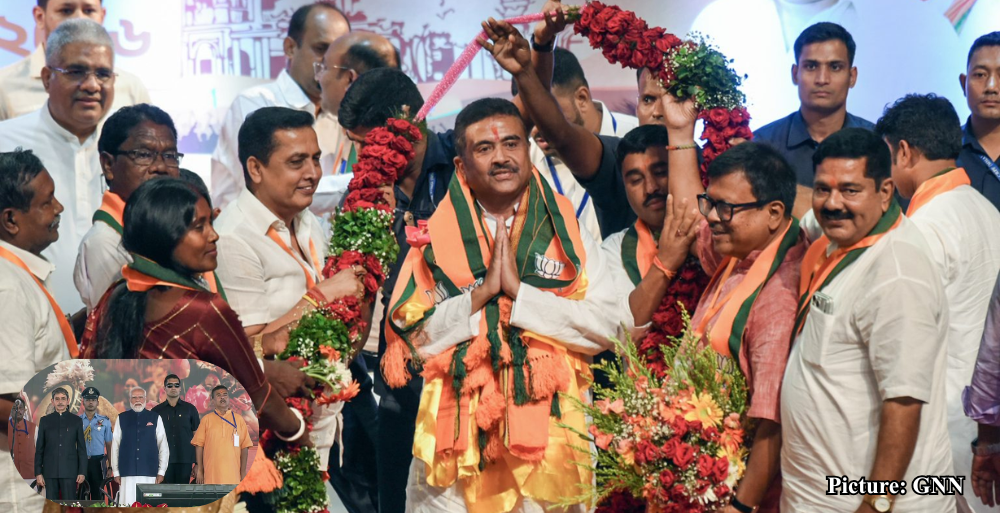
Suvendu Adhikari was sworn in as West Bengal’s first Chief Minister from the Bharatiya Janata Party (BJP) on May 9, 2026, following a historic electoral victory that has reshaped the state’s political landscape.
Suvendu Adhikari officially took office on May 9, 2026, marking a significant political transition in West Bengal. The BJP’s triumph in the recent assembly elections, where it secured 207 out of 294 seats, represents a decisive shift in a state long dominated by the Trinamool Congress (TMC), which was reduced to 80 seats. Adhikari’s election as the leader of the BJP’s legislature party occurred on May 8, 2026, during a meeting presided over by Union Home Minister Amit Shah, with unanimous support for his leadership.
Accompanied by notable BJP figures from the state, including Dilip Ghosh, Locket Chatterjee, and Tapas Roy, Adhikari met with Governor R.N. Ravi to formally claim the mandate to form the new government. The swearing-in ceremony was held at Kolkata’s Brigade Parade Grounds, attended by Prime Minister Narendra Modi and several Chief Ministers from BJP-led states.
Election Results and Political Context
The assembly elections represented a critical juncture for West Bengal, where the BJP’s victory reflects significant changes in voter sentiment. Adhikari, who won seats in both Nandigram and Bhabanipur, notably defeated former Chief Minister Mamata Banerjee in Bhabanipur by a margin of 15,115 votes. His political career has been marked by notable achievements, including serving as a Cabinet Minister in Banerjee’s government from 2016 to 2020 and as a Member of Parliament for Tamluk in the 2009 and 2014 elections.
Hailing from Purba Medinipur, Adhikari comes from a politically active lineage; his father, Sishir Adhikari, was a Union Minister of State for Rural Development and served as MP for the Kanthi Lok Sabha seat from 2009 to 2024. Adhikari rose to prominence in 2007 during protests against land acquisition in Nandigram, a movement that significantly bolstered his political profile and influence in the region.
Adhikari’s Vision and Governance Agenda
In his inaugural address to the newly elected MLAs, Adhikari articulated an ambitious vision for his administration, stating, “Bhoi [fear] is out, and as Narendra Modiji has said, bhorsa [faith] is in.” He expressed a commitment to expanding the BJP’s electoral base, targeting 60% of the vote in future elections, up from the 46% the party received in the most recent elections. His focus on improving women’s safety, instilling nationalism, and re-establishing West Bengal as the cultural capital of India underscored his ambitions for governance.
Adhikari also pledged to prioritize the fulfillment of promises made by Prime Minister Modi during the election campaign, which included economic development and public welfare initiatives. He announced plans to investigate allegations of corruption and crimes against women under the previous TMC regime. “A commission headed by a retired judge will investigate all corruption cases. Commissions will also probe incidents of atrocities against women and the guilty will be punished,” Adhikari stated, indicating a clear intention to address accountability and public safety issues.
Historical Implications of Leadership Change
Adhikari’s ascension as Chief Minister is historically significant; he is the first BJP leader to hold this office in West Bengal, a state that has seen TMC dominance for over a decade. The previous three Chief Ministers—Mamata Banerjee, Buddhadeb Bhattacharjee, and Jyoti Basu—were all from Kolkata, making Adhikari’s leadership from the rural heartland a notable departure. This shift may indicate evolving political dynamics in West Bengal, where rural voters appear increasingly aligned with the BJP’s platform.
As the state transitions to BJP leadership, the implications for local governance, law enforcement, and economic development are being closely monitored. The BJP’s approach in West Bengal, particularly under Adhikari’s guidance, may serve as a model for expanding its influence in other parts of India. The party’s strategy may also reflect broader efforts to consolidate power in regions previously resistant to its ideology.
Challenges Ahead
Despite the momentum gained from the electoral victory, Adhikari faces several challenges as he embarks on his term. The TMC remains a formidable political force, and the party’s established presence in West Bengal means that the BJP must navigate a complex political landscape. Additionally, fulfilling the ambitious goals laid out during the campaign will require effective governance and the ability to address the concerns of a diverse electorate.
Moreover, the investigations into the previous administration’s conduct could lead to significant political fallout, as they may provoke backlash from TMC supporters and complicate the BJP’s governance strategy. Adhikari’s ability to manage these challenges while maintaining party unity and public support will be critical to the BJP’s long-term prospects in West Bengal.
Overall, Suvendu Adhikari’s inauguration as Chief Minister heralds a new chapter in West Bengal’s political narrative, one that will be closely watched not only by local constituents but also by political observers nationwide. The outcomes of his administration could have lasting effects on the state’s governance and the broader political landscape in India.