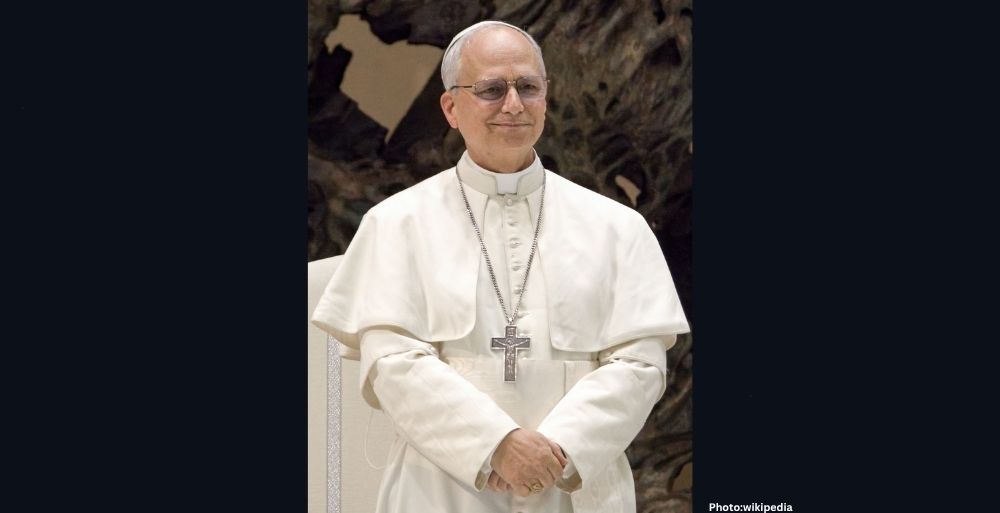
Pope Leo XIV expressed profound sorrow for the Holy See’s historical complicity in slavery, marking a significant moment in the Catholic Church’s reflection on its past actions.
Pope Leo XIV delivered a historic apology on Monday, acknowledging the Holy See’s role in legitimizing slavery and the failure to condemn such practices for centuries. This unprecedented acknowledgment was part of his first encyclical, titled “Magnifica Humanitas” (Magnificent Humanity), which was released on the same day. In his remarks, Pope Leo described the Vatican’s historical involvement in slavery as a “wound in Christian memory.”
While previous popes have issued apologies for the involvement of Christians in the trans-Atlantic slave trade, none have explicitly addressed the role of past popes in granting European monarchs the authority to enslave non-Christians. Pope Leo XIV, marking his tenure as the first U.S.-born pope, made this apology against the backdrop of his family’s complex history, which includes both enslaved ancestors and slave owners. The encyclical aims to safeguard humanity amid the growing reliance on artificial intelligence and highlights modern forms of exploitation that echo historical injustices.
Historical Context of Papal Directives
Pope Leo’s apology comes in response to decades of advocacy from Black American Catholics, activists, and scholars who have called for the Vatican to confront its colonial-era actions. In his encyclical, Leo stated, “It is impossible not to feel deep sorrow when contemplating the immense suffering and humiliation endured by so many in stark contrast to their immeasurable dignity as persons infinitely loved by the Lord. For this, in the name of the Church, I sincerely ask for pardon.”
The Vatican has historically maintained that it upheld the dignity of all human beings as children of God. However, a series of papal bulls from the 15th century explicitly authorized Portuguese sovereigns to conquer lands in Africa and the Americas and to enslave non-Christians. For instance, Pope Nicholas V issued the papal bull Dum Diversas in 1452, which granted the Portuguese king the right “to invade, conquer, fight and subjugate” non-Christians and to reduce them to perpetual slavery.
This papal bull, alongside another issued in 1455, known as Romanus Pontifex, laid the groundwork for the Doctrine of Discovery, a principle that justified the colonial seizure of land across the globe. The permissions granted to the Portuguese were later confirmed or renewed by subsequent popes, including Callixtus III, Sixtus IV, and Leo X. Spanish monarchs also received similar rights for territories in the Americas.
In 2023, the Vatican formally repudiated the Doctrine of Discovery, yet it has not rescinded the original bulls that facilitated colonial practices. The Vatican argues that a later bull, Sublimis Deus, issued in 1537, reaffirmed Indigenous peoples’ rights against enslavement and asserted that they should not be deprived of their liberty or property.
The Church’s Evolving Stance on Slavery
Pope Leo XIV referenced his namesake, Pope Leo XIII, who became the first pope to explicitly condemn slavery in 1888, a time when many nations had already abolished the practice. Historically, even church institutions partook in slavery during antiquity and the Middle Ages. In his encyclical, Pope Leo recognized the Church’s delayed response to denouncing slavery, stating, “Yet neither can we deny or diminish the delay with which both society and the church came to denounce the scourge of slavery.”
He emphasized that the Church has long upheld the dignity of every person as a core doctrine, remarking, “even if it took eighteen centuries for its full incompatibility with slavery to be explicitly recognized.” The pope articulated a need for the Church to condemn all forms of trafficking associated with the digital age to prevent future apologies for failing to respect human dignity.
Reflections on Past Papal Apologies
This moment of reflection follows previous papal gestures towards acknowledging historical injustices. For instance, during a visit to Cameroon in 1985, St. John Paul II sought forgiveness on behalf of Christians for their involvement in the slave trade, although he did not address the papal role specifically. In 1992, he visited Goree Island, a significant slave-trading port, where he denounced the injustices of slavery as a “tragedy of a civilization that called itself Christian.”
Genealogical research by Henry Louis Gates Jr. has revealed that Pope Leo XIV has a complex heritage, with 17 of his ancestors identified as Black in census records. His lineage includes individuals categorized as mulatto, Black, Creole, or free persons of color, raising important discussions about race and identity within the context of the Church.
Recently, during a visit to Angola, Pope Leo prayed at a shrine significant to the history of the slave trade, reflecting on the suffering endured by the people of Angola under colonial rule. However, he did not specifically mention slavery during this visit, which has drawn mixed reactions.