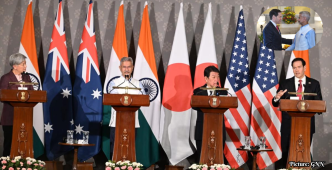
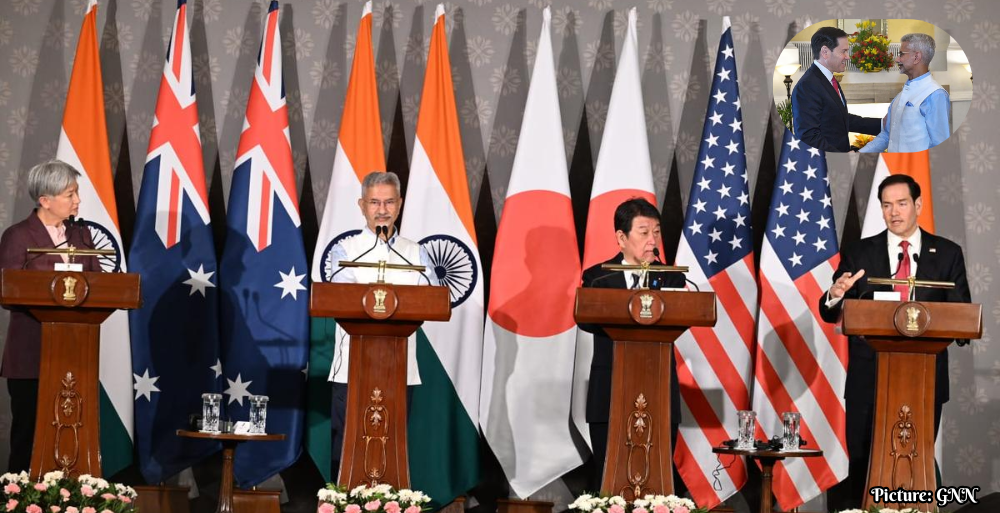
The foreign ministers of the Quad nations—India, the United States, Australia, and Japan—gathered in New Delhi to announce several initiatives aimed at bolstering maritime security, improving port infrastructure, and addressing critical mineral supply chains in the Indo-Pacific region.
On Tuesday, the foreign ministers of the Quadrilateral Security Dialogue (Quad), consisting of India, the United States, Australia, and Japan, convened at Hyderabad House in New Delhi. This significant meeting focused on aligning strategic perspectives and launching a series of initiatives that encompass maritime surveillance, port infrastructure development, critical minerals, and regional energy security.
External Affairs Minister S. Jaishankar, who presided over the discussions, emphasized that the talks largely revolved around the “current state of the world,” with particular attention to crucial issues relevant to the Indo-Pacific region. “We naturally focused on issues of particular relevance to the Indo-Pacific, because we are four maritime democracies located at different ends of the Indo-Pacific,” Jaishankar stated during the press briefing.
New Initiatives in Maritime Security
A key outcome of the meeting was the introduction of the Indo-Pacific Maritime Surveillance Corporation initiative, which aims to enhance information sharing among Quad countries by leveraging each member’s maritime surveillance capabilities. Additionally, the Quad announced the expansion of the Indo-Pacific Maritime Domain Awareness Initiative, designed to provide near-real-time tracking data to countries throughout the region, thereby improving maritime security.
This emphasis on maritime security is underscored by the fact that approximately 60% of global maritime trade passes through the Indo-Pacific, according to U.S. Secretary of State Marco Rubio. He remarked that this partnership must evolve beyond discussions into actionable outcomes to benefit not only the Quad nations but also the broader international community.
Moreover, the Quad launched its first-ever joint port infrastructure project under the newly established Quad Ports of the Future Partnership. This pilot project aims to enhance port infrastructure in Fiji, addressing the pressing issue of inadequate port capacity in the Pacific Islands. Jaishankar described this initiative as a “practical demonstration of our collective ability to deliver high-quality, resilient infrastructure in partnership with the region.”
Addressing Economic Vulnerabilities
Further underscoring the Quad’s commitment to regional stability, the ministers unveiled the Quad Critical Minerals Initiative framework. This initiative seeks to strengthen supply chains for critical minerals that are essential for various industries, thereby addressing vulnerabilities in the face of global economic volatility. Rubio noted that the Quad nations collectively represent about one-third of the world’s GDP and house nearly two billion people, sharing aligned interests and values that support economic development.
During the discussions, Australian Foreign Minister Penny Wong highlighted the deteriorating strategic circumstances in the region, emphasizing the Quad’s responsibility to provide real choices amidst an unpredictable global landscape. Wong stated, “We recognize the importance of maintaining the principle of freedom of navigation and our opposition to any tolling proposition,” indirectly referencing the geopolitical tensions surrounding maritime routes in the region.
Collective Security and Counter-Terrorism
Japanese Foreign Minister Toshimitsu Motegi reinforced the necessity of advancing cooperation for a “Free and Open Indo-Pacific,” reiterating the Quad’s commitment to oppose unilateral changes to the status quo. He also raised concerns about the export restrictions on critical minerals and addressed ongoing issues regarding North Korea, reaffirming the Quad’s commitment to denuclearization efforts.
In light of recent global events, Jaishankar also flagged the need for a unified front against terrorism, emphasizing that democratic nations must maintain a zero-tolerance policy towards terrorist activities. “Nations subject to terrorist attacks have the right to defend themselves,” Jaishankar asserted, reflecting the Quad’s collective stance on security challenges.
Future Collaborations and Strategic Resilience
The initiatives announced in New Delhi come as the Indo-Pacific region faces increasing economic and strategic challenges, including rising tensions in international trade and security dynamics. The Quad nations aim to foster economic resilience and strengthen supply chains, particularly in light of recent disruptions caused by geopolitical events.
Moreover, the ministers expressed their commitment to enhancing cooperation in energy security, with plans to host a fuel security forum later this year, organized by the U.S. Department of Energy. This forum aims to identify areas of collaboration in technology, management, policy, and international market analysis, thereby bolstering regional energy resilience.
As the Quad transitions from a dialogue mechanism to a more action-oriented partnership, the discussions held in New Delhi represent a significant step towards addressing regional challenges collaboratively. Jaishankar concluded that the collective efforts of the Quad nations are essential for navigating the complexities of the Indo-Pacific landscape and promoting stability and prosperity in the region. The emphasis on actionable outcomes indicates a strategic shift aimed at ensuring that the Quad serves as a proactive force in shaping the future of the Indo-Pacific.