The total solar eclipse on August 2, 2027, will be the longest of the 21st century, with maximum totality lasting over six minutes as it traverses a path from southern Spain to the Arabian Peninsula.
On August 2, 2027, a rare astronomical event will unfold as a total solar eclipse sweeps across a narrow corridor stretching from the Straits of Gibraltar to the Arabian Peninsula. NASA’s Goddard Space Flight Center has confirmed this eclipse will be the longest total solar eclipse of the 21st century, with a maximum duration of totality reaching 6 minutes and 23 seconds. The last comparable total solar eclipse was observed in 1991, and the next opportunity of similar magnitude will not occur until 2114.
Understanding the Duration of Totality
The extended duration of this eclipse results from the Moon’s position relative to Earth. On the day of the event, the Moon will be near perigee—the point in its orbit where it is closest to Earth. This proximity allows the Moon to appear large enough to completely obscure the Sun for an unusually extended period. Additionally, the point of greatest eclipse will occur in a region where the Sun is nearly overhead, adding crucial seconds to the duration of totality.
The path of totality will traverse several countries in North Africa, including southern Spain, northern Morocco, Algeria, Tunisia, Libya, and Egypt, before crossing into Saudi Arabia and Yemen. As the eclipse progresses from west to east, the duration of totality increases. For example, Tarifa, located at Spain’s southern tip, will experience 4 minutes and 39 seconds of totality, while Tangier, Morocco, will witness 4 minutes and 50 seconds. By the time the eclipse reaches Benghazi, Libya, observers can expect a totality lasting 6 minutes and 7 seconds, and in Luxor, Egypt, the duration will extend to 6 minutes and 19 seconds.
Favorable Meteorological Conditions
In addition to duration, meteorological conditions will play a crucial role in the viewing experience. August in North Africa typically brings intense heat, yet it also provides highly favorable conditions for eclipse observation, particularly in areas where totality will be longest. Jay Anderson, a Canadian meteorologist who analyzes eclipse weather conditions, noted that eastern Libya and western Egypt are expected to have “no chance of cloud.” In Luxor, for instance, the average cloud cover in August is merely 0.7 percent, making it an ideal location for observers.
However, there are regional variations in cloud cover. Around the Straits of Gibraltar, where many tourists are expected to gather, average cloud cover can reach approximately 30 percent, complicating visibility in that area. The local weather patterns can introduce moisture into the region, potentially impacting eclipse visibility.
Significant Population Within the Path of Totality
Another noteworthy aspect of the 2027 eclipse is the substantial population density within the path of totality. According to estimates from Timeanddate.com, approximately 88.9 million people reside within this narrow corridor, significantly surpassing the population of those who experienced the North American eclipse in April 2024. The eclipse will occur around midday in many locations, with Luxor witnessing totality at 1:02 p.m. local time, while Jeddah, Saudi Arabia, will experience it at 1:22 p.m. Tarifa will see totality earlier, at 10:45 a.m.
For regions outside the path of totality, a partial solar eclipse will be observable across much of Africa, Europe, and the Middle East. For example, Lisbon will see 93 percent of the solar disk obscured, while Madrid will experience 86 percent coverage. Other cities, including Paris and London, will observe 52 percent and 42 percent obscuration, respectively. Cairo, situated just south of the path, will see a remarkable 95 percent coverage, and cities like Algiers and Tripoli will record 99.9 percent obscuration without achieving totality.
What to Expect During Totality
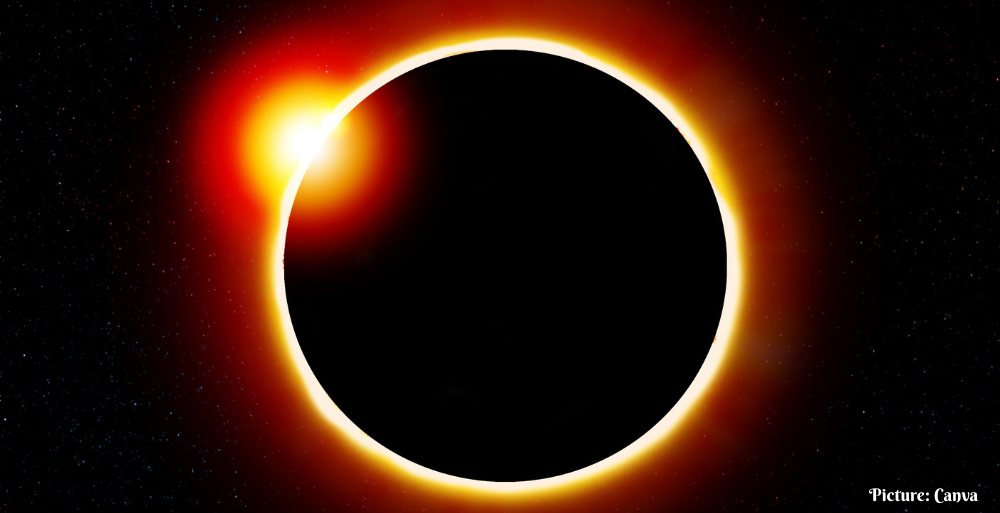
As the eclipse approaches totality, viewers will witness several striking optical phenomena. The first observable effect will be Baily’s Beads, where bright points of light appear around the Moon’s irregular edge as sunlight streams through lunar valleys. This will quickly transition into the diamond ring effect, signaling the moment just before the corona becomes fully visible. Once totality is achieved, the Sun’s corona will appear as a radiant halo, and the surrounding sky will darken sufficiently to reveal brighter stars and planets.
The temperature can drop significantly during totality, particularly in the dry desert air, which may be an abrupt and disorienting experience for observers. Safety precautions are critical; viewers must wear certified solar viewing glasses during all phases of the eclipse except for the brief period of total obscuration, when it is safe to view the event directly.
Navigational tools, such as NASA’s interactive eclipse map, provide precise contact times and eclipse durations, although adjustments may be necessary to account for geographical features like mountains and valleys. These corrections are typically published 12 to 18 months prior to the event.
Following the August 2027 eclipse, the next total solar eclipse will occur on July 22, 2028, visible from locations including Christmas Island, Cocos Islands, parts of Australia, and New Zealand, but its totality will be shorter than that of the upcoming eclipse.