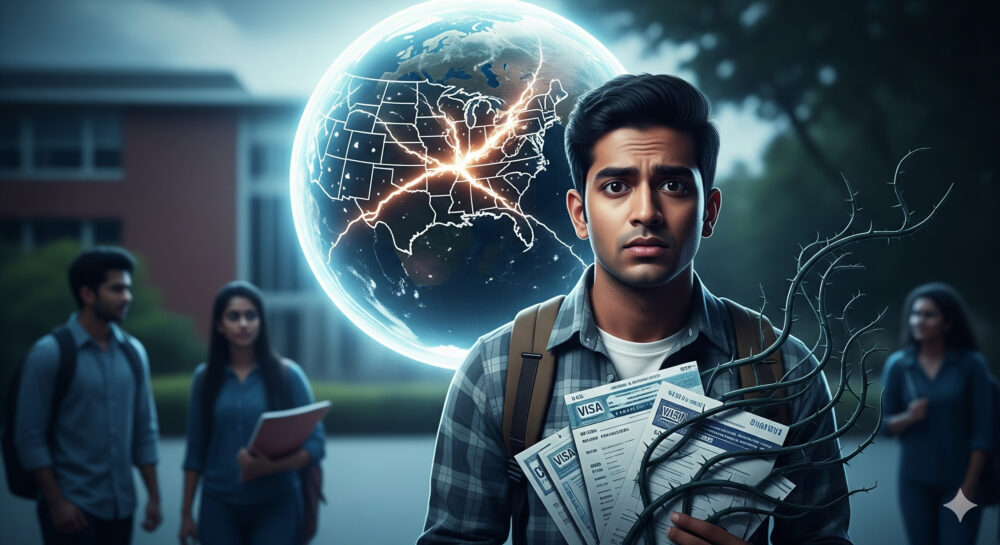
As U.S. colleges face a potential drop in international student enrollment, tighter visa restrictions and administrative policies are cited as key factors driving students to study abroad instead.
The landscape of higher education in the United States is facing significant challenges as international student enrollment is projected to decline sharply this fall. This trend is largely attributed to stricter visa regulations and administrative policies implemented by the Trump administration, which have made it increasingly difficult for foreign students to gain entry to U.S. educational institutions.
Historically, the United States has been a favored destination for international students, who contribute not only to the diversity of the academic environment but also to the financial health of colleges and universities. International students often pay full tuition rates, and their presence can subsidize educational programs for domestic students. However, recent data suggests that these students are now considering alternative destinations for their education.
Individual universities have reported significant drops in international enrollment figures. For instance, the University of Washington in Seattle has noted a decline in international student numbers for the second consecutive year, reaching a low not seen in over a decade. Similarly, The Ohio State University has experienced a nearly 13% decrease in international enrollment, marking the lowest figures in 16 years. Financially, institutions like the Illinois Institute of Technology are feeling the impact, with plans to borrow up to $200 million from their endowment to counterbalance losses associated with declining international student numbers.
Impact of Administrative Policies
The Trump administration’s immigration policies, which include tighter vetting and restrictions on student visas, are viewed as part of a broader strategy to limit immigration. Critics argue that these policies are detrimental not only to the institutions that rely on international tuition but also to the U.S. economy and cultural exchange.
Michael Roth, president of Wesleyan University, emphasized the importance of international students to the U.S., noting, “This is great for the United States that they’re spending money here, that they’re learning about our culture and our country. To just make it harder in the name of some kind of nationalism, it seems like we’re shooting ourselves in the foot just to see how good our boots are.” Roth’s sentiments are echoed by many in the higher education community who believe that the changing immigration landscape is likely to have long-lasting repercussions.
Furthermore, higher education leaders have expressed concern that the fluctuating visa rules and proposed restrictions could permanently tarnish the U.S.’s reputation as a welcoming environment for international talent. Zuzana C. Wootson, deputy director of federal policy at the Presidents’ Alliance, noted that every international student in bachelor’s degree programs at public universities creates two additional spots for American students, highlighting the interdependence between domestic and international student enrollments.
Political Perspectives
Reactions to the administration’s policies have varied widely. House Education and Workforce Chair Tim Walberg argued that current policies ensure that educational institutions are focused on American students, asserting that as domestic enrollment needs increase, there will be less emphasis on international students. However, this perspective is met with skepticism by many in academia, who stress that the contributions of international students are invaluable to the educational experience.
Patricia McGuire, president of Trinity Washington University, voiced concerns regarding the climate of fear that has arisen among international students due to immigration enforcement. She recounted an incident where one of her international students refrained from seeking help after an assault due to fears of deportation. “That is just disgraceful for this country,” McGuire stated.
Future Implications for International Education
As the fall semester approaches, international education advocates warn that the anticipated decrease in enrollment may set a precedent that is difficult to reverse. Fanta Aw, executive director of NAFSA: Association of International Educators, highlighted the increased competition from foreign institutions eager to attract students who may have once considered the U.S. as their first choice.
Recent survey data indicates that many institutions in Europe and Asia are experiencing an uptick in international student enrollments, further underscoring the shifting dynamics of global education. This trend coincides with the findings from NAFSA, which noted that half of the colleges in continental Europe reported increased undergraduate enrollment among international students.
The Department of Homeland Security (DHS) has defended its policies, claiming they are aimed at reducing visa fraud and ensuring that American workers are not unfairly competing with international students. A DHS spokesperson remarked, “Where was the outrage when foreign nationals were abusing the system, violating the terms of their student visas?” However, critics of the administration argue that the measures taken are overly punitive and detrimental to the higher education sector.
As the U.S. continues to grapple with these immigration challenges, it remains to be seen how universities will adapt to the potential fallout from declining international student enrollment. With proposed increases in visa fees and administrative hurdles, the landscape for foreign students seeking education in the United States could become even more complex, raising questions about the future of international education in the country.