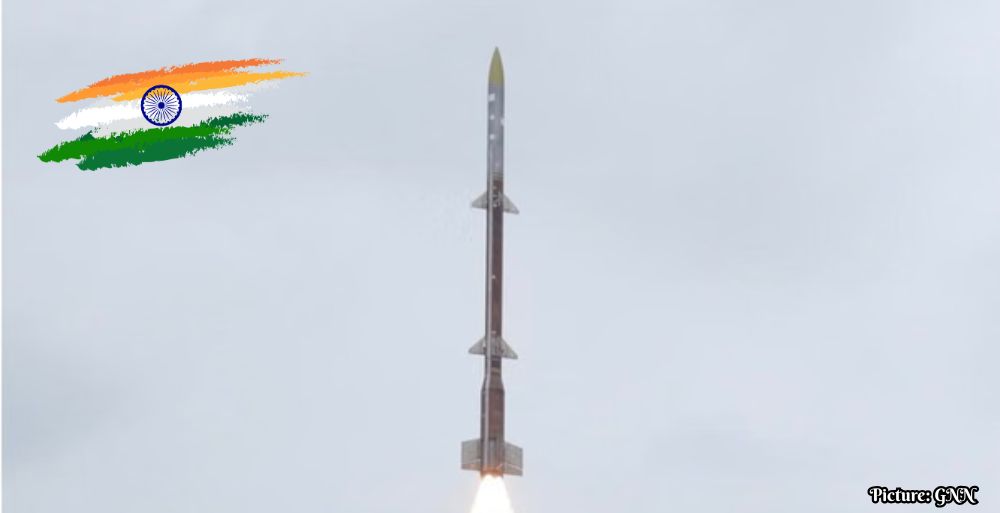
India’s Defence Research and Development Organisation has successfully conducted the maiden flight-test of the Kusha Long-Range Surface-to-Air Missile, marking a significant advancement in the country’s indigenous air defence capabilities.
BHUBANESWAR, India — On July 23, 2026, India’s Defence Research and Development Organisation (DRDO) executed the inaugural flight-test of the Kusha Long-Range Surface-to-Air Missile (LRSAM) from the Integrated Test Range (ITR) at Dr. APJ Abdul Kalam Island, situated off the coast of Odisha. This successful test signifies India’s entry into a select group of nations capable of designing, developing, and deploying long-range, multi-tiered area air defence systems.
Details of the Maiden Test
According to official statements from the Ministry of Defence, the missile effectively intercepted a high-speed, high-altitude electronic target, simulating advanced aerial threats. The trial was part of Project Kusha, also known as the Extended Range Air Defence System (ERADS), which aims to establish a sovereign, multi-layered air defence shield over Indian airspace by the end of the decade. This initiative significantly reduces India’s reliance on foreign defence systems.
The launch occurred from Launch Complex IV at the APJ Abdul Kalam Island testing facility. Union Defence Minister Rajnath Singh remarked, “The successful test flight of ‘Kusha’ marks an important milestone in Indian defence R&D,” emphasizing the strategic implications of this development for India’s defense autonomy.
Flight Test Parameters
The Kusha missile system is designed to counter various aerial threats, including fighter jets and hypersonic missiles. Key specifications of the flight test included:
- Target Profile: An advanced electronic target simulating a low radar cross-section stealth jet or high-altitude cruise missile traveling at supersonic speeds.
- Tracking and Engagement: Utilized ground-based Multi-Function Fire Control Radars (MF-FCR) and 3D Long-Range Observation Radars to continuously track the target, providing mid-course guidance updates to the missile.
- Kill Mechanism: The test validated the missile’s hybrid radio-frequency (RF) and infrared (IR) terminal seeker, along with an optical proximity fuse and pre-fragmented warhead.
Project Kusha Overview
Project Kusha was sanctioned by the Cabinet Committee on Security (CCS) in May 2022 and received an Acceptance of Necessity (AoN) from the Defence Acquisition Council (DAC) in September 2023, with an allocated budget of ₹21,700 crore (approximately $2.6 billion) for the procurement of five squadrons for the Indian Air Force (IAF).
Distinct from single-missile systems, Project Kusha employs three types of interceptor missiles (M1, M2, and M3) that operate from common, mobile Transporter Erector Launchers (TELs). The specifications for each interceptor include:
- M1 Interceptor: Range of 120-150 km, optimized for medium-to-long-range engagements against tactical strike aircraft and low-flying missiles.
- M2 Interceptor: Range of 250 km, designed to counter high-altitude bombers and UAVs.
- M3 Interceptor: Range of 350-400 km, capable of targeting airborne early warning systems and ballistic threats.
Technical Capabilities
The Kusha missile boasts several advanced features:
- Speed: Achieves speeds exceeding Mach 5.5, powered by dual-pulse solid-propellant rocket motors.
- Guidance Suite: Incorporates inertial navigation complemented by satellite-assisted mid-course corrections, transitioning to an active dual-mode seeker during terminal engagement.
- Hit-to-Kill Lethality: Utilizes both fragmentation warheads and kinetic impact technology for effective interception.
Complementing India’s Air Defence Shield
Project Kusha is designed to serve as the outer layer of India’s multi-layered air defence architecture, bridging the gap between medium-range systems and strategic anti-ballistic missile capabilities. The integration is expected to enhance operational effectiveness across various defence layers, which include:
- Strategic Layer: Kusha; BMD Phase I/II (PAD/AAD)
- Long-/Medium-Range Air Defence: S-400 Triumf; MRSAM / Barak-8
- Short-/Medium-Range Air Defence: Akash-NG; QRSAM
- Point Defence: VSHORAD; Igla-S
Global Comparisons
In comparison to other leading air defence systems worldwide, such as Russia’s S-400 and the United States’ MIM-104 Patriot, Kusha offers distinct advantages. For instance, while the S-400 relies on older hybrid processing architecture, Kusha employs modern Gallium Nitride (GaN)-based radars that enhance target resolution and electronic jamming resistance. Additionally, Kusha’s interceptor ranges exceed those of many competitors, allowing for greater defensive coverage.
As India moves towards a more self-reliant defense posture, Kusha is being developed in collaboration with various private sector partners, including Bharat Electronics Limited (BEL) and Bharat Dynamics Limited (BDL), with plans for significant production increases within the next decade.
Future Prospects
The successful flight-test of the Kusha missile positions India as not only a regional power but as a potential exporter of long-range surface-to-air missile systems to nations seeking alternatives to current global offerings. The IAF plans to conduct further developmental trials leading towards full operational capability by 2030, which will enhance India’s strategic deterrence and air defence capabilities significantly.
As India continues to invest in indigenous defence technology, the Kusha missile program is set to reshape the air power dynamics in South Asia and the broader Indo-Pacific region, ensuring that India remains at the forefront of advanced military capabilities.