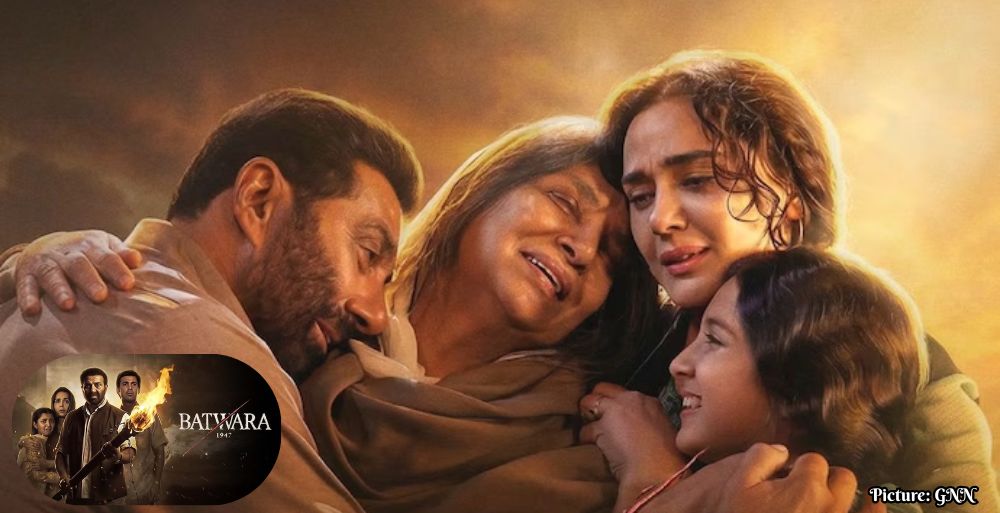
The trailer for ‘Batwara 1947,’ starring Sunny Deol and directed by Rajkumar Santoshi, was released on July 28, 2023, ahead of its premiere on August 14, coinciding with India’s Independence Day. The film addresses the historical context of the 1947 partition and its impact on communal relations.
On July 28, 2023, the trailer for the upcoming film ‘Batwara 1947’ debuted, featuring prominent Bollywood actor Sunny Deol and directed by notable filmmaker Rajkumar Santoshi. The film is set to be released on August 14, 2023, a strategic choice aligning with India’s Independence Day, a time when national identity and historical reflection are at the forefront of public consciousness.
Plot Overview and Themes
The trailer opens with characters portrayed by Sunny Deol and Preity Zinta, who play a married couple celebrating India’s independence. Their initial joy is swiftly overshadowed by the grim reality of the country’s partition, which forces them to flee to Pakistan. This narrative choice highlights the emotional and historical upheaval experienced by millions during the partition, a topic that has been revisited in various cinematic interpretations over the years.
As the plot unfolds, Deol’s character, reminiscent of his previous iconic role in ‘Gadar,’ engages in fierce confrontations to protect his family during their perilous journey across the border. Once in Pakistan, he is assigned a large residence, or ‘haveli,’ which was previously home to a Hindu family. The character played by Shabana Azmi, presumably the matriarch of that family, continues to reside there, creating a complex dynamic that speaks to the themes of displacement and cultural identity during this turbulent period.
In a particularly poignant moment from the trailer, Deol’s character declares, “Mandir todna Islam nahi hai” (Damaging temples is not in accordance with Islam), a statement that underscores the film’s exploration of communal tensions and the importance of safeguarding cultural heritage amidst violence. This dialogue not only reflects the film’s narrative focus but also serves as a commentary on the broader societal issues of religious intolerance and identity crisis that emerged during the partition.
Character Dynamics and Performances
In an interesting twist, Sunny Deol’s son, Karan Deol, portrays his on-screen son, amplifying the narrative tension when he warns an antagonist about his father’s fierce nature, stating, “Tu mere baap ko nahi jaanta. Na ghar dekhenge na sarhad, seedha ghus ke maarenge” (You don’t know my father; he won’t consider borders or homes when he attacks). This line encapsulates the film’s themes of familial loyalty, strength, and the instinct to protect loved ones, which resonate strongly with audiences familiar with Deol’s previous roles.
The film also marks a significant collaboration between Sunny Deol and producer Aamir Khan, a prominent figure in Bollywood known for his impactful storytelling. ‘Batwara 1947’ is inspired by Asghar Wajahat’s 1989 play ‘Jis Lahore Nai Vekhya, O Jamya E Nai,’ translating to ‘The one who hasn’t experienced Lahore, hasn’t lived yet.’ The film’s title underwent a change from ‘Lahore 1947’ to ‘Batwara 1947,’ reflecting the production’s evolving vision, with the new title confirmed in June 2026.
Historical Context and Filmmaking Background
The upcoming film is set against the backdrop of India’s partition in 1947, a historical event that resulted in the division of British India into two independent dominions, India and Pakistan. This division was marked by widespread violence, mass displacement, and profound communal strife, leaving lasting scars on the collective memory of the subcontinent. The partition’s legacy remains a poignant subject in Indian cinema, often portrayed through various narratives that seek to address both the personal and collective impacts of this historical tragedy.
The collaboration between Sunny Deol and director Rajkumar Santoshi is notable, as the two have a storied history of successful projects over the last three decades, including classics such as ‘Damini,’ ‘Ghayal,’ and ‘Ghatak.’ Their professional relationship faced challenges in the early 2000s due to a fallout during the production of competing Bhagat Singh films. Santoshi has previously expressed gratitude towards Deol for the opportunities provided to him in the early stages of his career, stating, “He recognised me at a time when the world didn’t know me.” This acknowledgment underscores the complexities of their relationship and the significance of their reunion in ‘Batwara 1947.’
Anticipation and Market Reception
As the release date approaches, anticipation for ‘Batwara 1947’ is building among audiences, particularly those interested in films that engage with historical narratives and their implications for contemporary society. The film aims to capture viewers’ attention not only through its action-packed sequences and emotional depth but also through its commentary on communal harmony during a tumultuous period in Indian history.
With its planned release during the Independence Day weekend, ‘Batwara 1947’ seeks to resonate with a diverse audience, invoking reflection on India’s past while exploring themes that remain relevant in today’s sociopolitical landscape. The film’s portrayal of familial ties, cultural identity, and communal strife is likely to spark discussions about the ongoing relevance of these issues in modern India.
Overall, ‘Batwara 1947’ represents a significant entry into the Bollywood landscape, poised to contribute to the ongoing dialogue surrounding India’s partition and the enduring impact it has on present-day society.