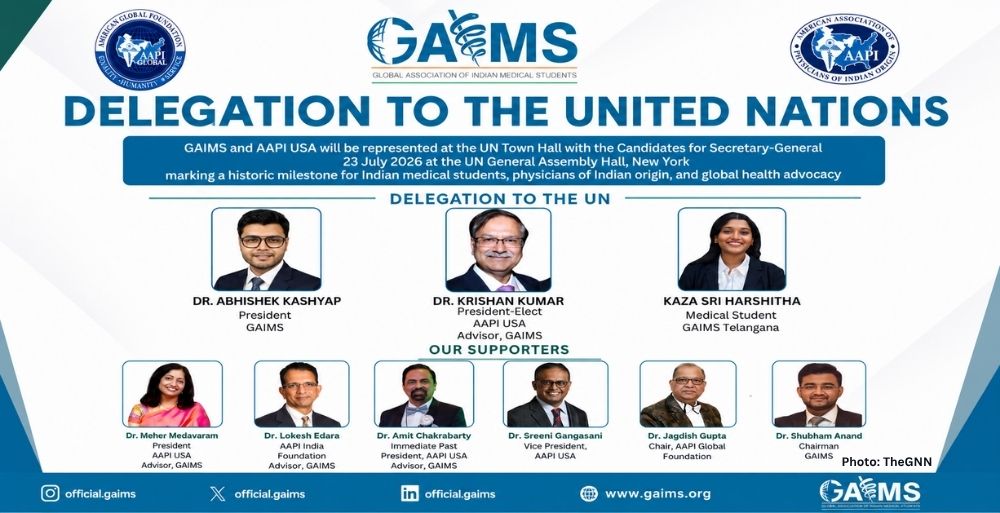
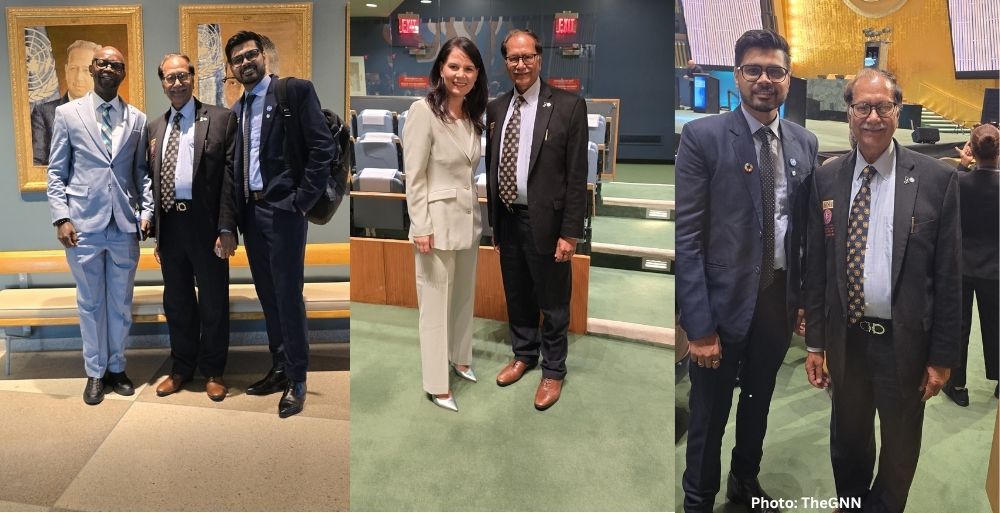
New York, July 2026 — In a landmark moment for the global Indian medical community, the American Association of Physicians of Indian Origin (AAPI) and the Global Association of Indian Medical Students (GAIMS) were represented at the United Nations Town Hall with the Candidates for Secretary-General, held on July 23, 2026, at the United Nations General Assembly Hall in New York.
According to Dr. Krishan Kumar, President-Elect of AAPI, and an Advisor to GAIMS along with Dr. Abhishek Kashyap, President of GAIMS, and Kaza Sri Harshitha, a Medical Student from GAIMS participated at the Town Hall.
The event placed Indian-origin physicians and medical students in a significant international policy forum where future global leadership priorities were discussed. The representation underscores the increasing role of healthcare professionals in shaping conversations on global public health, health equity, medical education, and international cooperation.
Dr. Kumar, who was at the Town Hall, said, “Our participation marks a proud milestone for Indian medical students and physicians of Indian origin, and a new step forward in global health advocacy.”
AAPI, the largest organization representing physicians of Indian heritage in the United States, has long identified advocacy, education, and service as central pillars of its mission. The organization describes itself as “the premier voice of Indian-origin physicians in the United States,” with a continuing commitment to advancing healthcare and public policy.
The United Nations participation aligns with AAPI’s broader vision of strengthening its presence in international health discussions. Recent AAPI leaders have repeatedly emphasized the importance of advocacy and global engagement.
Dr. Meher Medavaram, President of AAPI for 2026–27, stated, “My vision is to lead with unity, integrity, inclusion, and purpose,” while highlighting the growing influence of Indian-origin physicians in healthcare leadership.
The contest to succeed United Nations Secretary-General António Guterres rolled out beneath the glare of the spotlight at the organization’s headquarters last week, as candidates answered questions about their credentials for the job before member states and civil society groups.
Rafael Grossi (Argentina); Michelle Bachelet (Chile); Rebeca Grynspan (Costa Rica); María Fernanda Espinosa (Ecuador); Carolyn Rodrigues-Birkett (Guyana); and, Macky Sall (Senegal) are the six candidates, who participated at the Town Hall and answered questions from the panel, in the presence of a large audience from around the world.
It’s significant that for the first time in the United Nations’ 70-year history, candidates vying to become secretary-general made their pitch for the job to world governments in hearings last week.
Dr. Vijay Maurya, Chair of AAPI BOT, reaffirmed the organization’s commitment to healthcare advocacy, saying, “AAPI is committed to expanding the knowledge base of young physicians, enhancing their careers, and empowering them to lead in healthcare advocacy and community service.”
The importance of the UN appearance by AAPI leadership extends beyond symbolic representation. Indian-origin physicians constitute a major segment of the American healthcare workforce and have contributed extensively to medical innovation, patient care, and public health initiatives. AAPI represents more than 120,000 physicians, residents, fellows, and medical students of Indian origin, providing a unified platform for professional development and policy engagement.
Previous AAPI leaders have also stressed the need for a stronger voice in national and global health policy. Former AAPI President Dr. Amit Chakrabarty stated, “Our voice must be stronger, our advocacy bolder, and our unity deeper than ever before,” emphasizing the organization’s intention to participate in shaping healthcare policies internationally.
The joint representation of GAIMS and AAPI at the United Nations demonstrates the growing collaboration between established physician leaders and the next generation of healthcare professionals. As global healthcare challenges increasingly require international cooperation, the inclusion of Indian medical students and physicians in UN-level discussions highlights their expanding influence in global health diplomacy.
This historic participation is expected to strengthen future engagement between academic medicine, physician organizations, and international institutions while promoting the voices of Indian-origin healthcare professionals on the world stage. Fore more details, please visit: www.aapiusaorg.
U.N. Interviews Six Candidates Seeking to Become the Next Secretary-General
Overview
The United Nations has formally launched the process of selecting the successor to Secretary-General António Guterres, whose second and final term ends on 31 December 2026. As part of a transparency initiative introduced in recent selection cycles, six candidates participated in public “interactive dialogues” at U.N. Headquarters in New York, presenting their visions for the organization and answering questions from member states and civil society. [news.un.org], [un.org]
The interviews, held under the auspices of U.N. General Assembly President Annalena Baerbock, are considered an important stage in the selection process, although the decisive negotiations will ultimately occur within the U.N. Security Council. [un.org], [news.un.org]
Why the Selection Matters
The next Secretary-General will assume office at a time of significant global challenges, including geopolitical tensions, armed conflicts, financial pressures on the United Nations, climate-related risks, technological disruption, and growing questions about the effectiveness of multilateral institutions. The successful candidate will be expected to guide institutional reforms while preserving the U.N.’s core missions of peace and security, development, and human rights. [news.un.org], [un.org], [english.news.cn]
Baerbock described the choice as one that will shape the direction of the world’s foremost multilateral organization and demonstrate whether the U.N. reflects the diversity of the more than eight billion people it serves. [news.un.org], [english.news.cn]
The Six Candidates
Michelle Bachelet is a former President of Chile and former United Nations High Commissioner for Human Rights. She is one of the most internationally recognized candidates in the race and has campaigned on strengthening preventive diplomacy, defending human rights, and making the U.N. more effective and results-oriented. [unric.org], [english.news.cn]
Bachelet’s candidacy is particularly notable because she could become the first woman to lead the United Nations, an issue that has gained renewed attention during this selection process. [unric.org], [news.un.org]
Rafael Grossi currently serves as Director General of the International Atomic Energy Agency (IAEA). Widely regarded as one of the strongest contenders, Grossi has emphasized practical leadership, institutional efficiency, and effective results. His experience dealing with sensitive nuclear issues in countries such as Iran has elevated his international profile. [news.un.org], [passblue.com]
Many observers consider Grossi a leading candidate because of his executive experience within the U.N. system and his extensive diplomatic network. [passblue.com]
Rebeca Grynspan is an economist, former Vice President of Costa Rica, and Secretary-General of the U.N. Conference on Trade and Development (UNCTAD). During the dialogues, she promoted institutional reform and highlighted the use of data and artificial intelligence to help the United Nations anticipate and respond to crises more effectively. [unric.org], [news.un.org]
Her supporters view her as a seasoned U.N. insider with extensive development experience and strong credentials in international economic policy. [passblue.com]
Former Senegalese President Macky Sall entered the race as the principal African candidate. During his presentation, he called for a renewed emphasis on pragmatism, peace, and respect for state sovereignty. [unric.org], [news.un.org]
Sall’s candidacy brings experience from the highest level of political leadership in Africa and reflects ongoing efforts to secure stronger African representation in senior international positions. [news.un.org]
María Fernanda Espinosa, a former Ecuadorian foreign minister and former President of the U.N. General Assembly, joined the race later and participated in a subsequent dialogue session. Her credentials include extensive diplomatic experience and leadership within the U.N. system itself. [news.un.org], [passblue.com]
Her candidacy adds another Latin American voice to a field already dominated by candidates from the region. [passblue.com], [news.un.org]
Carolyn Rodrigues-Birkett serves as Guyana’s Permanent Representative to the United Nations. She also participated in a later dialogue session after formally entering the race. Her candidacy brings experience in diplomacy, governance, and multilateral negotiations. [news.un.org], [passblue.com]
Her entry further expanded the field and increased attention on candidates from developing nations and smaller states. [passblue.com]
Key Themes from the Interviews
Throughout the dialogues, candidates addressed several recurring issues:
• Reforming the United Nations to make it more effective and responsive. [news.un.org], [un.org]
• Managing growing geopolitical tensions and conflicts. [english.news.cn], [un.org]
• Protecting human rights while maintaining diplomatic credibility. [news.un.org], [english.news.cn]
• Strengthening development efforts and addressing inequality. [un.org], [english.news.cn]
• Improving transparency and accountability within the organization. [un.org], [news.un.org]
• Ensuring the U.N. remains relevant amid financial and political pressures. [news.un.org], [english.news.cn]
The sessions were televised and livestreamed, allowing governments, journalists, and civil society organizations worldwide to assess the candidates directly. [news.un.org], [un.org]
What Happens Next?
Although the public dialogues are designed to increase transparency, the decisive stage of the selection process remains the Security Council’s deliberations. The Council will conduct a series of confidential straw polls to determine which candidate can secure support from at least nine members without a veto from any of the five permanent members—China, France, Russia, the United Kingdom, and the United States. [unric.org]
The Security Council will then recommend a candidate to the 193-member General Assembly, which formally appoints the next Secretary-General. The successful candidate will begin a five-year term on 1 January 2027. [unric.org], [english.news.cn]
Conclusion
The New York interviews marked the public opening of one of the world’s most consequential diplomatic selections. The six candidates—Michelle Bachelet, Rafael Grossi, Rebeca Grynspan, Macky Sall, María Fernanda Espinosa, and Carolyn Rodrigues-Birkett—offered differing visions for how the United Nations should confront mounting global challenges. While the interviews improve transparency and public engagement, the ultimate decision will depend on the political dynamics inside the Security Council, where the race for the world’s top diplomatic post is now entering its most critical phase.
For decades, the selection of the UN chief has been the purview of the five permanent Security Council members — Britain, France, China, Russia and the United States — in a process kept mostly behind closed doors.
But the General Assembly in September voted to lift some of the secrecy surrounding the process, asking candidates to send a formal letter of application, present their resumes and appear at hearings.
Among the declared candidates are UNESCO chief Irina Bokova of Bulgaria, former New Zealand prime minister and head of the UN Development Programme Helen Clark, and forhe U.N. Charter is scant on details about the selection process, stipulating only that the secretary-general shall be appointed by the General Assembly on the recommendation of the Security Council. That effectively hands the Security Council a monopoly over the final decision as long as it names a single candidate.
The United States will undoubtedly have a big say in the final selection, but not a free hand. Any contender first needs to survive the Security Council’s secret straw polls, expected to begin in July, with the support of at least nine members, including all five veto-wielding permanent members: China, France, Russia, the United Kingdom, and the United States.
mer high commissioner for refugees Antonio Guterres of Portugal.
As of today, over 200 current and former heads of state, UN leaders, organisations, advocates, practitioners, and researchers from all regions of the world are calling on the next United Nations Secretary-General to commit, act and deliver on five concrete actions to advance gender equality across the UN system during their tenure.
The open letter, coordinated by Global 50/50 and published on the same day as the UN Townhall with Secretary General candidates, warns that the United Nations is facing a critical test of its commitment to gender equality at a moment of rising global backlash against women’s rights, shrinking civic space for feminist movements, and growing pressure on funding for gender equality programmes.
After 80 years and nine Secretaries-General, the United Nations has never been led by a woman. The letter states that this alone warrants change. The signatories further argue that the future Secretary-General must be held accountable for how they use their power to drive change for gender equality across the UN system once in office.
The next Secretary-General will lead the UN at a time when progress across the Sustainable Development Goals is under severe pressure. Gender equality is not a standalone issue: UN Women says women’s empowerment is integral to all 17 SDGs, shaping outcomes across poverty, health, education, economic development, climate resilience, peace, and human rights.
The next Secretary General is likely to come from the group of Latin American and Caribbean states, with five of the remaining six candidates coming from this region. The Economic Commission for Latin America and the Caribbean – ECLAC – reports that in 2024 at least 3,828 women were victims of femicide, feminicide or gender-related killings in 26 countries and territories, while the ILO reports that women’s labour force participation stood at 52.1%, compared with 74.3% for men. These inequalities directly impact safety, economic resilience, human rights, and sustainable development, illustrating why the next Secretary-General must embed gender analysis, resources, and accountability across the UN system.
Get the latest news delivered to your inbox.
Sign up for The Manila Times newsletters.
By signing up with an email address, I acknowledge that I have read and agree to the Terms of Service and Privacy Policy.
The letter calls on the next Secretary-General to act on five commitments for gender equality:
Advertisement
• Measure it: every UN agency must report sex-disaggregated data as standard, without exception.
• Analyse it: gender analysis must inform every UN initiative before it launches, not after.
• Centre it: feminist voices must shape every UN process, not as guests, but as architects.
• Fund it: gender equality must have dedicated resources in every UN budget.
• Institutionalise it: gender equality must be a condition of leadership across the UN system, built in rather than bolted on.
Professor Kent Buse, Co-CEO of Global 50/50, said:
“Gender equality is not a zero-sum game where men lose what women gain. It shapes everyone’s health, security and prosperity: fix the system and we all gain – stronger economies, healthier societies, more durable peace. The next Secretary-General should measure it, fund it and build it into how the UN is led, not as a favour to women, but as a test of leadership for us all.”
S. Mona Sinha, CEO, Equality Now said:
Advertisement
“As the world confronts escalating attacks on women’s rights, shrinking civic space, and declining resources for gender equality, the next Secretary-General will have a unique opportunity, and responsibility to demonstrate that gender equality is not a side issue, but fundamental to peace, security, economic prosperity, and human rights. The call’s emphasis on measurement, accountability, meaningful participation, dedicated resources, and institutional leadership is especially powerful.”
The call comes as the selection process for the next UN Secretary-General gathers pace, with the first round of Security Council straw polls expected in late July. The current Secretary-General, António Guterres, will complete his second term on 31 December 2026, with his successor expected to take office on 1 January 2027.