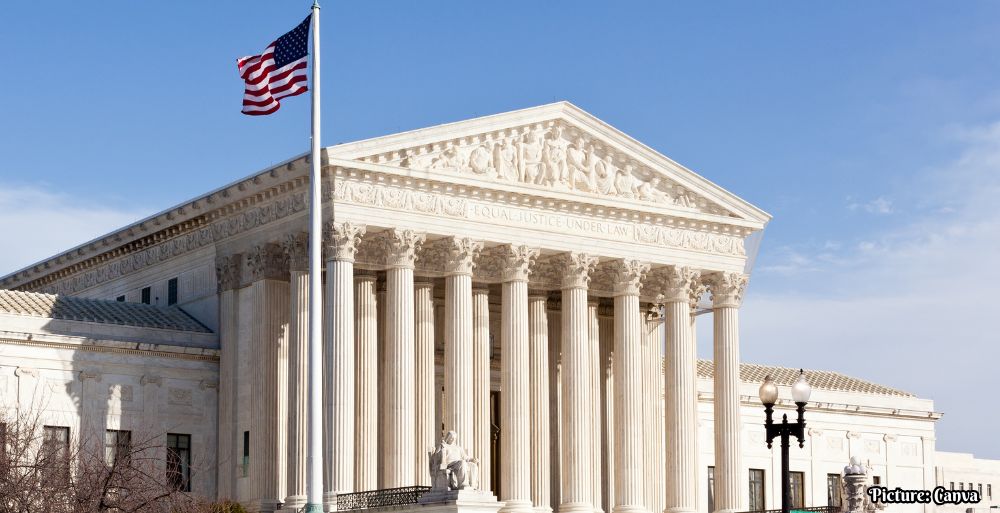
In a bid to enforce new mail-in voting restrictions, the Trump Administration has requested the Supreme Court to intervene following a district court ruling that blocked the implementation of an Executive Order aimed at altering election procedures ahead of the November midterm elections.
The Trump Administration is seeking the Supreme Court’s intervention to advance its election reform agenda just months before the upcoming midterm elections in November. This effort centers on an Executive Order that aims to impose strict limitations on mail-in voting across the nation. A filing from the Justice Department on Monday requested that the high court temporarily halt a district court ruling that had previously blocked the enforcement of this order.
Originally issued in March, the Executive Order mandates that the Department of Homeland Security and the Social Security Administration compile lists of eligible voters in each state and prohibits the U.S. Postal Service from distributing absentee ballots to individuals who are not included on these state-specific mail-in or absentee participation lists. The order has faced legal challenges from officials in 23 states and the District of Columbia, who allege that it constitutes an unconstitutional overreach of presidential authority.
In August, a federal judge in Massachusetts, appointed during the Obama administration, issued a ruling that blocked certain provisions of the Executive Order in the states involved for the November elections. Following this decision, an appeals court in Massachusetts declined the Administration’s request to pause the injunction while the appeal is processed. The appellate court’s ruling was notably split, with the majority opinion authored by two judges appointed by President Biden, while a Trump appointee concurred in part but dissented in other aspects.
Legal Arguments and Implications
D. John Sauer, the Solicitor General, is advocating for an immediate administrative stay on the district court’s injunction until the appeal is resolved. In his legal arguments, Sauer contended that the district court “lacked jurisdiction to resolve this premature dispute,” noting that the federal agencies involved have yet to finalize their protocols for implementing the Executive Order.
In early June, the U.S. Postal Service proposed amendments to its rules to align with the restrictions outlined in Trump’s order. At a Senate hearing later that month, Postmaster General David Steiner confirmed that if the order were to be enacted, mail-in ballots would not be delivered in states that do not comply with sharing sensitive voter information with federal authorities.
Sauer asserted that the injunction “imposes irreparable harm on the government” by hindering the President’s oversight of the Executive Branch. He argued that an administrative stay is vital to provide the necessary time for federal agencies to establish their policies in alignment with the Executive Order.
Justice Ketanji Brown Jackson has requested that the states challenging the order submit a written response by next Monday.
Political Context and Reactions
Trump’s Executive Order regarding mail-in voting is part of a broader campaign to reshape the electoral landscape in the United States, amid his ongoing assertions of widespread voter fraud. The President has publicly characterized mail-in voting as “rigged” and “corrupt as hell,” claiming that the U.S. stands alone in its approach to mail-in voting, a statement that lacks factual support. Evidence suggests that incidents of fraudulent mail-in ballots are exceedingly rare, and many states have implemented safeguards to mitigate potential fraud.
Despite these findings, the President’s push to eliminate broad, no-excuse mail-in voting could have significant electoral implications, particularly as studies indicate that Democratic voters are more inclined to utilize mail-in ballots compared to their Republican counterparts. Trump’s urgency to restrict mail-in voting comes in tandem with his advocacy for the SAVE America Act, which proposes controversial voter identification requirements. He has indicated a willingness to withhold his signature on other legislation until this act is passed.
Recently, in a primetime address, Trump reiterated unsubstantiated claims of interference in the 2020 election by foreign actors, framing this narrative as a justification for the election reforms he proposes.
In Congress, some Republican Senators have suggested canceling the August recess to expedite the passage of the voter ID bill. However, this legislation has encountered obstacles in the Senate, with Senate Majority Leader John Thune cautioning that Republicans lack the numbers to pass it without resorting to the elimination of the filibuster, which he has described as a “bad idea.”