
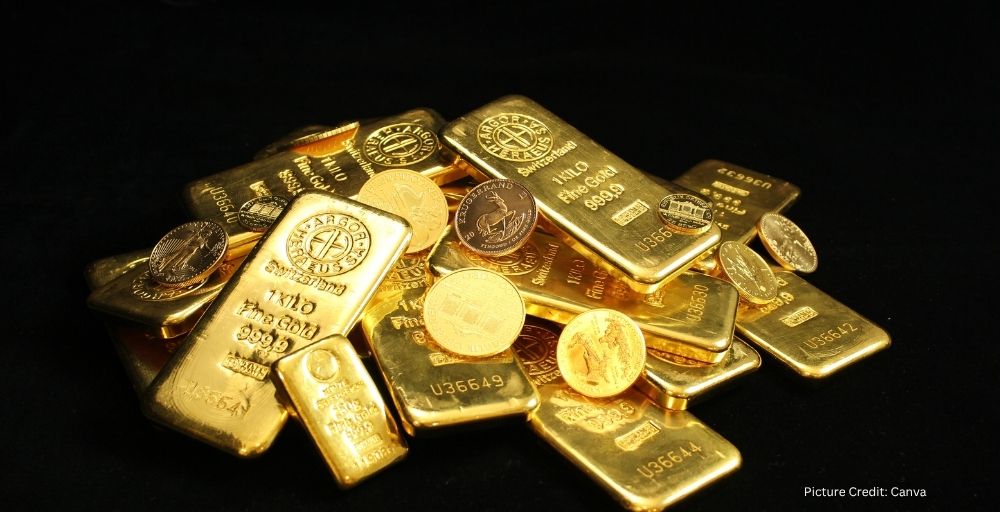
The global gold reserves landscape in 2026 is dominated by the United States, with China and India following as significant players, reflecting both economic strategy and financial stability.
As of May 5, 2026, the distribution of gold reserves among countries underscores the strategic role that gold plays in national financial frameworks. The United States retains its position as the country with the largest gold reserves, totaling 8,133.46 tonnes, significantly ahead of its nearest competitors, Italy and China. This landscape not only highlights economic stability but also reflects broader financial strategies employed by nations worldwide.
Current Gold Reserves by Country
According to data from the World Gold Council and World Atlas, the following are the top ten countries based on their gold reserves:
- United States: 8,133.46 tonnes
- Italy: 2,451.84 tonnes
- China: 2,313.46 tonnes
- India: 880.52 tonnes
- Japan: 845.97 tonnes
- Poland: 581.64 tonnes
- Turkey: 534.85 tonnes
- Uzbekistan: 415.54 tonnes
- Kazakhstan: 353.59 tonnes
- United Kingdom: 310.29 tonnes
United States: A Leader in Gold Reserves
The United States holds the most substantial amount of gold reserves globally, with over 8,000 tonnes secured in various locations, including Fort Knox and the New York Federal Reserve Bank. This large reserve is a critical element of the U.S. economy, providing a hedge against inflation and currency fluctuations. The substantial gold holdings also enhance the dollar’s status as the world’s primary reserve currency.
Italy’s Historical Accumulation
Italy ranks second, with 2,451.84 tonnes of gold reserves. Italy’s position is attributed more to historical accumulation than recent purchases, reflecting a strategic approach to maintaining fiscal integrity within the European Union. This reserve acts as a safeguard against economic instability, particularly given Italy’s high national debt levels.
China’s Growing Reserves
China’s gold reserves stand at 2,313.46 tonnes as of early 2026, showcasing the country’s commitment to increasing its gold holdings as a means to reduce dependence on the U.S. dollar. The People’s Bank of China has been actively acquiring gold, reflecting broader efforts to enhance the nation’s financial autonomy and stability against global market fluctuations. Analysts suggest this strategy is part of a larger geopolitical maneuver to assert China’s economic power.
India’s Cultural and Economic Significance
India, with 880.52 tonnes of gold reserves, emphasizes the cultural and economic importance of gold within its society. The Reserve Bank of India has progressively increased its gold reserves to diversify foreign exchange holdings. Gold’s traditional role in Indian culture, combined with a burgeoning economy, contributes to high domestic demand and significant imports of the precious metal. The interplay between cultural significance and economic necessity positions India as a key player in the global gold market.
Japan’s Strategic Gold Holdings
Japan, although known for its advanced financial systems, maintains 845.97 tonnes of gold reserves. These reserves serve primarily to instill confidence in the economic system, especially as Japan’s economy heavily relies on exports. The gold holdings act as a buffer during economic fluctuations and contribute to Japan’s overall financial stability. This strategic reserve is essential for maintaining investor trust, particularly in times of global uncertainty.
The Rise of Poland and Turkey
Poland and Turkey have emerged as notable players in gold reserves. Poland, with 581.64 tonnes, has rapidly increased its gold holdings in recent years, aiming for financial self-sufficiency and stability. The National Bank of Poland’s strategy involves acquiring gold to reduce reliance on foreign currency while strengthening its economic position within Europe.
Turkey, holding 534.85 tonnes of gold, utilizes its reserves flexibly to manage economic challenges such as inflation and currency volatility. The Central Bank of the Republic of Turkey employs gold as a stabilizing asset, highlighting the importance of gold within its economic policies. This approach reflects a broader trend among emerging economies to bolster their financial systems with tangible assets.
Central Asian Contributions: Uzbekistan and Kazakhstan
Uzbekistan possesses 415.54 tonnes of gold, a significant asset in relation to its economic strength. This country has leveraged domestic gold production to enhance its financial stability and export earnings. The strategic use of gold supports Uzbekistan’s economic sovereignty, as it seeks to establish itself as a competitive player in the global market.
Kazakhstan, with 353.59 tonnes of reserves, actively accumulates gold produced locally. This strategy bolsters the nation’s financial resilience and provides a buffer against external financial shocks, capitalizing on its robust mining sector. Kazakhstan’s approach to managing its gold reserves underscores the importance of natural resources in shaping national economic strategies.
The United Kingdom’s Historical Context
The United Kingdom rounds out the top ten with 310.29 tonnes of gold. Although this figure is comparatively lower than historical highs, the Bank of England retains a substantial portion of the country’s reserves. Despite a significant reduction in gold holdings in the early 2000s, the UK has maintained its reserves steady, with London remaining a global hub for gold trading. The city’s historical significance in the gold market continues to shape its financial identity.
In conclusion, the distribution of gold reserves among these countries reflects broader economic strategies and the role of gold as a financial safety net. As geopolitical tensions and economic challenges persist, the importance of gold in national financial strategies is likely to endure. The variations in gold holdings illustrate each nation’s approach to economic resilience, showcasing how this precious metal continues to play a pivotal role in global finance.