A 13-year-old student from Connecticut has been awarded the title of America’s Top Young Scientist for developing an innovative system aimed at combating ocean acidification, showcasing the potential of youth-led scientific endeavors.
ST. PAUL, Minn. — Raji Doshi, a 13-year-old eighth grader from Farmington, Connecticut, was named America’s Top Young Scientist on October 13, 2026, after winning the prestigious 3M Young Scientist Challenge. Her innovative project addresses the pressing environmental issue of ocean acidification, which poses a significant threat to marine ecosystems.
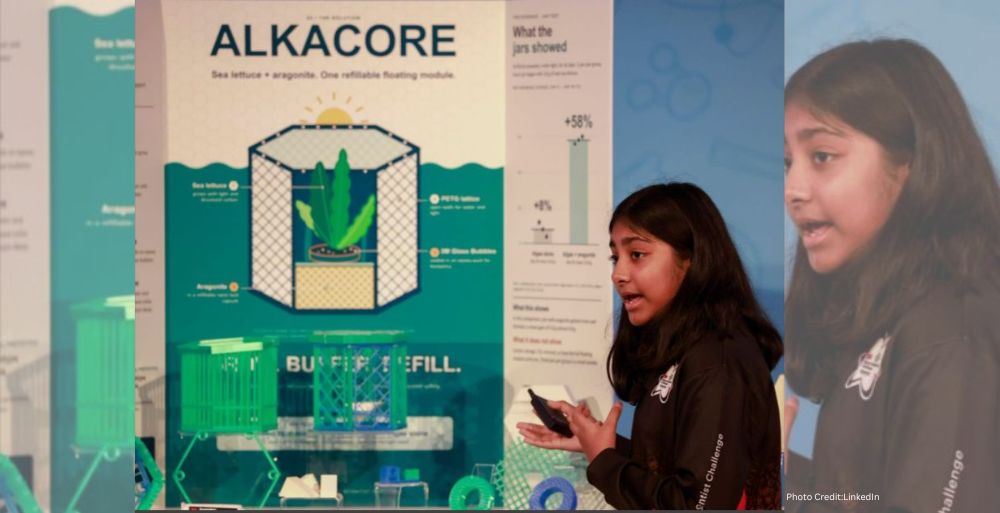
Doshi’s award-winning project, titled Engineering a Novel Durable Algae-Aragonite Alkalinity System to Reduce CO2-Driven Ocean Acidification, involves the development of a system utilizing natural materials, specifically algae and aragonite, to enhance seawater alkalinity and mitigate carbon dioxide levels in marine environments. For her achievement, she received a cash prize of $25,000.
The 3M Young Scientist Challenge
This year’s competition, held at 3M’s global headquarters in St. Paul, Minnesota, brought together ten finalists from across the United States for the final evaluation round on October 12 and 13. The event featured rigorous assessments of each contestant’s scientific knowledge, creativity, communication skills, and their ability to apply science, technology, engineering, and mathematics (STEM) to address real-world problems.
According to William Brown, chairman and CEO of 3M, “The 3M Young Scientist Challenge highlights the incredible potential of young people to tackle real-world challenges through science. The talent and creativity displayed by this year’s finalists was exceptional, and we congratulate Raji on earning the title of America’s Top Young Scientist.”
Understanding Ocean Acidification
Ocean acidification results from the absorption of excess atmospheric carbon dioxide into ocean waters, altering the chemical composition of seawater and reducing its alkalinity. This environmental challenge particularly affects marine organisms that rely on calcium carbonate to form their shells and skeletons, including shellfish and corals. As the ocean absorbs more carbon dioxide, the increased acidity can hinder these organisms’ ability to thrive, posing a threat to marine biodiversity and ecosystems crucial for human livelihoods and food security.
Through her research, Doshi demonstrated that aragonite, a naturally occurring form of calcium carbonate, could enhance algae growth while simultaneously reducing dissolved carbon dioxide levels in seawater. Her project also included the development of a computational model to identify the optimal quantity of aragonite needed to maximize the system’s effectiveness, which is critical for ensuring sustainability in marine environments.
Inspiration and Mentorship
Doshi’s passion for marine life, particularly her interest in collecting seashells, inspired her to tackle the challenge of ocean acidification. “Raji’s project reminds us that when you’re passionate about something, you can use that interest to change the world,” said Deborah Isabelle, a product engineering specialist at 3M, who mentored Doshi throughout the competition. “She loves collecting seashells and was distressed that ocean acidification is starting to damage the seashells and the creatures that live inside them.”
This personal connection to her project highlights an essential aspect of scientific inquiry: the importance of passion and personal investment in addressing global challenges. Doshi’s approach not only reflects her scientific aptitude but also her commitment to advocating for marine conservation.
Recognition of Young Scientists
In addition to Doshi, several other students of Indian origin were recognized in this year’s competition. Aaisha Asif from Sarasota, Florida, and Sharvi Mahajan from San Diego, California, secured second and third place, respectively, with both receiving $1,000 prizes. Other notable finalists included Ahmed Abdelsalam from Cambridge, Massachusetts; Aiden Jo from Houston, Texas; Roy Kim from Beaverton, Oregon; Arika Kundu from Shorewood, Minnesota; Millie Pradawong from Fairfax, Virginia; Naboshree Santra from Oviedo, Florida; and Abigail Stein from Nashville, Tennessee.
The diversity of talent among the finalists underscores the growing participation of young people in scientific research and innovation, particularly in addressing environmental issues. This year’s competition showcased not only the creativity of these young scientists but also their potential to contribute to meaningful solutions in a rapidly changing world.
Historical Context and Future Implications
Now in its 19th year, the 3M Young Scientist Challenge encourages middle school students to devise innovative scientific solutions to everyday problems. Previous winners of the competition have gone on to achieve significant accomplishments, including filing patents, founding nonprofit organizations, delivering TED Talks, and earning recognition on the Forbes 30 Under 30 list. This trend highlights the challenge’s role as a springboard for future innovators and leaders in science and technology.
The competition is part of the Young Scientist Lab educational initiative, a collaboration between 3M and Discovery Education that aims to provide free science and technology resources to students, educators, and families across the nation. This initiative underscores the importance of fostering scientific inquiry and innovation among young people, preparing them to address future challenges in science and technology.
As global environmental issues like climate change and pollution grow increasingly urgent, initiatives like the 3M Young Scientist Challenge play a crucial role in inspiring the next generation of scientists and innovators. By encouraging young people to engage with and develop solutions for real-world problems, these programs help cultivate a more informed and proactive citizenry, equipped to tackle the complex challenges of the future.