God Is the Most Intelligent Designer
Prof. Bellamkonda K. Kishore, M.D., Ph.D., MBA
DNA, which stands for deoxyribonucleic acid, is a household name. People know that each person’s DNA is unique, like fingerprints. That is true in general, as even siblings can be differentiated based on their DNA profiles. But what is less known or appreciated is that we can find the fingerprints of God in DNA.
The DNA molecule is basically a code, coding for about 7.8 million distinct animal species, including Homo sapiens, or present-day human beings. Yet, DNA uses an alphabet of only four chemical letters—A, T, G, and C (standing for the nucleobases adenine, thymine, guanine, and cytosine). With different combinations of just four letters arranged in a linear sequence, DNA contains the instructions required to build three-dimensional living organisms of breathtaking complexity. Comparatively, we have 26 letters in the English alphabet. Yet, there are only one million known words in English. That is the fundamental difference between the language of nature and the language invented by human beings. If one believes in a Creator, or a Master Designer, it is difficult not to marvel at the elegance of such a system.
A Shoebox That Could Hold the World’s Information
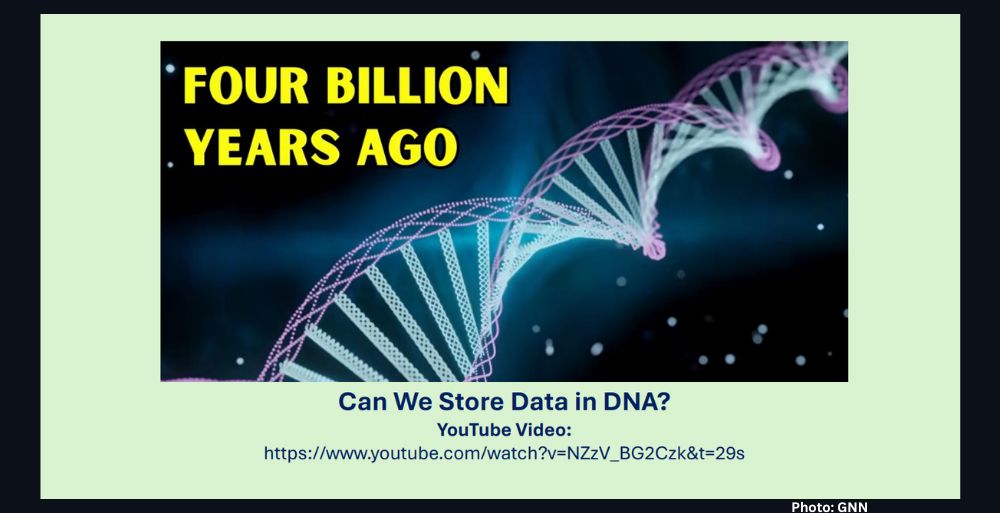
Perhaps the most astonishing property of DNA is its information density, or how much information it can hold in a small volume. Human civilization is generating information at an astonishing rate. We build ever-larger data centers, consume enormous amounts of electricity, and continually replace one generation of storage technology with another. Yet, nature has been using an extraordinarily compact information-storage system for billions of years in the form of DNA.
Digital information can be translated into DNA sequences and chemically synthesized into DNA molecules. Since the average size of DNA molecules is measured in nanometers (1 nanometer = 10⁻⁹ meter), a lot of information can be accommodated in a grain of sand. Thus, the storage capacity is enormous: quantities of DNA small enough to fit in a shoebox can potentially encode all the information in the world. None of the current digital storage devices or media can come anywhere close to that capacity. More importantly, unlike current data-storage devices and infrastructure, the costs involved in materials and maintenance are not there in storing data in the form of DNA. There is no need for continual replacement with new technologies. Physical transportation is also easy. These are all possible because DNA stores information at the molecular level.
Information That Can Survive Centuries
Density is only part of DNA’s remarkable story. None of today’s digital storage devices or media can beat DNA for its life expectancy or life cycle. They all become obsolete after some time. They need to be protected or stored under ideal conditions of ambient temperature, humidity, etc.
DNA, by contrast, can remain recoverable for extraordinarily long periods under appropriate conditions. Scientists have reconstructed genetic information from ancient biological remains thousands—and, in exceptional circumstances, vastly more—years old. Synthetic DNA stored under carefully controlled conditions therefore offers the possibility of extremely long-term archival storage. The irony is striking. Our supposedly advanced civilization continually invents new storage platforms, while nature has relied upon essentially the same molecular information system throughout the history of life—more than 3 billion years.
DNA Also Carries a Record of Our Past
DNA does something even more remarkable than storing the instructions necessary to make us who we are today. Our genome also contains evidence of our evolutionary history. Comparative genomics reveals relationships among species through shared genes, conserved sequences, mutations, and remnants inherited from distant ancestors.
Development likewise reflects deeply conserved biological programs. The developing human kidney, for example, proceeds through the pronephric, mesonephric, and metanephric stages, which are structurally similar to the kidneys of lower animals in evolutionary biology, such as fish, amphibians, or birds. These developmental programs reflect the deep evolutionary history of vertebrate organ development. We do not literally become fish, amphibians, or birds during development, but biology has retained the memory of ancient developmental machinery while modifying it over evolutionary time. Thus, our past has not simply disappeared. Parts of its history remain written within us.
One Platform Across the History of Life
Human information technologies are remarkably transient. Punch cards gave way to magnetic tapes. Floppy disks gave way to optical disks. Hard drives were joined by solid-state storage and cloud computing. Formats become obsolete within decades, sometimes within years.
Nature did something very different. From the simplest organisms to human beings, the fundamental information platform remained one molecule: DNA. Evolution did not repeatedly discard the platform and invent another one. It changed the information encoded on the platform without changing the code itself. That distinction is profound.
Nature developed an information architecture capable of enormous expansion and diversification without abandoning its fundamental language or platform.
Are We Looking for God in the Wrong Places?
For believers, perhaps this raises a larger philosophical question. Human beings have spent millennia constructing temples, churches, mosques, scriptures, rituals, and elaborate pathways through which we seek God. Yet, one of the most extraordinary phenomena associated with life, or God’s creation, has been sitting right inside virtually every cell of our bodies all along. We are not aware of that.
A four-letter molecular language carries biological information across generations, preserves traces of life’s evolutionary history, and possesses an information density that modern engineers are now attempting to imitate for future data-storage systems.
Science can increasingly explain how DNA works. Whether its extraordinary properties signify anything beyond biology is not a scientific question; it is a philosophical and theological one.
Francis Collins, M.D., the physician-geneticist who led the Human Genome Project and later directed the National Institutes of Health, explored this intersection of science and faith in his book The Language of God. For Dr. Collins, decoding the human genome did not diminish his belief in God; rather, the extraordinary information written in DNA provided a profound source of wonder and was entirely compatible with his belief in a Creator.
Dr. Collins called DNA the “Language of God.” I would take that beautiful metaphor one step further. If DNA is the language, then perhaps the extraordinary elegance, universality, durability, and evolutionary history embedded within that language can be viewed as The Fingerprints of its Author. For me, therefore, the conclusion is deeply personal:
The fingerprints of God are more prominent in the DNA He created than in any book we have written or any place of worship we have built.