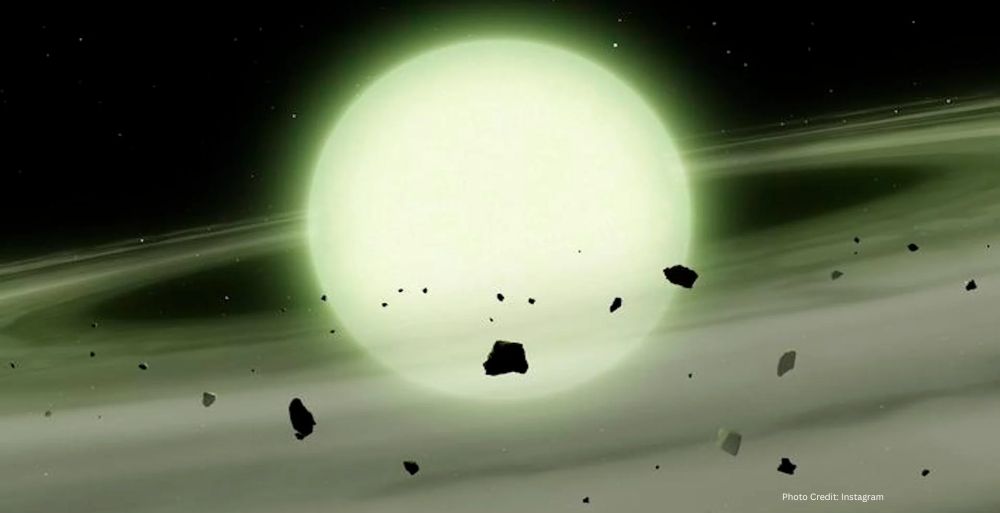
Astronomers have identified a previously undocumented green star, a white dwarf known as WD J1330+6435, located approximately 280 light-years from Earth in the constellation Draco, which exhibits a unique ghostly green hue due to its atmospheric composition.
WASHINGTON, Oct 16 (Reuters) – For the first time, astronomers have documented a green star, specifically a dense stellar remnant known as a white dwarf, which has taken on a ghostly shade of chartreuse following the ingestion of rocky debris from its planetary system. This discovery, published in the journal RAS Techniques and Instruments, marks a significant milestone in our understanding of stellar evolution and color classification.
The star, designated WD J1330+6435, is situated approximately 280 light-years away from Earth in the constellation Draco. A light-year is defined as the distance that light travels in one year, equivalent to about 5.9 trillion miles (9.5 trillion kilometers). Traditionally, a star’s color is determined by its temperature, with cooler stars appearing orange, medium-temperature stars like the sun appearing white, and the hottest stars exhibiting a pale blue hue. However, white dwarfs, which are the remnants of low to medium mass stars, can display a variety of colors based on their chemical composition and atmospheric conditions.
Understanding the Green Star’s Composition
White dwarfs are formed when stars exhaust their nuclear fuel and expel their outer layers, leaving behind a dense core. The color of a white dwarf is typically white; however, variations in their chemistry over time can lead to the emergence of rare colors. In the case of WD J1330+6435, the star’s unique green color results from its high atmospheric density, which allows sodium to absorb a broader spectrum of light. Astrophysicist Mark Hollands of the University of Warwick, the lead author of the study, explained, “We first became interested in this white dwarf because bits of planetary material have fallen onto its surface, enriching its outer layers in elements including calcium, lithium, and, in particular, sodium.”
Typically, sodium absorbs a specific wavelength of orange light, as seen in street lamps. However, the extreme density of WD J1330+6435 alters the atomic energy levels of sodium due to constant bombardment by surrounding helium atoms. Hollands elaborated, “The end result is that the sodium atoms no longer absorb one very narrow wavelength of orange — they absorb the yellows, oranges, and some of the red wavelengths. And what you’re left with is a star that has a beautiful chartreuse green glow, something that wouldn’t be possible for sun-like stars.”
The Project and Broader Implications
This discovery is part of a larger project assessing the colors of white dwarfs as they would be perceived by the human eye. White dwarfs are typically about half the mass of the sun but are condensed into a volume similar to that of Earth. Boris Gänsicke, a co-author of the study, noted, “Because white dwarfs are super-dense stars — they are roughly the size of the Earth, but contain about 165,000 times its mass — even a small amount of sodium blocks out a large amount of the orange light coming out of the star.”
Researchers analyzed 151 white dwarfs located within approximately 65 light-years of Earth, with white being the average observed color. Among their findings was another notable star, WD J1011+2845, which displayed a salmon pink hue, attributed not to sodium, but to carbon emerging from the star’s deeper interior. Gänsicke explained, “Rather than something hitting the star, in this case, the carbon comes out from its deep interior.” This analysis revealed that the colors of white dwarfs can be categorized based on their atmospheric compositions, with carbon-rich white dwarfs typically appearing pink or purple, and those enriched with debris from planetary systems leaning toward yellow.
Conclusion and Cultural Significance
While WD J1330+6435 is the first documented instance of a green star identified in reality, the concept of green stars has been a staple of science fiction, including recent portrayals in popular media. Hollands remarked, “It does show that the universe is sometimes just as weird as anything science fiction can conjure up.” The discovery not only expands the catalog of stellar phenomena but also poses intriguing questions regarding the evolution of stars and the composition of planetary systems. As astronomers continue to explore the cosmos, the identification of unique celestial objects like WD J1330+6435 paves the way for new insights into the nature of the universe and its myriad forms.