Indian security forces initiated a massive police operation across New Delhi on Saturday, deploying anti-riot units, establishing road checkpoints, and detaining thousands of demonstrators to preemptively dismantle a nationwide protest organized by the youth-led “Cockroach” movement. The planned rally at Jantar Mantar targeted the Election Commission of India’s Special Intensive Revision of voter rolls, an administrative initiative that opposition leaders and student activists allege has disenfranchised over 130 million citizens. Coming just months after the movement forced the resignation of Prime Minister Narendra Modi’s education minister over standardized exam leaks, the sweeping security response highlights escalating political friction over election integrity, civil liberties, and youth activism ahead of key 2027 state elections.
NEW DELHI — Indian authorities executed an extraordinary security operation across the National Capital Territory of New Delhi on Saturday, detaining thousands of demonstrators and preemptively disabling the leadership of the youth-led “Cockroach” movement. The coordinated crackdown was mounted to prevent a massive planned protest against the Election Commission of India’s ongoing Special Intensive Revision (SIR) of voter rolls—a contentious administrative process that critics allege has systematically purged tens of millions of eligible voters from electoral registries.
Beginning in the early hours of Saturday morning, Delhi Police and paramilitary units established heavy multi-layered barricades along major arterial highways leading into the capital, intercepting commercial buses, passenger vehicles, and commuter trains. At Jantar Mantar, the designated public assembly ground in central Delhi, authorities enforced Section 144 of the Code of Criminal Procedure, prohibiting gatherings of five or more individuals. Anti-riot vehicles equipped with tear gas launchers and water cannons lined the perimeter, while localized mobile internet shutdowns and transit diversions effectively isolated key sectors of the capital.
The heavy-handed operational response targeted the core leadership of the “Cockroach” movement before organizers could reach the assembly site. Key organizers, including Abhijeet Dipke, Saurav Das, and Ashutosh Ranka, were intercepted by law enforcement officers immediately upon landing at Indira Gandhi International Airport following a flight from Mumbai. Video footage released by the movement’s political wing, the Cockroach Janta Party, showed uniformed police personnel boarding the commercial aircraft on the tarmac to take the three leaders into custody.
“The pre-planned interception by Delhi Police aims to cripple the leadership of today’s peaceful demonstrations before they even reach the protest site,” the movement stated in an official press release issued shortly after the arrests.
Escalating Tensions Over the Special Intensive Revision
At the core of the nationwide unrest is the Election Commission of India’s Special Intensive Revision, a nationwide administrative overhaul of voter registries initiated earlier this year. According to official disclosures, the program has resulted in the deletion of more than 130 million names from master electoral lists across multiple states.
The Election Commission and Prime Minister Narendra Modi’s ruling Bharatiya Janata Party (BJP) maintain that the revision is a standard, non-partisan administrative procedure necessary to eliminate duplicate entries, update residential relocations, and purge deceased individuals from official records. However, opposition parties—led by the Indian National Congress—and youth activists argue that the process disproportionately targets marginalized communities, rural laborers, minority populations, and demographic groups historically aligned against the ruling party.
Protesters are demanding the immediate suspension of the revision process and the resignation of Chief Election Commissioner Gyanesh Kumar. The dispute has unified previously fragmented opposition blocs, with high-profile leaders such as Congress leader Rahul Gandhi joining recent street demonstrations. Gandhi was briefly taken into police custody during a parallel march in New Delhi earlier in the week after accusing election authorities of facilitating systemic voter suppression to benefit the BJP’s electoral prospects.
Appearing at a press briefing in New Delhi on Saturday afternoon, BJP national spokesperson Sambit Patra rejected the allegations of voter manipulation and strongly defended the security measures taken by the police.
“Their flop show has been completely demolished,” Patra declared, characterizing the organizers as “anarchic elements” attempting to undermine constitutional institutions. “The Election Commission is an independent, autonomous body performing its statutory duty to ensure clean, transparent voter rolls. These protests are nothing more than a politically motivated attempt to create disorder.”
The Rise of the “Cockroach” Movement and Opposition Resentment
The “Cockroach” movement emerged in May 2026 as a decentralized online network of university students and young professionals protesting systemic paper leaks and scoring irregularities in the National Eligibility cum Entrance Test (NEET-UG) and other public service competitive examinations. Borrowing its name as a satirical badge of resilience—symbolizing an inability to be crushed by state power—the group quickly demonstrated an ability to organize sustained offline demonstrations, hunger strikes, and civil disobedience campaigns.
The movement achieved a major political victory in July 2026, when weeks of persistent student occupations in the capital forced the resignation of Union Education Minister Dharmendra Pradhan. That concession marked a rare political setback for Prime Minister Modi, who has maintained an authoritative hold on national governance since taking office in 2014. By pivoting from education reform to electoral integrity, the youth movement has broadened its mandate, transforming into a formidable political force capable of challenging the government midway through Modi’s third term.
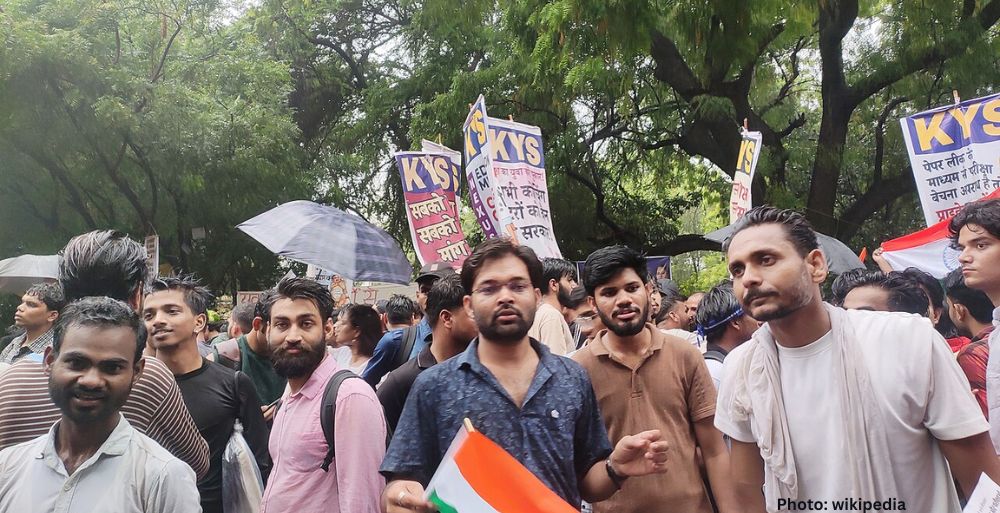
Despite the heavy police presence and transit blockades on Saturday, small pockets of demonstrators managed to breach security perimeters around central New Delhi. Holding banners and chanting slogans against Modi and the Election Commission, small groups attempted to march toward Jantar Mantar before being dragged away by police and loaded into waiting transport vehicles bound for temporary detention centers on the city’s outskirts.
“We are a democracy, yet peaceful protests are being crushed by force. Shouldn’t we fight for our rights?” asked Tanya Negi, a 21-year-old college student who traveled over 800 miles from Mumbai with two classmates to join the demonstration. “Why is Modi afraid of India’s young people?”
The scale of the suppression drew sharp condemnation from opposition lawmakers, several of whom were detained alongside student activists while attempting to reach the protest site.
“Is there a democracy in this country? A total siege over the city. Citizens are being driven out,” stated John Brittas, a Member of Parliament representing the Communist Party of India (Marxist), shortly before he was escorted into a police van by uniformed officers.
Political Implications for Upcoming State Elections
While national parliamentary elections are not scheduled until 2029, the intensifying confrontation between the government and the youth movement carries immediate stakes for upcoming state assembly elections in 2027. Crucial electoral contests in Uttar Pradesh—India’s most populous state with over 240 million residents—and Gujarat, Prime Minister Modi’s political home base, will serve as critical referendums on the administration’s economic and administrative record.
Political analysts note that the government’s aggressive security response reflects growing sensitivity to youth discontent, particularly regarding high youth unemployment rates, civil service exam failures, and perceived erosion of democratic norms. As opposition parties increasingly align with the “Cockroach” movement, the battle over voter registration lists is set to remain a central flashpoint in Indian politics, testing the limits of public dissent and state power in the world’s most populous nation.