

Driving Innovation, Healing a Nation, and Shaping Educational Excellence
Introduction
J D Vance, the Vice President of the United States, on October 8th, 2026, while referring to foreign workers hired on H1-B visas as “foreign indentured servants.” And, rightly so, this insensitive remarks have drawn criticism from around the world, especially from the Indian American community and from the Government of India, who stated, “resorting to terminology that carries painful historical and colonial legacy connotations is deeply offensive”.
Delhi’s response came hours after the US administration suspended some of the largest IT outsourcing firms in the world from the Permanent Labor Certification Program. The PERM is a key provision used by American employers to sponsor foreign workers for Green Card.
The US administration has arbitrarily suspended eight IT firms, including Microsoft, Tata Consultancy Services, Infosys and Wipro, from PERM to apply for Green Cards for foreign workers.
In his remarks, perhaps, the Vice President of the US has minimized and ignored the significant contributions and accomplishments of the flourishing Indian Americans across the nation.
Representing just over one percent of the U.S. population, Indian Americans have emerged as one of the most influential communities in the nation’s economic and intellectual life. Their impact extends across technology, healthcare, higher education, entrepreneurship, and scientific research. Through leadership in major corporations, innovation in startup ecosystems, service in medical institutions, and contributions to universities and research centers, Indian Americans have become a critical pillar of American competitiveness. This article examines the statistical and economic significance of Indian Americans and highlights their contributions to the sectors that increasingly define the future of the United States.
The Beginning
The rise of the Indian American community is among the most remarkable success stories in modern American history. Since the passage of the Immigration and Nationality Act of 1965, skilled immigrants from India have contributed significantly to the nation’s technological prowess, healthcare infrastructure, innovation ecosystem, and academic excellence. Today, approximately 4.8 to 5.2 million Americans trace their roots to India, making them one of the largest and fastest-growing immigrant-origin populations in the United States.
Their achievements are reflected not only in personal success but also in measurable economic impact. A study by Indiaspora and Boston Consulting Group estimates that Indian Americans contribute approximately $250 billion to $300 billion annually in federal, state, and local taxes while helping support an estimated 11 to 12 million American jobs.
As noted by Satya Nadella, Chairman and CEO of Microsoft: “America’s strength has always come from its ability to attract talent from around the world and empower people to innovate.” Few communities exemplify this principle more effectively than Indian Americans.
Technology: Powering America’s Innovation Economy
No discussion of Indian American contributions would be complete without recognizing their extraordinary role in technology.
Indian-born entrepreneurs have founded approximately 15.5 percent of Silicon Valley technology firms, underscoring their central place in America’s innovation ecosystem. Furthermore, Indian professionals utilizing the legal work – Visa pathway, provide critical talent to sectors ranging from artificial intelligence and cloud computing to cybersecurity and semiconductor development.
Indian Americans currently lead some of the world’s most influential technology companies, including:
- Sundar Pichai, CEO of Google and Alphabet
- Satya Nadella, Chairman and CEO of Microsoft
- Arvind Krishna, Chairman and CEO of IBM
- Shantanu Narayen, Chairman and CEO of Adobe
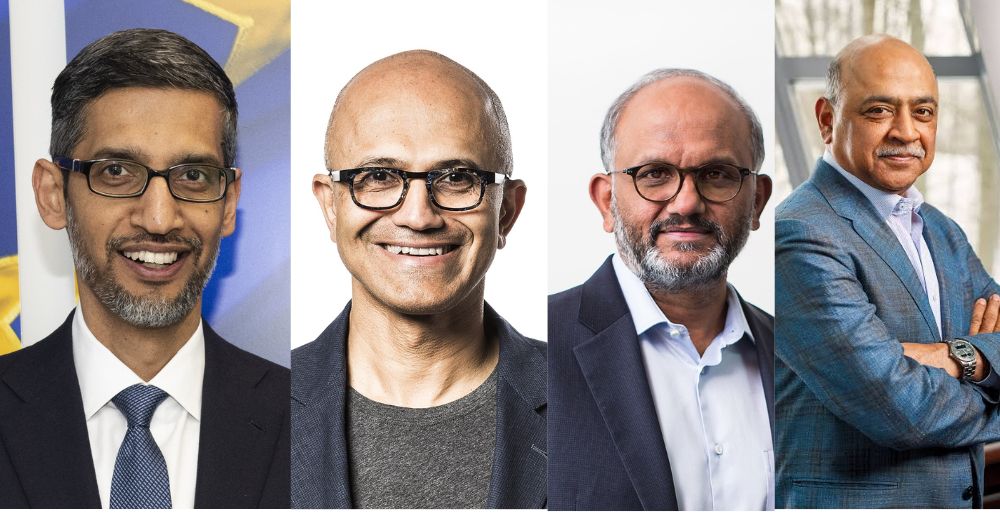
Their leadership demonstrates how immigrant talent has helped maintain America’s global technological dominance.
The entrepreneurial impact is equally striking. A 2026 report from the National Foundation for American Policy found that Indian-born entrepreneurs founded or co-founded 96 U.S. unicorn companies, more than immigrants from any other nation. These firms collectively contribute billions of dollars in market value and create thousands of high-paying jobs.
Notable founders include:
- Aravind Srinivas of Perplexity AI
- Mohit Aron of Cohesity and Nutanix
- Jyoti Bansal of AppDynamics and Harness
- Arvind Jain of Rubrik and Glean [nripulse.com], [indiawest.com]
As venture capitalist Vinod Khosla once observed: “Innovation is not constrained by geography or ethnicity. It is driven by opportunity, education, and ambition.” The Indian American experience vividly validates this observation.
Medicine: Healing America
Perhaps nowhere is the contribution of Indian Americans more visible than in healthcare.

According to industry analyses, approximately one in every twenty physicians practicing in the United States is of Indian origin. More than 120,000 Indian-born physicians and Fellows serve patients across the nation, accounting for a sizable number of the country’s immigrant physician workforce.
Indian-origin physicians are represented throughout the healthcare system, including:
- Internal Medicine
- Cardiology
- Oncology
- Psychiatry
- Pediatrics
- Family Medicine
- Academic Medicine and Research [advancestudy.org], [medboundtimes.com]
Their significance extends beyond numbers. Many Indian doctors practice in rural and underserved communities where physician shortages are most acute. They occupy key positions in hospitals, medical schools, and research institutions throughout the country.
The influence of organizations such as the American Association of Physicians of Indian Origin (AAPI) has further strengthened professional collaboration and healthcare service delivery.
As the COVID-19 pandemic demonstrated, healthcare resilience depends heavily upon immigrant medical professionals. Indian American physicians stood prominently on the front lines of the nation’s response, reflecting a longstanding tradition of service and public commitment.
Education and Research: Building America’s Intellectual Capital
Education remains the foundation of Indian American achievement.
Nearly 75 percent of Indian American adults possess at least a bachelor’s degree, making them among the most highly educated demographic groups in the United States. A substantial proportion also hold professional, doctoral, and advanced research degrees.
The educational pipeline continues to grow. During the 2023-24 academic year, India became the largest source of international students in the United States, with more than 330,000 students enrolled at American colleges and universities.
Tuition payments that support university operations
- Graduate research programs
- STEM education
- Scientific innovation
- Development of future entrepreneurs and faculty members [nripulse.com],
Indian Americans are also heavily represented among university professors, researchers, engineers, and scientists. Their contributions have helped advance fields including artificial intelligence, medicine, biotechnology, computer science, public health, and space exploration.
Former Google CEO Eric Schmidt once remarked: “Talent is the ultimate renewable resource.” The educational accomplishments of Indian Americans demonstrate the economic returns that accompany sustained investment in human capital.
Entrepreneurship Beyond Technology
Indian American entrepreneurial success extends well beyond Silicon Valley.
One of the most cited examples is the hospitality industry, where Indian Americans own more than half of all motels in the United States. This achievement, often described as the “Patel Motel” phenomenon, illustrates how immigrant entrepreneurship has revitalized local economies and generated employment opportunities across the country.
Indian-owned businesses are also prominent in retail, healthcare services, finance, consulting, manufacturing, and transportation. Their success contributes to local tax bases, community development, and job creation nationwide. [iaimpact.org], [theprint.in]
Conclusion
The Indian American community represents a powerful example of how immigration, education, and opportunity can transform both individual lives and national economies.

Although they constitute only a small fraction of the U.S. population, Indian Americans contribute hundreds of billions of dollars in taxes, support millions of jobs, lead globally significant corporations, found billion-dollar startups, strengthen the nation’s healthcare workforce, and enrich its educational institutions. [theprint.in], [nripulse.com],
Their story is not simply one of immigrant success. It is a story of America’s continued capacity to attract talent, reward innovation, and benefit from diversity.
As the United States confronts the challenges of the 21st century, from artificial intelligence and healthcare delivery to scientific discovery and global competition, Indian Americans will remain among the nation’s most valuable contributors and partners in progress.
“The Indian American story is, in many ways, the American story itself: a belief that knowledge, hard work, and opportunity can create lasting prosperity for future generations.”