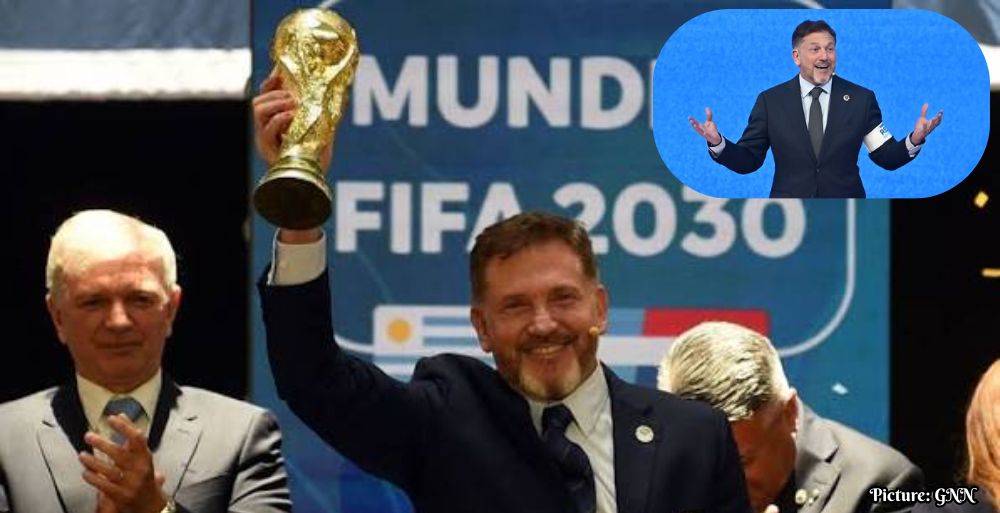
CONMEBOL President Alejandro Domínguez announced via social media that the 2030 FIFA World Cup will feature a 64-team format, celebrating the tournament’s centenary in Uruguay, Argentina, and Paraguay.
The president of the South American Football Confederation (CONMEBOL), Alejandro Domínguez, unveiled a proposal on July 21, 2026, suggesting that the upcoming 2030 FIFA World Cup will adopt a 64-team format. This announcement was made through a post on the social media platform X, coinciding with the centennial celebrations of the first World Cup, which took place in Uruguay in 1930.
In his statement, Domínguez expressed enthusiasm for the potential expansion, stating, “In 2030, the World Cup comes to Uruguay, Argentina and Paraguay, a great opportunity for football, to celebrate the World Cup Centenary with a 64-team tournament.” This vision aligns with ongoing discussions regarding the future structure of the World Cup, although it is crucial to note that FIFA has not yet officially confirmed this proposed change.
Host Nations and Historical Significance
The 2030 World Cup is set to be co-hosted by Spain, Morocco, and Portugal, but will also commemorate its origins with three centenary matches played in Uruguay, Argentina, and Paraguay. This decision highlights the historical importance of the tournament, marking a century since its inception. The centenary matches symbolize a return to the roots of the World Cup, emphasizing the tournament’s rich legacy and global impact.
FIFA President Gianni Infantino previously indicated on July 12, 2026, that discussions would take place regarding the expansion to a 64-team format after the conclusion of the 2026 tournament, which was won by Spain and marked the first occasion that 48 teams participated in the event. During an interview with Swiss broadcaster Blue Sport, Infantino noted, “When you organize a World Cup, it’s important that you organize it for the whole world. It’s not just Europe and South America, but the entire world, effectively. Every nation should be able to dream of taking part in the World Cup.”
This commitment to inclusivity underscores FIFA’s aim to promote football development on a global scale, ensuring that smaller nations have the opportunity to compete on the world stage.
Implications of a 64-Team Format
If implemented, the 64-team format would significantly increase the number of matches played during the tournament. Under the current 32-team format, which was utilized from 1998 to 2022, a total of 64 matches were held. The 2026 World Cup, featuring 48 teams, expanded this figure to 104 matches. The proposed 64-team format for the 2030 tournament would double the match count to 128, representing a considerable logistical challenge for FIFA and the host nations.
Critics of expanding the tournament often argue that increasing the number of teams could dilute the quality of the competition. However, FIFA’s rationale for broadening participation aims to enhance the sport’s global reach and inclusivity, allowing more nations to experience the prestige of the World Cup.
Contextualizing FIFA’s Expansive Vision
Historically, the World Cup has undergone various changes in its structure and format, reflecting the evolving nature of international football. The inaugural tournament in 1930 featured just 13 teams, while the 1998 tournament first expanded to 32 teams, a format that remained in place for over two decades. With the increasing competitiveness among nations, FIFA’s interest in expanding the tournament further aligns with the growing quality of football across various regions, particularly in Africa and Asia.
Infantino’s emphasis on the need for inclusivity is underscored by recent developments in international football, where nations traditionally considered underdogs have made significant strides. Allowing smaller countries to participate in the World Cup not only provides them with invaluable experience but also serves as an inspiration for future generations of athletes.
Looking Ahead to 2030
As anticipation builds toward the 2030 tournament, discussions surrounding its structure and format will likely continue to evolve. The prospect of a 64-team World Cup not only reflects FIFA’s desire to enhance global participation but also represents a shift in how football is perceived and celebrated worldwide. The increased match count and expanded participation could reshape the tournament experience for fans and players alike, offering a broader array of exciting matchups and narratives.
The 2030 World Cup represents more than just a sporting event; it is a celebration of football’s history and its potential to unite nations. As the host countries prepare for this landmark occasion, the implications of a 64-team format will be closely scrutinized, and the decisions made during the lead-up to the tournament will undoubtedly influence the future of international football.