Protests led by the youth-driven Cockroach Janta Party continue to challenge the Indian government, demanding education reforms and the resignation of Education Minister Dharmendra Pradhan, amidst escalating tensions and police intervention.
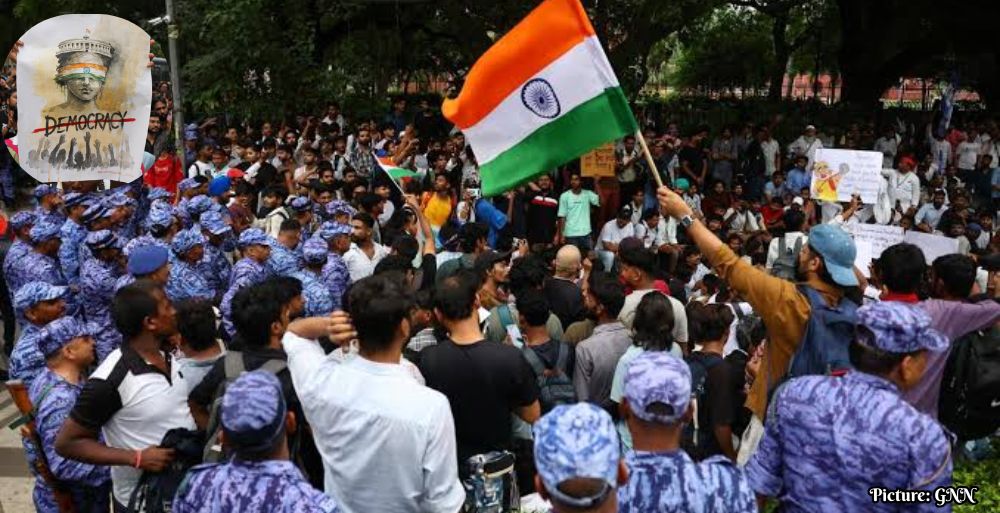
NEW DELHI – The Indian government, led by Prime Minister Narendra Modi, is facing increasing pressure as protests organized by the Cockroach Janta Party (CJP) have continued to attract thousands of participants in the capital, Delhi, despite adverse weather conditions. The movement, which advocates for significant reforms in the education sector, has gained momentum following a violent confrontation between police and protesters on Monday, which resulted in numerous injuries on both sides.
Thousands of demonstrators gathered at Jantar Mantar, a historical protest site, to voice their demands for educational reforms and the resignation of Education Minister Dharmendra Pradhan. The protests intensified on Tuesday as leaders from India’s main opposition party, the Congress, joined the demonstrators, staging a protest outside Modi’s residence. This gathering was a direct response to a police crackdown during the CJP’s march to parliament, which coincided with the commencement of the monsoon session.
Clashes and Political Fallout
On Monday, police employed batons and tear gas to disperse tens of thousands of protesters who had marched to central Delhi. Reports indicate that at least 60 individuals, including both protesters and police personnel, sustained injuries during the clashes. The police also dismantled the protest stage and makeshift tents at Jantar Mantar, but the demonstrators have been resolute in their resolve, maintaining a continuous sit-in, emphasizing their determination to remain until their demands are addressed.
In the aftermath of the violence, prominent opposition leaders, including former Delhi Chief Minister Arvind Kejriwal and veteran politician Sharad Pawar, visited the protest site to express solidarity with the demonstrators. On Tuesday, Congress President Mallikarjun Kharge and Rahul Gandhi led a surprise march to Modi’s residence, calling for the resignations of Pradhan, Home Minister Amit Shah, and Prime Minister Modi himself.
Gandhi criticized the government’s actions, asserting that it must apologize to students for the police’s aggressive response. He claimed that the Congress party sought to raise these issues in parliament but was met with resistance from the Speaker, who indicated that government permission was required for such discussions. Gandhi’s statements reflect a broader discontent among opposition leaders regarding the government’s handling of the situation.
Government’s Response
In response to the allegations made by Gandhi, Federal Minister Jitendra Singh stated that the government was open to discussion but accused Gandhi of shifting the focus and continuing the protests despite assurances of dialogue. Singh’s remarks highlight the ongoing tensions between the ruling party and the opposition, as both sides accuse each other of political maneuvering.
Education Minister Dharmendra Pradhan, addressing the protests for the first time since the violent events, criticized the Congress party for allegedly exploiting students for political gain. He emphasized that the government is committed to delivering necessary reforms and accountability in education, maintaining that the focus should be on solutions rather than political theatrics.
Origins of the CJP Movement
The CJP movement is rooted in a satirical response to earlier comments by India’s Chief Justice, who referred to unemployed youth as ‘cockroaches.’ This remark ignited widespread outrage and was interpreted as a critique of young individuals pursuing careers in journalism and activism. Since its inception, the CJP has transformed from a satirical commentary into a significant movement, capable of mobilizing tens of thousands of participants in public demonstrations.
The movement gained traction in recent weeks, notably after activist and educationist Sonam Wangchuk joined the protesters and began an indefinite hunger strike on June 28 to support their demands. Wangchuk’s presence has drawn international attention to the cause; however, he was forcibly removed from the protest site by police and taken to a hospital, where he continues his hunger strike.
Support for the CJP has expanded beyond Delhi in recent days, with protests reported in major cities such as Mumbai, Hyderabad, Bengaluru, and Ahmedabad. These demonstrations reflect a growing sense of public dissent against the Modi government, particularly concerning issues of education and youth employment. The CJP’s ability to attract substantial crowds underscores the discontent among young people, many of whom feel that the current educational framework does not adequately prepare them for the job market.
Implications for Governance and Future Protests
The ongoing protests signify a crucial moment for the Modi administration, which has faced criticism over its handling of various social and economic issues. Education has become a focal point of public frustration, as many young Indians struggle with unemployment and a lack of opportunities. The CJP’s demands for reform touch upon broader systemic issues, including curriculum updates, job placements, and the need for increased governmental accountability in education.
As the protests continue, it is likely that the government will be under increasing pressure to engage with the demonstrators and address their concerns. With opposition parties rallying around the movement, the political landscape in India could see significant shifts in response to these calls for reform. The situation remains fluid, and the government’s next steps will likely be closely scrutinized by both supporters and detractors alike.
In conclusion, the Cockroach Janta Party’s protests represent not only a challenge to the Modi government’s policies but also a broader demand for change within India’s educational system. As activists and opposition leaders mobilize support, the movement may catalyze a larger conversation about the future of education and employment for India’s youth.