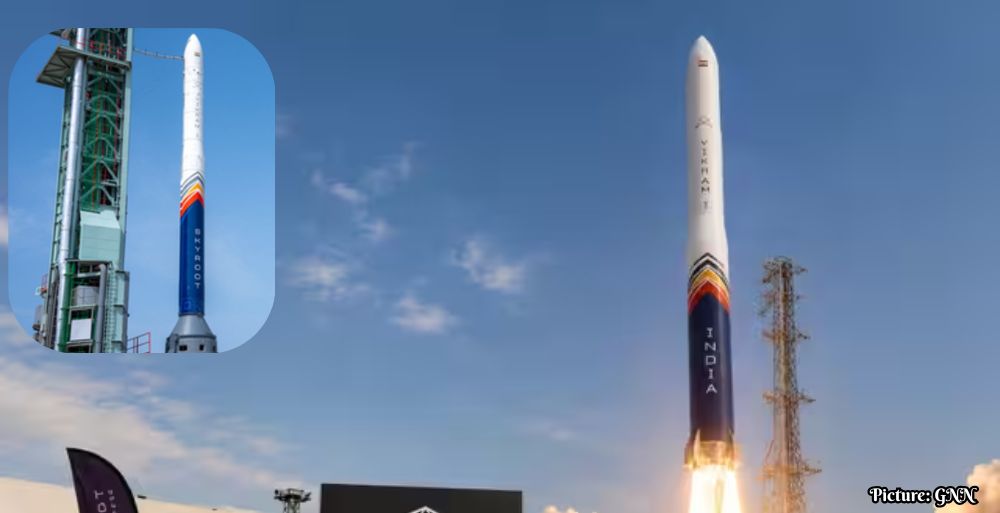
Skyroot Aerospace has successfully completed a test launch of its low-orbit rocket, positioning India among the elite nations capable of private orbital launches, and setting the stage for commercial operations in 2027.
On Saturday, Indian space-tech startup Skyroot Aerospace achieved a significant milestone by successfully test-launching a low-orbit rocket that carried a payload of 350 kilograms. This accomplishment marks India’s first entry into the private orbital launch market, traditionally dominated by American and Chinese companies. The launch occurred at 11:30 a.m. Indian Standard Time and was conducted from the Satish Dhawan Space Centre in Sriharikota, Andhra Pradesh.
Naga Bharath Daka, co-founder of Skyroot, expressed optimism about the future of the company, stating that it plans to commence commercial operations in 2027 with an ambitious goal of one launch per month. Daka mentioned that after one additional test flight scheduled for later this year, the company will transition to commercialized launches. “We will be the most cost-competitive launch vehicle in this space [small payload], even before the economies of scale come into play,” he stated in an interview with CNBC.
Background and Context
The demand for satellite launches has been steadily increasing worldwide, driven by the limited number of companies capable of delivering payloads into space. With only a handful of players in the market, competition is expected to intensify. Skyroot aims to carve out a niche in the sub-1,000 kg launch market, competing against established U.S. startups such as Rocket Lab, Firefly Aerospace, and Astra Space, as well as Chinese private firms including i-Space and Galactic Energy, according to data from market intelligence firm Analysys Mason.
Small launch vehicles like Skyroot’s are increasingly important as they address specific operational, strategic, and financial challenges that larger payload carriers face. Ujjwal Chaudhry, a partner at Analysys Mason, described small rockets as “orbit-on-demand taxis,” emphasizing their ability to deliver a single customer’s payload directly to its intended location in space. This capability allows for dedicated launch windows, eliminating the need for smaller satellites to wait for ridesharing opportunities with larger launches.
Cost Competitiveness and Market Position
India’s space sector has garnered a reputation for cost efficiency, exemplified by the Indian Space Research Organisation (ISRO) successfully executing missions to Mars and the Moon at significantly lower costs than many Western counterparts. Daka, along with co-founder Pawan Kumar Chandana, both former ISRO employees, are now leveraging this legacy in their venture. Daka noted the importance of a measured approach to funding, stating, “We had to be ultra cautious with money, and the focus was on getting the first time right.”
The market for small satellite launches is currently valued at approximately $5 billion, with the potential for growth as demand increases. Notably, California-based Rocket Lab reported that its order backlog has more than doubled over the past year, reaching $2.2 billion, with launches scheduled through 2029. In contrast, Skyroot’s valuation currently stands at $1.1 billion following a $60 million fundraising round in May 2023.
Investment Challenges and Future Prospects
While U.S. space tech startups benefit from a robust private funding ecosystem, Indian firms like Skyroot face challenges in securing investment. Natasha Malpani Oswal, founder and general partner at venture capital firm Boundless Ventures, remarked on the limited availability of patient capital for space tech in India. However, she noted that investments from sovereign wealth funds and institutional investors such as BlackRock and GIC signal a growing interest in the Indian space sector.
Daka indicated that Skyroot is well-funded to execute its upcoming commercial launches but acknowledged the need for further fundraising to develop a reusable rocket. This strategic move could enhance the company’s competitive edge, particularly if its cost structure allows for high profit margins.
Implications for the Indian Space Sector
Skyroot’s successful launch not only represents a pivotal moment for the company but also for India’s aspirations within the global space economy. As the nation seeks to increase its share of the lucrative space market, the success of private ventures like Skyroot could catalyze further investment and innovation within the sector. The potential for growth in the private space industry could lead to a more vibrant ecosystem for satellite technology and services in India.
In summary, as Skyroot Aerospace embarks on its journey toward commercial operations, the company’s trajectory will be closely monitored by investors and industry experts alike, as it seeks to establish itself as a leading player in the competitive landscape of global space launches.