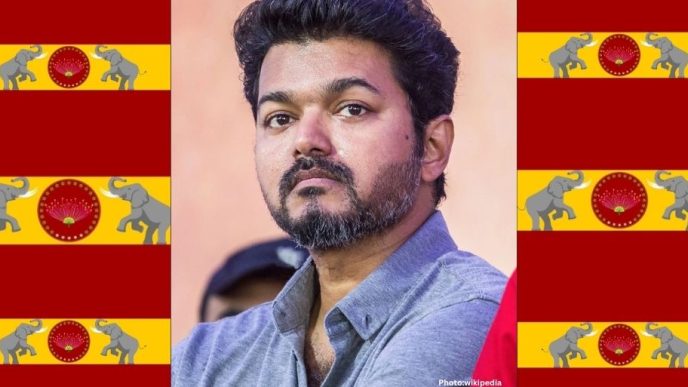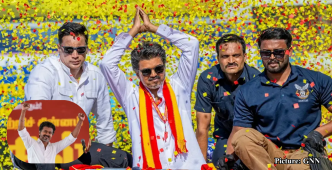
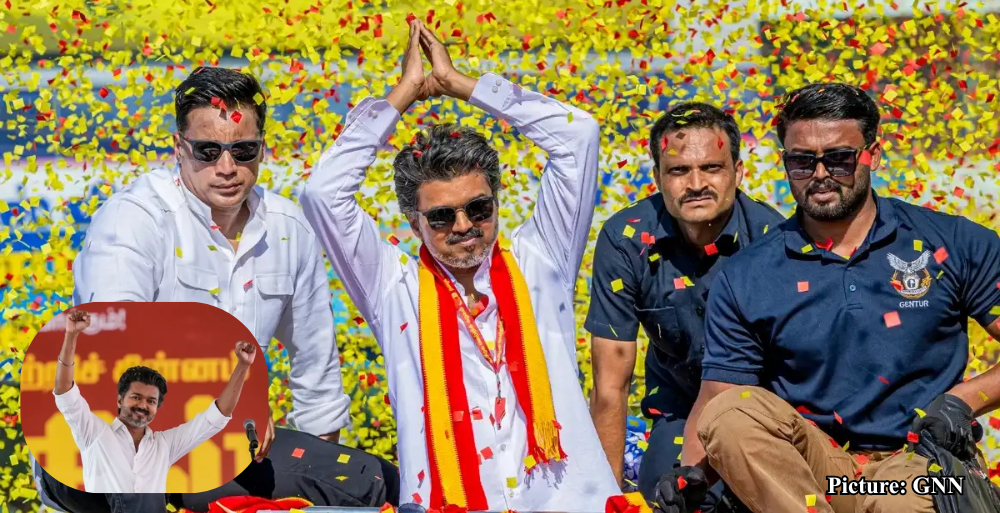
A significant political shift occurred in Tamil Nadu as C. Joseph Vijay, president of the Tamilaga Vettri Kazhagam (TVK), met with Governor Rajendra Arlekar to stake a claim to form the state government following the recent assembly elections.
In a notable turn of events in Tamil Nadu’s political landscape, C. Joseph Vijay, the president of the Tamilaga Vettri Kazhagam (TVK), officially met with Governor Rajendra Vishwanath Arlekar at Lok Bhavan in Chennai on May 6, 2026, to assert the party’s claim to form the government. This meeting comes in the wake of the TVK emerging as the single largest party in the recent assembly elections, having secured 108 of the 234 seats in the Tamil Nadu Assembly.
Mr. Vijay arrived at Lok Bhavan around 3:15 PM and engaged in discussions with Governor Arlekar for over half an hour. Accompanying him were several senior leaders of the TVK, including general secretary N. Anand, K.A. Sengoattaiyan, the chief coordinator of the high-level administrative committee, Aadhav Arjuna, general secretary overseeing election campaign management, K.G. Arunraaj, general secretary for policy and propaganda, treasurer P. Venkataramanan, and joint general secretary C.T.R. Nirmalkumar.
Election Results and Political Alliances
The TVK’s electoral success marks a significant shift in Tamil Nadu’s political dynamics, particularly against the backdrop of the longstanding dominance of the Dravida Munnetra Kazhagam (DMK) and its allies. With 108 seats, the TVK’s effective strength in the assembly is 107, as Mr. Vijay won from two constituencies—Perambur and Tiruchi East.
Historically, the Congress party has been a key ally of the DMK as part of the Secular Progressive Alliance. However, in a surprising move on the same day as Mr. Vijay’s meeting with the governor, the Congress announced its decision to sever ties with the DMK and form an alliance with the TVK. In the recent elections, the Congress retained five seats, which could play a crucial role in the TVK’s efforts to establish a government.
Despite securing the largest number of seats, the TVK is still short of an outright majority in the assembly, requiring the support of at least five additional MLAs. In pursuit of this goal, the TVK has reached out to the Communist Party of India (Marxist), the Communist Party of India, and the Viduthalai Chiruthaigal Katchi—three parties that have previously aligned with the DMK. As of now, these parties have not publicly responded to the TVK’s overtures.
Implications for Tamil Nadu Politics
This development raises important questions about the future of governance in Tamil Nadu. The breaking of the alliance between the Congress and the DMK signals a possible realignment of political affiliations in the state, which could have far-reaching implications for both parties and their supporters. The TVK’s ability to secure the necessary support to form a stable government will be closely watched, as it could reshape the political landscape in Tamil Nadu for years to come.
The TVK’s emergence and the potential coalition dynamics highlight the evolving nature of Tamil Nadu’s political environment. As the situation develops, the responses from the CPI(M), CPI, and Viduthalai Chiruthaigal Katchi will be crucial in determining whether the TVK can translate its electoral success into actual governance.
Furthermore, the implications of this political realignment extend beyond immediate governance. The Congress party’s shift away from the DMK could signal a transformation in voter sentiment within Tamil Nadu, particularly as parties recalibrate their strategies in response to changing political allegiances. The impact on local constituencies, party bases, and voter engagement will be essential to monitor in the coming weeks.
The TVK’s claim to power is also indicative of a broader trend in Indian politics where regional parties are gaining prominence amid the national parties’ struggle to maintain cohesive alliances. Tamil Nadu has historically been a battleground for regional parties, and the emergence of the TVK as a significant player adds another layer of complexity to the state’s political narrative.
As the TVK navigates its path forward, the party faces challenges not only in solidifying its majority but also in establishing a governance framework that resonates with the electorate’s expectations. Balancing diverse interests within a coalition government, should it come to fruition, will be crucial for the TVK’s longevity and effectiveness in office.
Ultimately, the unfolding scenario in Tamil Nadu serves as a reminder of the fluidity of political alliances and the importance of strategic negotiations in the formation of government. As the situation evolves, the interplay of party dynamics, electoral strategies, and public sentiment will define the future of governance in Tamil Nadu.