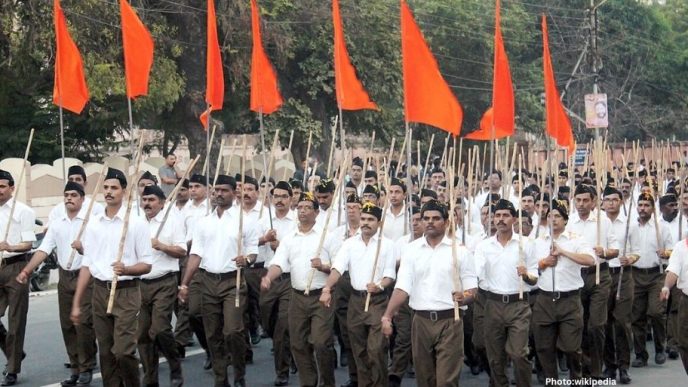
NEW YORK – The Rashtriya Swayamsevak Sangh (RSS) has increasingly found itself at the center of India’s political and social discourse, with an influence that goes far beyond what it describes as a cultural and social organization. The latest controversy involves allegations surrounding its role in the recent student protests, whether by direct participation or through groups allegedly used to intimidate students and discourage future protests. Whatever the facts of those allegations may ultimately establish, they raise a larger and more consequential question: What exactly is the RSS, and where does its professed cultural mission end and its political influence begin?
That question assumes greater significance because the RSS is not simply another organization participating in India’s public debate. Its ideological relationship with the Bharatiya Janata Party (BJP), which governs India, gives the organization an unusual place in the country’s political architecture. The BJP exercises governmental and electoral power, while the RSS describes itself as a cultural organization and remains formally outside the structures of electoral accountability. Yet its ideological footprint is visible across politics and public life.
International scrutiny has progressively focused on this relationship. In its 2026 Annual Report, the U.S. Commission on International Religious Freedom (USCIRF) expressed serious concerns about religious-freedom conditions in India and discussed the role of Hindutva organizations and their relationship with the governing BJP. Significantly, USCIRF went further by explicitly naming the RSS among the entities it recommended for targeted U.S. sanctions for responsibility for or tolerance of severe violations of religious freedom.
Whether one agrees with USCIRF’s conclusions or not, such an extraordinary recommendation concerning an organization with close ideological ties to India’s ruling party deserves attention. It also brings into sharper focus a fundamental question of democratic accountability: If the RSS seeks to influence public policy, political leadership, education, religious identity, and ultimately the direction of the Indian state, should it not be subjected to a level of disclosure and scrutiny commensurate with that influence?
The Registration Debate: Priyank Kharge’s Challenge to the RSS
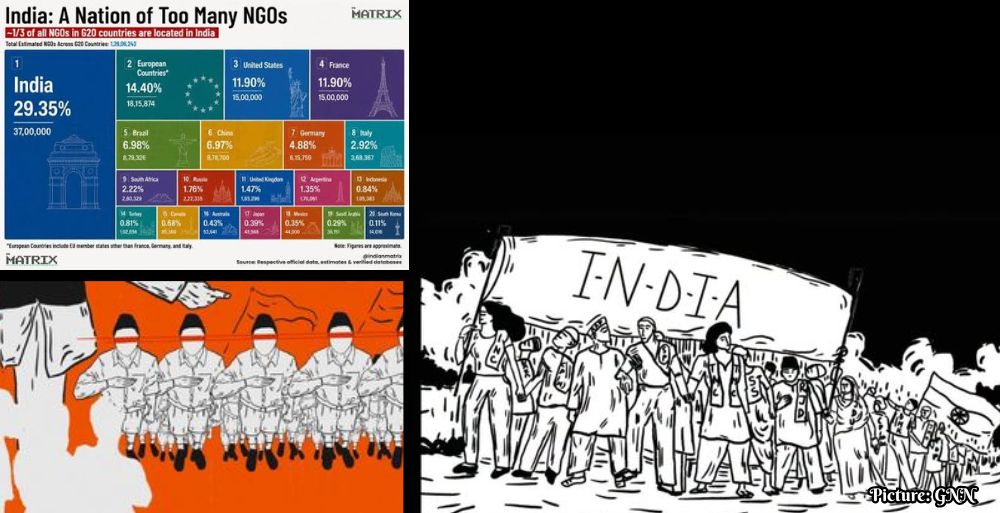
Perhaps nowhere is this contradiction more visible than in the debate over the RSS’s legal status, registration, finances, and accountability. Karnataka Home Minister Priyank Kharge has repeatedly raised precisely these questions. He has challenged how the RSS, an organization that portrays itself as one of the world’s largest voluntary organizations and exercises considerable influence over India’s political and social landscape, can operate without conventional organizational registration.
“If you are the world’s largest NGO, shouldn’t you be registered?” Kharge asked why the organization should not be subject to disclosure and accountability standards comparable to those expected of other organizations. Kharge subsequently intensified the issue by writing directly to RSS chief Mohan Bhagwat, seeking clarification on the organization’s legal status, finances, office-bearers, assets, donations, and tax compliance. His underlying argument is clear: businesses, charities, religious institutions, NGOs, and countless other organizations are required to maintain records and comply with regulatory requirements. Why, then, should an organization possessing the nationwide reach and political influence of the RSS not face comparable expectations of transparency?
The RSS strongly disputes the premise of this criticism. Bhagwat has maintained that the RSS functions legally as a recognized “body of individuals” and that registration was not compulsory when the organization began operating. That defense deserves to be acknowledged. The issue, however, goes beyond the narrow legal question of whether the RSS is technically required to register under a particular statute.
An organization may conceivably satisfy the minimum requirements of the law while still exercising enormous influence over government, politics, education, culture, and public policy. The relevant democratic question, therefore, is not simply whether the RSS has found a legally permissible organizational structure. It is whether an organization exercising such extraordinary influence over India’s governing establishment should operate without the degree of institutional and financial transparency routinely demanded of other organizations.
The FCRA Paradox: Selective Transparency for Civil Society
This issue becomes especially striking when viewed against the BJP government’s approach to the Foreign Contribution (Regulation) Act (FCRA). The government argues that stringent FCRA regulations are necessary to guarantee transparency, prevent the misuse of foreign funds, and protect India’s national interest. Consequently, NGOs, charities, humanitarian organizations, and religious and minority institutions receiving foreign contributions are already subject to extensive registration, reporting, auditing, and compliance requirements. The proposed legislation expected to be taken up during the forthcoming Monsoon Session could tighten this regulatory framework even further, reportedly expanding enforcement powers to include the attachment or seizure of assets in cases of alleged non-compliance. Such provisions, if enacted, would significantly raise the stakes for civil society and minority institutions operating under the FCRA regime.
There is nothing inherently unreasonable about demanding financial transparency from organizations receiving funds from abroad. Governments have a legitimate responsibility to ensure that money entering the country is properly accounted for and used for lawful purposes. The problem arises when transparency appears to become a selective principle rather than a universal one.
Christian organizations, minority institutions, humanitarian groups, and civil-society organizations can be required to account for their funding and activities in considerable detail, with violations potentially resulting in the suspension or cancellation of their ability to receive foreign contributions. At the same time, an organization exercising substantial ideological influence over the country’s governing political establishment continues to face fundamental public questions concerning its own organizational status and financial transparency.
This raises another legitimate question: Do the RSS or organizations affiliated with the broader Sangh Parivar receive funds, donations, or other financial support from sources outside India? If so, through what channels are such funds received, how are they accounted for, and what regulatory and disclosure requirements apply to them? Transparency, if it is truly the objective, should invite these questions rather than place any organization beyond their reach.
It is important to recognize that FCRA registration and the organizational registration questions surrounding the RSS are legally different matters. They should not be confused. But the underlying principle connecting them is difficult to ignore: transparency and accountability. If transparency is essential to protecting India’s national interest, it should be embraced consistently. If financial disclosure is necessary to establish public trust, that principle should not become burdensome only for organizations outside the ideological orbit of those in power.
One Standard of Governance: Restoring Equality Before the Law
The real test of democratic governance is not how rigorously a government scrutinizes its critics, but whether it is willing to apply the same principles to institutions close to its own centers of power. If NGOs must disclose their finances, the principle behind that requirement should be transparency, not political convenience. If religious and charitable organizations have to account for their activities, accountability should not suddenly become less important when questions concern an organization with powerful connections to the governing establishment.
This is ultimately larger than the RSS, the BJP, the FCRA, or even the present government. It concerns a fundamental principle upon which every constitutional democracy depends: equality before the law must also mean equality before the standards of public accountability.
India cannot sustain two standards, one demanding exhaustive scrutiny from organizations outside the corridors of power and another offering greater latitude to those close to them. In a democracy, accountability cannot be a weapon directed outward while becoming a shield for those within the circle of power. The same light of transparency that the state shines upon its critics must also illuminate those who stand closest to the power.