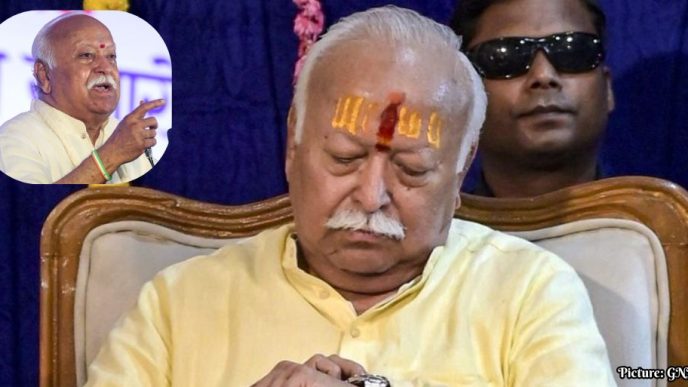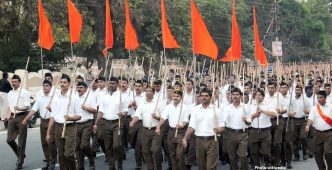
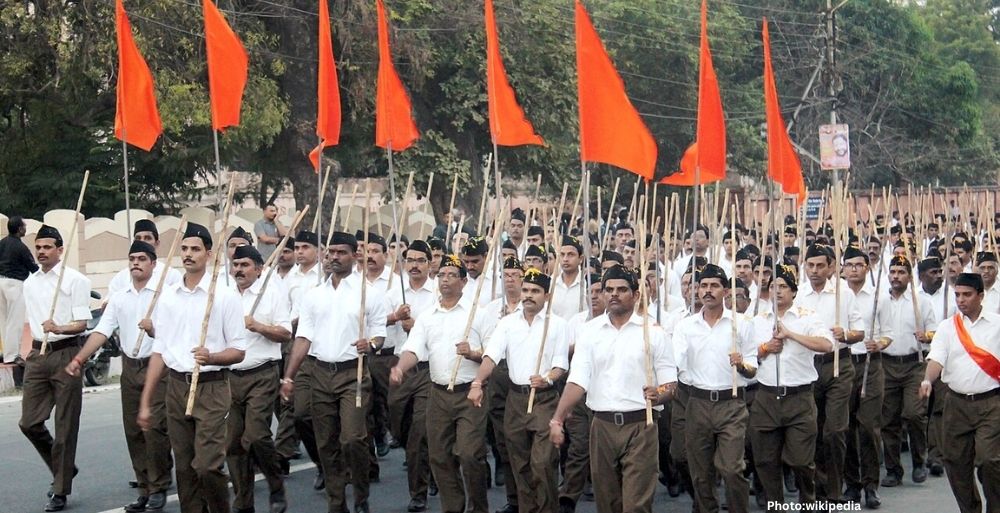
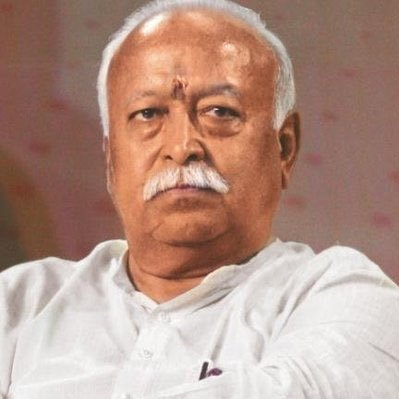
The scheduled appearance of Mohan Bhagwat, chief of the Rashtriya Swayamsevak Sangh (RSS), in New York City on August 29, 2026, has triggered widespread protests, criticism from elected officials, and renewed scrutiny of the RSS’s role in shaping Hindu nationalist politics in India. He is scheduled to address about 5,000 members of Indian American groups in the Infosys Theater, located in Madison Square Garden.
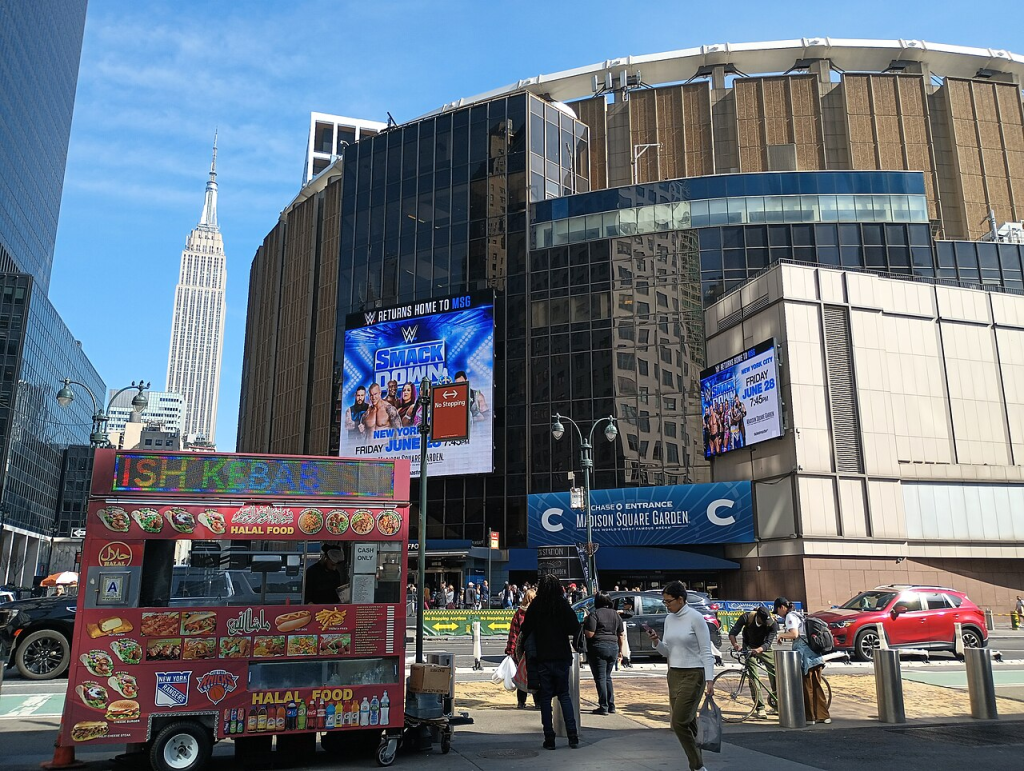
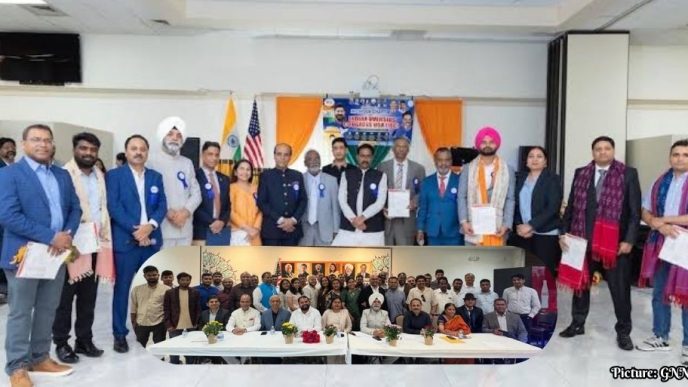
Titled “Universal Oneness Celebration,” the event is being organized by American Hindus for Engagement and Dialogue. The group’s news release says the event is a collaboration among more than 200 Hindu American organizations and is built around the ancient Sanskrit phrase “Vasudhaiva Kutumbakam,” which means “the world is one family.”
Expected attendees include entrepreneurs, educators, artists, youth leaders, faith leaders and public officials as well as representatives from temples and yoga centers. RSS has over 250 centers and youth groups in the U.S.
Sunil Ambekar, RSS’ national spokesperson, said in a statement on X that Bhagwat will “communicate with a diverse, multicultural, and multifaith audience.”
“Organized in the spirit of open dialogue and mutual respect, the event reflects Bharatiya (Indian) ethos which is fundamentally inclusive and welcoming to all,” he said. “This initiative is in line with the longstanding tradition of engagement by RSS with varied communities across India and the world fostering understanding and shared purpose.”
The Hindu American Foundation, a nonprofit that advocates for U.S. Hindus, has issued an alert urging those attending the event “to be situationally aware, vigilant and maintain civility.”
The RSS and the Ideology of Hindutva
Mohan Bhagwat is the chief of the RSS, a large Hindu nationalist organization founded in 1925. The RSS is widely regarded as the ideological parent organization of India’s ruling Bharatiya Janata Party (BJP). Prime Minister Narendra Modi emerged from the RSS ranks, and the organization’s philosophy has significantly influenced contemporary Hindu nationalist politics in India. Critics argue that the RSS promotes the ideology of Hindutva, which seeks to define Indian national identity primarily through Hindu religious and cultural values, often at the expense of India’s secular and pluralistic traditions.
Human rights advocates, scholars, and minority rights organizations have repeatedly warned that the growth of Hindutva politics has coincided with increasing hostility toward Muslims, Christians, Dalits, Sikhs, and other marginalized communities. Protest organizers contend that Mohan Bhagwat, as the chief architect and public face of the RSS, bears responsibility for normalizing and amplifying these trends.
International Concerns
The controversy intensified when the U.S. Commission on International Religious Freedom (USCIRF) urged the U.S. government to consider sanctions against RSS members and called for closer scrutiny of Bhagwat’s visit, citing ongoing concerns about religious freedom in India. Protesters view this as evidence that concerns about the RSS extend beyond political opponents and are shared by international human rights observers.
In addition, New York City Mayor Zohran Mamdani publicly stated that he opposed the event and described RSS ideology as inconsistent with the pluralistic values of New York City, although he acknowledged that the city lacked authority to cancel a privately organized gathering.
Allegations of Anti-Minority Violence and Intolerance
Critics of the RSS point to numerous incidents and policy developments that they believe reflect the consequences of Hindu nationalist mobilization. These include:
- Mob lynchings linked to allegations of cow slaughter or beef consumption, disproportionately targeting Muslims.
- Attacks on churches and Christian communities under anti-conversion campaigns.
- Demolition of Muslim-owned homes and businesses through so-called “bulldozer justice” operations.
- Citizenship and legal measures that critics argue discriminate against Muslims while favoring other religious groups.
- Growing social hostility and discrimination against religious minorities in public life.
- Opponents argue that while the RSS often distances itself from acts of violence, its rhetoric and organizational influence help create an atmosphere in which such actions become socially and politically acceptable.
Why Protesters Oppose Bhagwat’s New York Event
Dozens of interfaith, civil rights, Dalit, Muslim, Sikh, Christian, and progressive Hindu organizations shared their opposition to Bhagwat’s appearance, arguing that the event’s title, “Universal Oneness Celebration,” is fundamentally inconsistent with the RSS’s record. Protesters contend that the language of unity and dialogue cannot be separated from an organization they believe has contributed to division and exclusion in India.
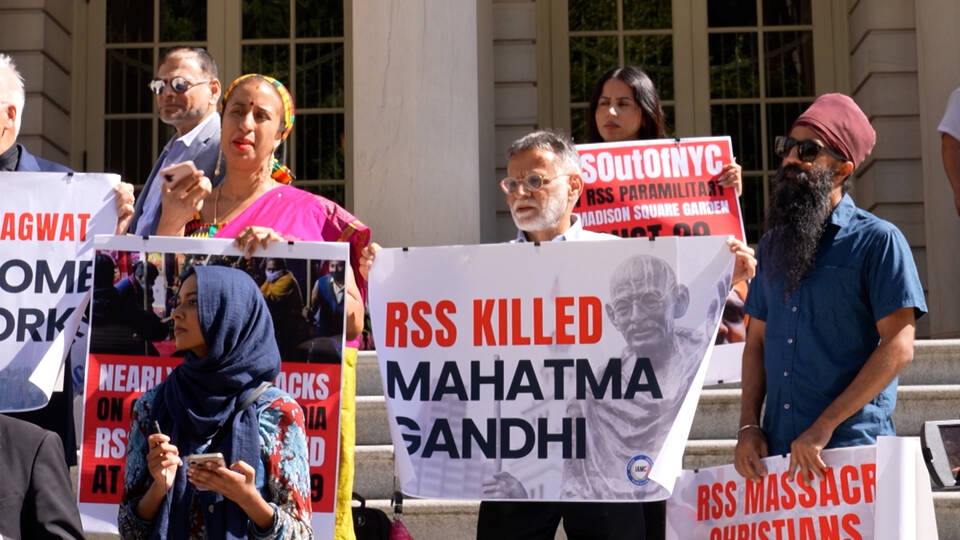
Several interfaith and civil rights groups — including Hindus for Human Rights, the Indian American Muslim Council and the Interfaith Center of New York — held a news conference outside New York City Hall last week calling for the event to be canceled.
The protests were organized under slogans such as “No Platform for Hate,” reflecting the belief that prestigious American venues should not be used to elevate leaders associated with exclusionary nationalist ideologies.
They accused RSS of promoting the political ideology of Hindutva, which means “the essence of being Hindu,” and seeks to define Indian culture and national identity in terms of Hindu values.
They argued that Bhagwat’s visit should not be viewed as a routine diaspora event, but as an effort to mainstream and legitimize an organization that has long been accused of promoting exclusionary and anti-minority ideologies.
They asserted that Bhagwat does not represent all Hindus and that many Hindu Americans reject the political project of Hindutva. Their criticism is directed not at Hinduism as a religion, but at what they describe as a form of religious nationalism that undermines democratic pluralism and minority rights.
Hindus for Human Rights
Sunita Viswanath, executive director of Hindus for Human Rights, said her group is one of 61 interfaith and secular organizations that signed an open letter protesting Saturday’s event. She said many of the groups’ supporters will show up in person with the message that “the RSS and their Hindutva ideology do not represent us.” Even if a majority of the diaspora doesn’t support Hindu nationalism, Viswanath said not enough are speaking against it.
“So, our only option is to show up again and again with love and with the intention that our love should drown out the hate of these people and their organizations,” she said.
A new investigation from Savera, where Hindus for Human Rights serves as a core member, maps the organizations and political networks behind RSS chief Mohan Bhagwat’s U.S. visit and August 29 appearance at Madison Square Garden. Fibs, Fronts & Fixers draws on public records and Sangh sources to expose the infrastructure advancing Hindu nationalism in the United States.
People are protesting Mohan Bhagwat’s visit to New York because they view him and the organization he leads, the Rashtriya Swayamsevak Sangh (RSS), as representing a form of Hindu nationalism that they believe has contributed to discrimination against religious minorities in India. Critics argue that giving him a prominent platform at Madison Square Garden legitimizes those views.
A Broader Debate About Hindu Nationalism
Supporters of the RSS argue that the organization is primarily focused on cultural preservation, social service, and community engagement. However, critics counter that these activities cannot obscure what they describe as a century-long projects of advancing Hindu majoritarianism and marginalizing religious minorities. They view Bhagwat’s U.S. tour as part of a broader effort to rebrand the RSS internationally while avoiding accountability for the movement’s impact on democratic institutions, secularism, and minority rights in India.
For protesters, the issue is not simply one speech in New York. Rather, it is a question of whether American institutions should provide legitimacy and visibility to a movement that many human rights advocates associate with intolerance, discrimination, and the erosion of India’s secular democratic foundations.
The contrasting reactions to the RSS chief’s visit to USA underscore the sharp political and ideological divisions within the Indian American community regarding Prime Minister Narendra Modi and his party, which enjoys significant support in the United States, much as they do in India.