By Asad Pervez, Center for Peace & Spirituality USA
BOSTON (August 15, 2026) — One of the most exciting topics I used to discuss with Maulana Wahiduddin Khan was pre-independence India. He was in his 20s when India gained independence in 1947. During my visits, I was also in my 20s, and I wanted to know what that experience was like for a young man back then.
The young and impatient version of me used to pepper him with questions about what it was like to witness and live through pre- and post-independence India — to see the birth of a nation firsthand and watch it grow over several decades. I wanted to hear his perspective on all of it. I believe my curiosity came from the fact that he had lived this history, while I had only read about it in books. No book or documentary can match the firsthand knowledge and wisdom you get from your elders.
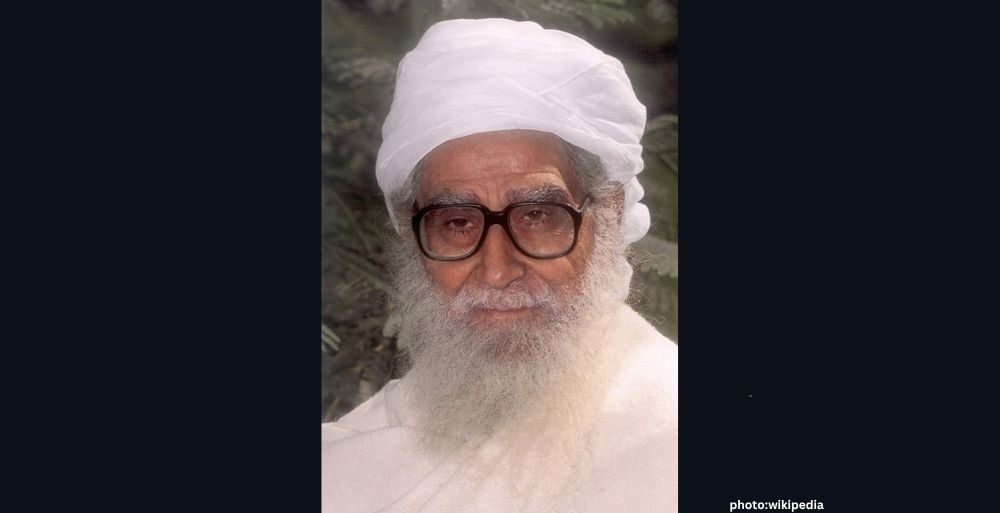
Maulana Wahiduddin Khan was regarded as one of the most influential spiritual leaders in India and the world. He passed away in April 2021, at age 96, after contracting COVID-19. About six months before his passing, he penned down a message for India in his longstanding periodical, Al-Risala (first published in October 1976).
The piece, titled “Ek Senior Citizen Ki Zubani” (From the Words of a Senior Citizen), also appears in his book The Spirit of Patriotism, available to read for free — like all his books — on CPS International’s website (cpsglobal.org/books). It was originally written in Urdu, then translated and edited into English by Professor Farida Khanam. I’ve copied the English translation below.
From the Words of a Senior Citizen:
I was born on January 1st, 1925, in Uttar Pradesh during the British India era. Now, as a senior citizen, I have witnessed the transition from colonial rule to independent India. I was born into a family renowned for its role in the freedom struggle.
My elder brother, Iqbal Ahmad Khan Suhail (MA LLB), Advocate (1884–1955), was not only a freedom fighter but also a poet. In one of his poems, he wrote:
Ghalat hai yeh keh faqat Hinduon ka leader tha; Ke tha tamaam jahan bhar ka rehnuma Gandhi
(It is wrong to say he was only the leader of Hindus; Gandhi was a guiding figure for the entire world.)
Iqbal Ahmad Khan Suhail contested the 1936 elections in Uttar Pradesh and, after winning, became a member of the UP Assembly.
As I grew older, I came across Swami Vivekananda’s book ‘Letters of Swami Vivekananda.’ In letter number 271 dated June 10, 1898, he wrote to a friend and shared his vision for a free India. He expressed it in these words: “For our own motherland, a junction of the two great systems Hinduism and Islam—Vedanta brain and Islam body—is the only hope I see in my mind’s eye, the future perfect India rising out of this chaos and strife, glorious and invincible with Vedanta brain and Islam body.” (Letters of Swami Vivekananda, p. 427)
These beautiful memories stay etched in my heart. I actively participated in the freedom movement to the best of my ability. For example, before independence, I once travelled to Mau (UP) to hear Jawaharlal Nehru (1889-1964) speak. I still remember how eager people were to attend, even riding on the rooftops of buses and trains just to get there.
Similarly, I attended a rally in Phoolpur (Azamgarh) where I heard Subhas Chandra Bose (1897-1945) speak. As we know, Subhas Chandra Bose formed the Azad Hind Fauj (Indian National Army) in 1942. His iconic slogan still echoes in history: “Give me blood, and I will give you freedom.”
In the same spirit, I once attended a socialist gathering where I heard a speech by Jayaprakash Narayan (1902-1979). The event was held in Azamgarh. As is well known, Jayaprakash Narayan later became known as Lok Nayak. And so, my youth days passed by.
Then came that historic day, August 15, 1947. I did not hear the famous speech delivered at midnight by the then Viceroy, Lord Mountbatten (1900-1979), broadcast on All India Radio at 12:01 AM, in which he declared: “Today, India is free.”
Like many others, I couldn’t listen to the speech live on the radio, but I read it in the newspaper the next morning. On August 15, 1947, I was in Azamgarh. I still remember that night clearly: when I stepped out of my residence and walked through the streets of the city, I was surrounded by the glow of joyous lights. The entire city was lit up in celebration. That light has now faded, but the time has come for all of us to come together and light a new lamp, heralding a new era for India. An era of rebuilding the nation. The era envisioned by Swami Vivekananda. The era for which Mahatma Gandhi gave his life. The era whose final chapter perhaps still awaits the pen of India’s historian.
I am now over 90 years old, but my hopes are still alive. Every morning, I leave my room and sit quietly, waiting for the sun to rise. I remember that once, during an Independence Day program, I heard an Urdu poet recite:
Burj-e-mehn se nikla sooraj, roshan apna mustaqbil hai
(From the tower of endeavour, a sun rises; our future shines brightly)
I watch the sunrise every morning, hoping that this day might be the one—the day longed for by a freedom fighter who once wrote a book titled Roshan Mustaqbil, ‘A Bright Future.’ I greet each new dawn with these words: “That morning will surely come; That morning will surely come.”
India earned its historic freedom through peaceful struggle. Now, the task of rebuilding India should also be pursued through peaceful means. Just as India once made history with peace, it is now time to harness that same strength—peace—for its reconstruction. Peace was India’s strength in the past; it remains so today, and it must continue to be our strength in the future.
On August 15, 2020, India celebrated its seventy-fourth Independence Day. Now, the time has come to decisively chart our course as a free nation. Independence Day should serve as a trendsetter for us. We must declare the year 2020 as a trend-setting year and carefully determine the direction we want to take as an independent people. Swami Vivekananda once said that his dream for India was to see it emerge as a spiritual superpower after independence.
India, without doubt, has the potential to become such a spiritual superpower. To turn that potential into reality, only one thing is needed, a united and democratic effort by all.
I am over 90 now, and in that sense, I have gained extensive life experience. Based on my experience, I believe there is only one practical model for India’s development. That is the same natural model often called the American model.
The American model emphasizes free competition, which means creating an environment where individuals succeed based on merit, not favouritism. The true key to progress is competition, not favouritism. In America, the principle in every field is compete or perish, meaning either compete or be finished.
In common terms, this is called do or die. According to the law of nature, no group in this world can advance through favouritism. It can only succeed by demonstrating its worth through competition. It is competition that elevates a person from man to superman. This is because the Creator has designed this world based on the principle of challenge and response.
The key to individual or societal progress is to let nature operate freely. Any other principle would be man-made and can never be practically implemented. This is the natural model. The model of competition is motivating.
In contrast, Nehru adopted the Russian model, which he called the socialist model. But in practice, this model is demotivating. Now is the time for us to adopt a model based on motivation and to fully abandon the model that leads to demotivation.
The final moment has arrived for us to replan India’s development. Once, John Kenneth Galbraith (1908-2006), a former US ambassador to India, said in a statement, India is a functioning anarchy. I do not see this as criticism but as a challenge, and I pray that India becomes an ideal democracy.
(Al Risala, October 2020)
About CPS USA
Center for Peace and Spirituality USA, as is apparent from its name, is an organization, which aims to promote and reinforce the culture of peace. Non-profit and non-political in nature, it is engaged in promoting peace and spirituality through inter-faith efforts. Drawing inspiration from the Quran, the preserved word of God, and the Sunnah, the sayings and actions of the Prophet Muhammad, CPS USA seeks to share the spiritual principles of Islam with the world. A faith-based on peace, tolerance, and coexistence.
CPS USA drives its values from and is the official US representative of Maulana Wahiduddin Khan, an Islamic scholar who adopted peace, spirituality, and inter-faith harmony as the mission of his life.
CPS USA distributes Qurans translations around the world. We send out thousands of free Quran to individuals, inmates, hospitals, interfaith events, book fairs, chaplain offices, Universities, libraries, etc.
CPS USA was founded in 1997 as ‘Alrisala Forum International Inc.’ and later renamed as CPS USA is a 501(c)3 registered organization.