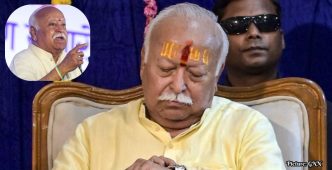
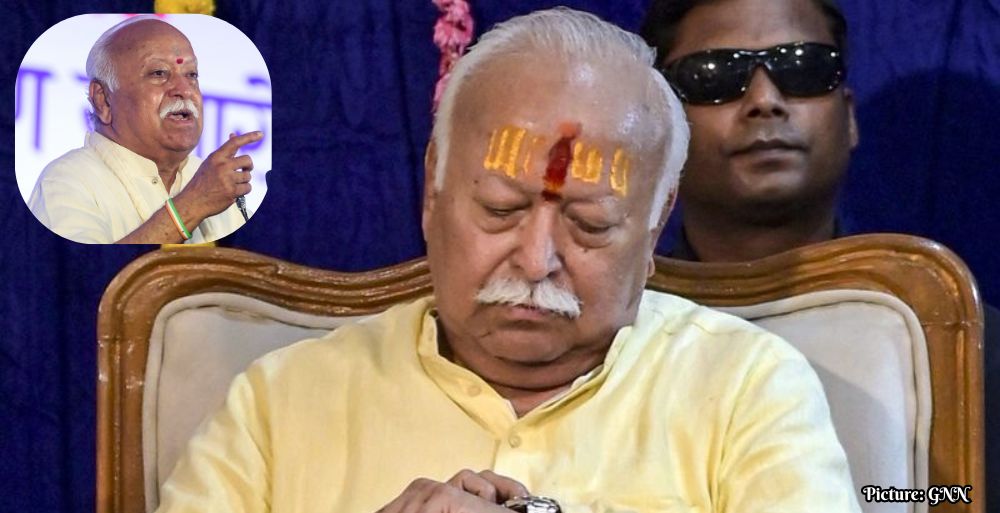
A group of approximately 90 American politicians has pledged to refuse political contributions connected to the Rashtriya Swayamsevak Sangh (RSS), coinciding with the organization’s leader Mohan Bhagwat’s recent address in New York City.
On Monday, following a high-profile speech by Mohan Bhagwat at Madison Square Garden in New York City, a coalition of nearly 90 U.S. politicians announced a commitment to reject political donations from entities associated with the RSS, a Hindu nationalist organization in India. The pledge was initiated by the advocacy groups Hindus for Human Rights Action and SACRED Acts and includes elected officials and candidates from various political affiliations across eight states.
The six-page pledge not only calls for the rejection of RSS-linked contributions but also emphasizes a commitment to denounce political violence and intimidation. It further stipulates that any funds previously accepted from RSS-affiliated sources must be returned or redirected to organizations supporting democratic practices.
Prominent Signatories
Among the notable signatories are U.S. Representatives Pramila Jayapal (D-WA), Ro Khanna (D-CA), and Robin Kelly (D-IL). Additionally, Abdul El-Sayed, the Democratic nominee for the Senate in Michigan, along with Brad Lander, a local Democratic congressional nominee who protested Bhagwat’s speech, signed the pledge. Khanna, a prominent figure in this initiative, expressed his dedication to combating the influence of the RSS in American politics, stating, “I’m proud to lead on this pledge and re-assert my commitment to overcome the RSS and their attacks on global democracy.”
Financial Actions by Politicians
The pledge prompted immediate financial actions by some signatories. Khanna, for example, announced the return of a $6,600 contribution received from a billionaire linked to pro-MAGA sentiments and the RSS. He emphasized his determination to prevent the RSS from establishing a political action committee (PAC) or influencing elections in the United States.
Since his election to Congress in 2016, Khanna has maintained a close relationship with the Hindu-American community and its advocacy groups. In the past, he has attended events organized by the Hindu American Foundation (HAF), which has opposed the explicit recognition of caste discrimination in U.S. law while maintaining a nonpartisan stance. The HAF has denied any formal connection to the RSS.
Despite his associations, Khanna has acknowledged receiving significant campaign contributions from Hindu-American donors aligned with Hindutva causes, amounting to over $110,000 in the past twelve years, as reported by The Nation. In response to inquiries regarding these contributions, Khanna stated that he has a diverse donor base and does not interrogate each contributor about their views on Indian political matters.
Legislative Context
In 2023, Khanna adopted a more cautious stance toward California’s Senate Bill 403, which aimed to explicitly include caste as a protected category in the state’s civil rights laws. Advocates for Dalit rights argued that existing legal categories inadequately addressed caste discrimination, while Hindu-American organizations, including the HAF, criticized the bill as discriminatory. Ultimately, the legislation passed the California state legislature but was vetoed by Governor Gavin Newsom in October 2023, who asserted that existing protections were sufficient.
Growing Opposition to RSS Influence
This recent pledge reflects a broader movement against the perceived influence of the RSS within American political structures. Days prior to Bhagwat’s address, the U.S. Commission on International Religious Freedom urged the Trump administration to consider imposing sanctions on RSS members and barring their entry into the United States, although this recommendation was non-binding.
The initiative spearheaded by SACRED Acts aims to expose what it describes as “extremist South Asian American groups” and has garnered support from various organizations, including the Indian American Muslim Council and Asian American Midwest Progressives. According to Pushkar Sharma, the Executive Director of SACRED Acts, individuals linked to the RSS have funneled approximately $2.5 million into political campaigns across both major parties in Illinois, promoting an agenda that he claims does not represent the majority of South Asian Americans.
Challenges in Tracking Funding
However, tracking the flow of funds associated with the RSS within American political and social landscapes presents significant challenges. Political donations in the United States can traverse through various channels, including PACs and affiliated organizations. As a result, discerning contributions directly linked to the RSS from a politician’s campaign finance records can be complex.
Ria Chakraborty, Executive Director of Hindus for Human Rights Action, stated, “For far too long, RSS-affiliated organizations and individuals have represented themselves as the only advocates for Hindu Americans in U.S. politics. This pledge and its adoption by almost 100 political leaders is a historic rebuke to the RSS’s misrepresentation of South Asian and Hindu American communities.”
International Context
Coinciding with the pledge in the U.S., a Canadian organization named Just Peace Advocates announced its intention to investigate RSS-related funding in Canada. The group filed a complaint with the Canada Revenue Agency to examine the charitable status of 21 registered Canadian charities connected to the RSS. A study cited by the organization claims that approximately $46 million has moved between RSS-affiliated organizations in Canada, with $21.5 million sent from Hindutva organizations to RSS-linked groups abroad.
This growing scrutiny of the RSS’s influence in North America marks a significant development in the intersection of U.S. politics and international Hindu nationalism, reflecting rising concerns about the implications of foreign influence in domestic political affairs.