A dramatic shift in corporate hiring strategies is underway across India’s technology sector, as major IT service providers sharply curtail their reliance on the U.S. H-1B specialty occupation visa route. Data released by the United States Citizenship and Immigration Services reveals steep reductions in H-1B registrations by industry giants for Financial Year 2027, with companies like Infosys and Tata Consultancy Services cutting applications by up to 95 percent. The systemic pullback follows a series of stringent policy measures enacted under President Donald Trump’s administration—including a substantial $100,000 fee requirement for certain overseas petitions and a new September 18 executive order targeting firms that lay off domestic staff—prompting a accelerated transition toward U.S.-based local hiring models.
WASHINGTON — Changing United States immigration enforcement policies and mounting regulatory financial hurdles are fundamental reshaping how India’s largest technology institutions source and deploy international engineering talent. According to official registration records published by the United States Citizenship and Immigration Services (USCIS), India’s top IT services conglomerates have implemented historic cutbacks in their submission of new H-1B visa registrations for Financial Year 2027, signaling a decisive departure from decades-old offshore staffing models.
The statistical downturn across major Indian technology vendors represents one of the most pronounced structural realignments in the 36-year history of the H-1B nonimmigrant visa program. Infosys, long one of the single largest corporate sponsors of specialty occupation visas, reduced its H-1B initial registrations from 8,886 in previous cycles down to just 759 for FY2027. Tata Consultancy Services (TCS) executed an even steeper reduction, slashing its registration filings from 5,955 to a mere 284 applications. Parallel declines ranging from 85 percent to nearly 96 percent were recorded by peer institutions including HCL America, Tech Mahindra, and Wipro.
The rapid scaling back of foreign petition filings comes as a direct response to a succession of protectionist immigration mandates designed to prioritize domestic employment and disincentivize international labor transfers.
Escalating Regulatory Costs and the September 18 Executive Order
The primary catalyst behind the sharp contraction in H-1B filings stems from aggressive policy shifts instituted under the Donald Trump administration aimed at curtailing corporate reliance on nonimmigrant technical labor.
In September 2025, federal authorities instituted a regulatory framework requiring an additional $100,000 payment on specific new H-1B petitions involving prospective foreign workers applying from abroad. Framed by administration officials as an essential mechanism to protect American workers and eliminate cost advantages associated with overseas staffing, the substantial financial levy was recently extended through September 2027 despite ongoing constitutional and administrative legal challenges brought by industry coalitions in U.S. federal courts.
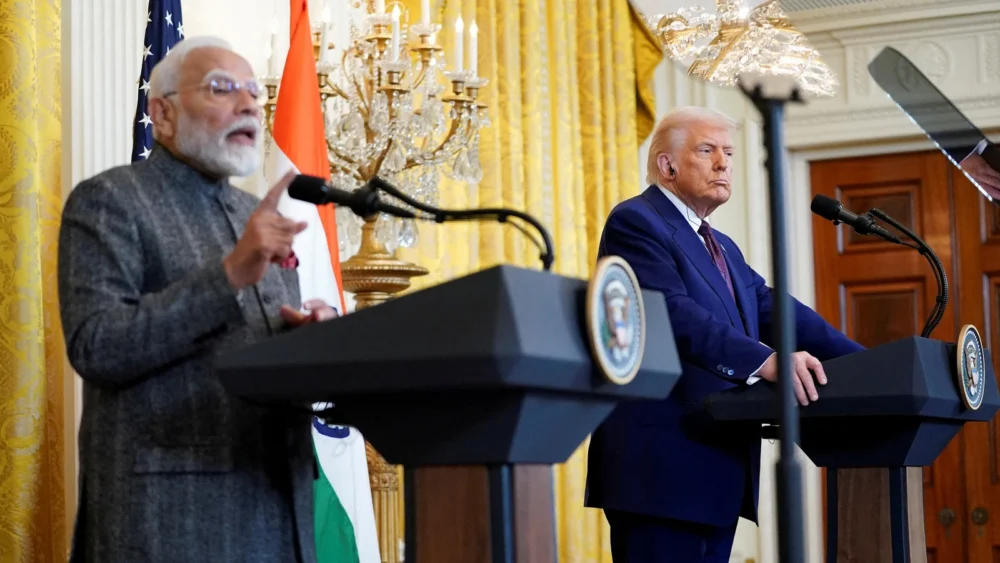
Corporate pressure intensified further on September 18, 2026, when President Trump signed Executive Order 14431, directing federal adjudicatory agencies to apply heightened regulatory scrutiny to H-1B applications submitted by corporate entities that have recently conducted workforce reductions or layoffs of U.S. workers. The directive mandates mandatory multi-agency coordination among the Department of Labor (DOL), the Department of Homeland Security (DHS), and the Department of State to verify that sponsoring companies are not displacing qualified domestic professionals.
“Federal oversight of nonimmigrant employment programs must ensure that American workers are not subjected to unfair wage suppression or systemic displacement,” White House press officials stated during the executive order signing ceremony in the Oval Office, describing the action as a core pillar of the administration’s broader “America First” economic platform. “Employers seeking specialty visas must demonstrate rigorous compliance, transparency, and a primary commitment to the domestic labor market.”
The administration’s regulatory directives have effectively altered the risk-reward calculations for multinational outsourcing firms, transforming the high-volume visa application strategy into a cost-prohibitive administrative process.
Indian Professionals Retain Dominant Share Amid Broader Program Cooling
Despite the sharp reduction in new corporate registrations by offshore IT vendors, Indian nationals continue to represent the overwhelming majority of total approved H-1B visa beneficiaries across the global talent pool.
According to comprehensive USCIS approval metrics for FY2025, Indian-born professionals accounted for 69.9 percent of all approved H-1B beneficiaries nationwide. Out of 406,000 total approved petitions—encompassing both initial employment and continuing cap-exempt extensions—283,000 beneficiaries were born in India. Mainland China ranked as the second-largest origin country with a 12.1 percent share. Together, India and China accounted for more than four out of every five approved H-1B specialty occupation visas in the United States.
This structural presence reflects the deep integration of Indian science, technology, engineering, and mathematics (STEM) graduates within American higher education and the broader U.S. technology ecosystem. While Indian IT service firms have historically utilized the visa program to transfer specialized personnel to client delivery locations across North America, an increasing proportion of approved Indian beneficiaries are now U.S.-educated advanced degree holders hired directly by American technology giants, financial institutions, and research universities.
Simultaneously, the macro-level demand for the H-1B program has cooled substantially from peak post-pandemic levels. Historical USCIS registration figures show that total submitted registrations surged from 274,237 in FY2021 to an all-time record of 780,884 in FY2024. Following anti-fraud measures introduced by USCIS—including beneficiary-centric selection processes—and elevated filing fees, total registrations dropped to 479,953 in FY2025, 358,737 in FY2026, and further down to approximately 211,600 for FY2027.
Strategic Pivot: From Overseas Transfers to Local U.S. Talent Acquisition
Faced with escalating compliance costs, protracted legal uncertainty, and rigorous federal auditing, Indian IT services leaders are fundamentally restructuring their global delivery models. Rather than relying on cross-border talent transfers from technology centers in Bengaluru, Hyderabad, and Pune, major firms are aggressively scaling up local recruiting and hiring operations within the United States.
Industry executives note that Indian tech firms have spent recent years establishing regional development centers and technology hubs in U.S. metropolitan areas, recruiting directly from American universities, and expanding localized engineering teams. By building a domestic workforce inside the United States, technology providers can fulfill enterprise client contracts without facing the volatility of annual visa lotteries, foreign worker fee surcharges, or federal immigration audits.
“The economics of relying exclusively on nonimmigrant visa transfers have fundamentally changed,” said industry analyst Rajesh Malhotra, evaluating the sector’s operational restructuring. “High compliance costs, combined with rigorous federal scrutiny surrounding domestic job displacement, have accelerated a transition that was already underway. Indian IT companies are transforming into localized global consulting entities with deep roots in American labor markets.”
As the FY2027 adjudication cycle progresses, the sharp decline in H-1B filings by major Indian firms highlights a permanent evolution in international corporate labor dynamics. While Indian engineering talent remains central to North American technological infrastructure, the era of relying on high-volume, cross-border visa transfers has given way to localized talent acquisition and selective, high-value visa sponsorship.