The Kerala government is advancing a high-speed rail project that promises to connect Thiruvananthapuram and Kannur in just three and a half hours while prioritizing green technology.
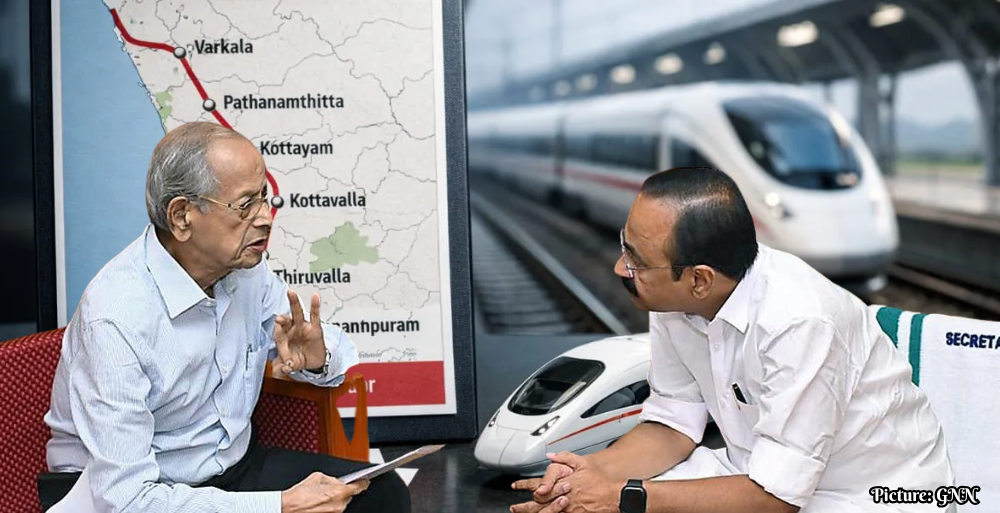
The Kerala government is progressing towards an ambitious high-speed rail initiative aimed at reducing travel time between the state capital of Thiruvananthapuram and the northern city of Kannur to just three hours and thirty minutes. This plan was detailed in an interim report submitted by renowned technocrat E. Sreedharan to Chief Minister V.D. Satheeshan during a meeting on Friday in Thiruvananthapuram. The proposed Kerala High-Speed Railway (KHSR) seeks to establish what is touted as the world’s first green rail corridor.
Project Overview
The proposed railway line will span approximately 473.20 kilometers, commencing from Poojapura in Thiruvananthapuram and terminating at Mundayad in Kannur. The design includes 23 stations strategically positioned along the route. Notably, the entire line will be elevated, with the exception of a 6.5-kilometer tunnel in the Thiruvananthapuram area. This structure is designed to enhance connectivity by linking three major airports in Kerala, while the Kannur International Airport will be accessible via a dedicated 10-kilometer road link.
Technical Specifications
The KHSR will adopt a standard gauge system, which involves a reduction in axle load from the traditional 25 tonnes in broad gauge to 15 tonnes. This change is anticipated to significantly lower both investment and operational costs. The report emphasizes that many advanced countries utilize standard gauge for high-speed rail operations due to its flexibility for technological upgrades. This strategic decision is expected to align India with global advancements in railway technology, fostering self-sufficiency in this sector.
Under the proposed specifications, the average distance between stations will be about 21.5 kilometers. Trains on this route will be engineered to achieve a maximum speed of 200 kilometers per hour, with an operational speed capped at 180 kilometers per hour and an average commercial speed of 140 kilometers per hour. Each train is designed to consist of 12 coaches, accommodating up to 800 passengers, with the potential for expansion to 16 coaches as demand grows. Initially, train services are projected to operate every 20 minutes during peak hours, which are defined as 6 a.m. to 11 a.m. and 4 p.m. to 8 p.m., and every 40 minutes during non-peak hours. This operational structure aims for a daily carrying capacity of 54,400 passengers, with the possibility of increasing train frequency to one every five minutes during peak periods.
Environmental Considerations and Land Use
This project has been framed as environmentally friendly, requiring minimal land for construction, estimated at only a 20-meter-wide corridor. Upon completion, plans include leasing the land back to original owners for agricultural or grazing purposes, which aligns with sustainable land use practices. Furthermore, the entire energy requirement for the KHSR will be sourced from a captive solar power system, designed to produce surplus electricity that can be sold to the Kerala State Electricity Board (KSEB). This initiative reinforces the project’s commitment to environmental sustainability and positions it as a pioneering green rail corridor.
Financial Aspects and Funding
The total projected cost for the KHSR stands at ₹60,000 crore (approximately $7.2 billion). Of this total, ₹36,000 crore will be funded through equity contributions from both the Central and State governments in a ratio of 51:49. The remaining ₹24,000 crore is proposed to be raised through crowdfunding initiatives, a unique approach that encourages public involvement in financing this infrastructure project. The average construction cost is estimated at ₹127 crore per kilometer. The report optimistically suggests that, pending the necessary approvals, the project could be completed within five years.
Context and Implications
This high-speed rail initiative emerges at a time when India is increasingly focusing on enhancing its transportation infrastructure to accommodate a growing population and demand for efficient travel options. By connecting major cities like Thiruvananthapuram and Kannur, the KHSR is expected to not only improve regional connectivity but also stimulate economic development, potentially creating jobs and increasing access to markets.
Moreover, this project aligns with global trends towards sustainable transportation solutions. As nations worldwide grapple with climate change and seek to reduce their carbon footprints, the KHSR’s emphasis on green technology serves as a potential model for future rail projects not only in India but across the globe. If successful, it could pave the way for similar initiatives aimed at promoting environmentally responsible transportation.
Conclusion
The interim report on the KHSR project marks a significant step toward realizing Kerala’s vision for modern, efficient, and sustainable transportation infrastructure. As the state government evaluates the findings of this report, there is considerable anticipation regarding the potential impacts of the KHSR on travel efficiency, economic growth, and environmental sustainability. The outcomes of this initiative may serve as a blueprint for future high-speed rail projects throughout India, reflecting a commitment to innovation and ecological responsibility in the transportation sector.