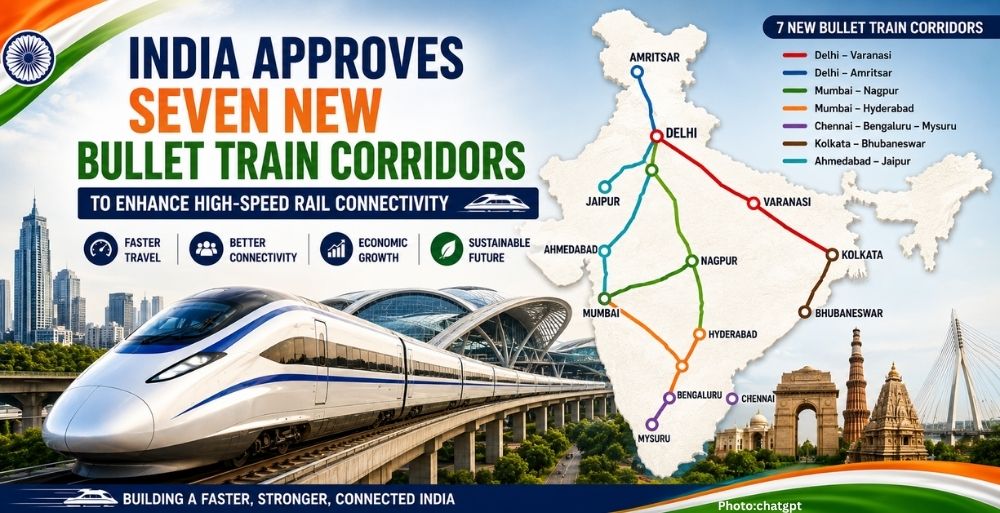
The Indian government has announced the approval of seven new bullet train corridors, aiming to significantly enhance high-speed rail connectivity across the nation and reduce travel times between major cities.
In a strategic move to bolster its high-speed rail infrastructure, the Indian government has approved seven new bullet train corridors designed to improve connectivity between major urban centers. This initiative is part of the government’s broader commitment to modernizing transportation infrastructure, which has become a focal point of its development agenda.
Details of the Newly Approved Corridors
The newly sanctioned bullet train corridors and their expected travel times are as follows:
- Mumbai to Ahmedabad: 1 hour 57 minutes
- Mumbai to Pune: 48 minutes
- Bengaluru to Chennai: 73 minutes
- Bengaluru to Hyderabad: 2 hours 10 minutes
- Pune to Hyderabad: 2 hours 8 minutes
- Delhi to Lucknow: 2 hours
- Delhi to Varanasi: 3 hours 15 minutes
- Delhi to Siliguri: 6 hours
This announcement coincided with a series of railway advancements highlighted by Minister of Railways Ashwini Vaishnaw during an inauguration event in Bihar. On the same day, a new weekly train service between Chhapra Junction and Anand Vihar Terminal was inaugurated by Vaishnaw and Bihar Chief Minister Samrat Choudhary. The minister remarked on the significant improvements planned for Bihar, stating that over 200 new train services are set to be introduced in the state over the next seven to eight years.
Railway Expansion Plans in Bihar
During the inauguration ceremony, Minister Vaishnaw announced that railway projects valued at more than ₹1.15 lakh crore (approximately $15 billion) are currently underway in Bihar. He characterized this as a period of unprecedented growth in railway infrastructure for the state. In addition to the new services, Vaishnaw confirmed that the long-awaited Delhi–Varanasi–Patna bullet train corridor has received approval. Once operational, this line is projected to reduce travel time between Patna and Delhi to just 4 hours and 41 minutes, with future plans to extend the line to Siliguri, further enhancing regional connectivity.
Background on India’s High-Speed Rail Initiatives
India’s ambitions in high-speed rail technology began to take shape with the official launch of its first project in 2017, focusing on the Mumbai-Ahmedabad corridor. This flagship initiative, spanning 508 kilometers, is being developed with financial and technical support from Japan and employs the Shinkansen system, renowned for its efficiency and speed. The Mumbai-Ahmedabad High-Speed Rail corridor is seen as a model for future high-speed rail projects throughout the country.
The introduction of high-speed rail in India is not merely about modernizing transportation; it represents a significant shift towards more efficient and sustainable forms of transport. The government envisions that a robust high-speed rail network could serve as a catalyst for economic growth, regional development, and a solution to alleviate congestion on existing railway lines.
Potential Economic and Social Implications
The expansion of high-speed rail corridors is poised to have far-reaching implications for India’s socio-economic landscape. By facilitating faster travel between key urban centers, these initiatives may stimulate economic growth, improve access to essential services, and enhance tourism prospects. Regions linked by these corridors could see a surge in economic activity as businesses leverage improved connectivity.
A well-functioning high-speed rail system may also attract foreign investment, bolstering India’s competitive edge on the global stage. With reduced travel times, the potential for increased inter-city collaboration and commerce expands, potentially leading to a more integrated national economy.
Challenges and Considerations
Despite the promising outlook, the successful realization of these high-speed rail projects will require meticulous planning, substantial investment, and cooperation among various stakeholders. Several challenges lie ahead, including land acquisition, environmental concerns, and the integration of advanced technologies. The government must navigate a complex regulatory landscape and work closely with local communities to secure support for these ambitious infrastructure initiatives.
Financial backing is also a critical element for these projects. While the government has announced significant financial commitments, the execution will likely depend on public-private partnerships and international financing, particularly given the scale of investment required to bring these projects to fruition.
Conclusion
As India embarks on this ambitious expansion of its rail network, the implications of these initiatives will be closely scrutinized by industry experts, policymakers, and the public. The government’s commitment to enhancing high-speed rail connectivity illustrates a broader vision of modernizing transportation and fostering economic development across the nation. If executed effectively, India’s high-speed rail ambitions could usher in a transformative era for its transportation infrastructure, potentially reshaping the way people travel and conduct business across the country.