A decision by Delhi Police to denotify Jantar Mantar as a designated protest venue has prompted strong criticism from activist groups, who argue it undermines the right to dissent and could escalate tensions over electoral issues.
NEW DELHI/HINGOLI: In a contentious move, the Delhi Police announced on October 11 that Jantar Mantar, a long-standing site for public demonstrations, will no longer be designated as an official venue for protests. This decision has drawn sharp criticism from Abhijeet Dipke, founder of the Cockroach Janta Party (CJP), who warns that the action signifies a broader assault on democratic rights.
Dipke, currently in his native Hingoli district of Maharashtra, stated, “Delhi is once again flooded with people standing up to save democracy. If Modi thinks taking away Jantar Mantar will put an end to protests, he is mistaken. Jantar Mantar is not just a location but a spirit of resistance that nobody can ever take away.” His comments were shared via social media platform X, reflecting the sentiments of many who believe the denotification is an attempt to stifle dissent.
Context of the Decision
The directive from Delhi Police Commissioner Anurag Kumar comes amidst heightened security measures in the national capital, particularly following calls from the CJP and opposition leaders for protests demanding the resignation of Chief Election Commissioner Gyanesh Kumar. The calls for demonstrations stem from allegations of irregularities in the Special Intensive Revision (SIR) of electoral rolls, which have raised concerns about the integrity of the electoral process in India.
As part of the new order, alternative sites for protests have been designated, including Ramlila Maidan, Burari Ground, and CBD Ground, which are located at varying distances from Jantar Mantar. Ramlila Maidan is approximately four kilometers away, while Burari Ground is about 21 kilometers from the former protest site. The police cited a review by a committee from the Union Ministry of Home Affairs as the basis for this decision, stating that the changes were made to provide citizens with alternative venues for expressing their right to protest.
Reactions and Allegations
Following the announcement, Dipke raised concerns about the motivations behind the denotification, predicting a potential escalation in confrontations over the right to demonstrate. He remarked, “Today, Modi denotified Jantar Mantar as a designated protest site. Tomorrow, he will denotify democracy itself. The dictator’s problem was never the protest site. It was the very idea of people protesting.” This statement underscores the anxiety among some activists that the government’s actions may further curtail civil liberties.
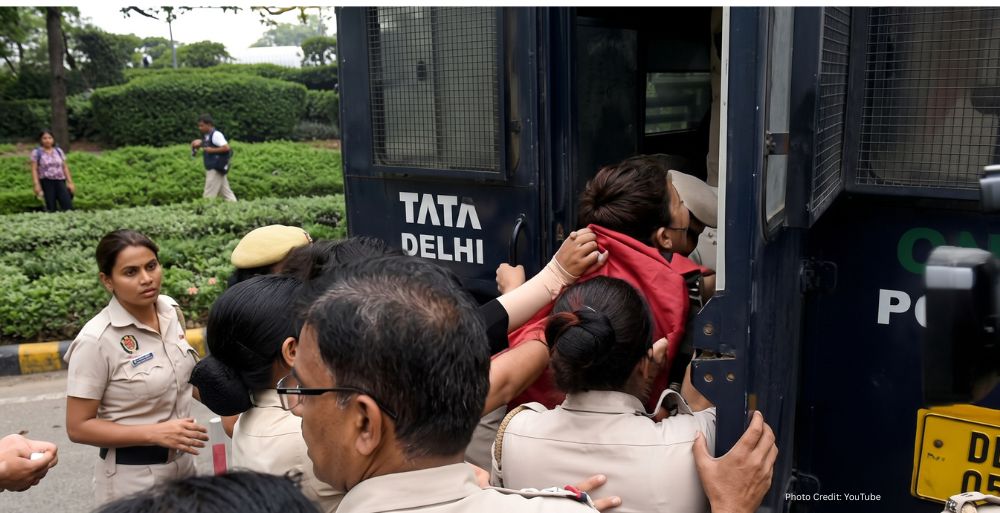
Moreover, Dipke’s recent experiences with the police have amplified his criticism. He was detained by Delhi Police on October 10 while attempting to travel to the capital for a protest, which he claims added to his family’s distress following the death of his grandmother. He alleged that police subjected him and his family to mental distress during his detention, stating, “They wanted to stress me out and give tension to my parents, who were already grieving my grandmother’s death. This was mental torture that my family and I faced due to Delhi Police.”
Dipke also disputed the police’s portrayal of the events surrounding his detention, alleging that they released an edited video to manipulate public perception. He claimed that the police did not allow him access to his mobile phone to contact family during his arrest, stating, “They should show the full video, especially the part where I asked for my phone to speak to my brother and my lawyers, and also the part where I was crying after they broke the news to me.” His allegations suggest a serious breach of protocol and sensitivity, particularly given the circumstances surrounding his family’s loss.
Implications for Civil Liberties
The denotification of Jantar Mantar has raised broader questions about the right to protest within India’s democratic framework. Activists like Dipke argue that such measures are indicative of an authoritarian drift in governance, as they restrict citizens’ ability to voice dissent effectively. The CJP, alongside other opposition groups, has previously organized demonstrations at Jantar Mantar, including significant protests against perceived injustices in the education system, highlighting its role as a critical space for public discourse.
In recent months, New Delhi has witnessed numerous protests, with security forces frequently deployed to manage crowds and prevent unrest, especially in sensitive areas near governmental institutions. The current political climate, marked by allegations of electoral malpractice, raises concerns about the implications of restricting protest sites. Activists fear that limiting access to protest locations could lead to civil disobedience and unrest as groups search for alternative means to express their grievances.
As political tensions continue to escalate, the denotification of Jantar Mantar serves as a flashpoint for ongoing debates about civil liberties, the right to protest, and the fundamental principles of democracy in India. Dipke’s assertions that such actions represent a war on the rights of citizens resonate with a growing cohort of activists and opposition leaders who are increasingly vocal in their dissent against the current administration.