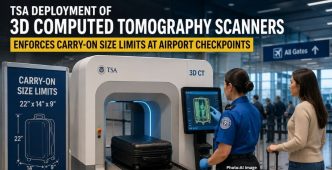

The Transportation Security Administration’s ongoing $781 million nationwide rollout of advanced 3D computed tomography (CT) scanners is fundamentally altering the airport screening process. While the upgraded systems expedite checkpoints by allowing passengers to leave electronics and liquids inside their luggage, they feature slightly smaller tunnel dimensions than legacy X-ray machines. This structural alteration forces strict practical enforcement of airline carry-on size limits, rejecting bags that exceed standard dimensions before travelers can proceed toward their gates.
WASHINGTON — A quiet technological shift at airport security lines across the United States is creating an unexpected hurdle for travelers accustomed to pushing the boundaries of carry-on baggage limits. The Transportation Security Administration (TSA) is rapidly deploying hundreds of next-generation Computed Tomography (CT) scanners as part of a massive infrastructure modernization program.
While the agency designed the multi-million-dollar technology upgrade to detect explosives and hidden threats with unparalleled precision, the physical constraints of the machinery are establishing a hard line for luggage dimensions. The new scanners feature slightly narrower entry apertures—the physical tunnels through which bags pass on the conveyor belt—compared to the older, more forgiving dual-view X-ray systems.
As a result, oversized or over-packed roller bags that previously slipped past gate agents are now physically jamming or failing to fit into the security machines entirely. When a bag cannot clear the scanner tunnel, the screening process comes to a halt. TSA officers must then direct the passenger back to the airline ticketing counters to formally check the piece of luggage, introducing unexpected delays and a potential risk of missing flights.
The Logistics of a $781.2 Million Modernization
The transition is anchored by large-scale procurement contracts valued at up to $781.2 million, which have introduced advanced 3D screening systems into more than 350 domestic airports. Major travel hubs including Miami International Airport (MIA), Denver International Airport (DEN), and Los Angeles International Airport (LAX) have overhauled their standard screening lanes to integrate these high-resolution systems.
Unlike standard X-ray machines that produce flat, two-dimensional projections, CT technology utilizes a rotating gantry to capture hundreds of sequential images. Sophisticated algorithms then combine these exposures into a highly detailed three-dimensional rendering of the bag’s interior. Security personnel can rotate, zoom, and isolate specific layers of the object on touchscreen interfaces, reducing false-alarm rates and minimizing the need for time-consuming manual bag searches.
However, the precision required for volumetric analysis demands a tightly controlled environment. The physical dimensions of the scanning tunnel are optimized to keep the item at a specific distance from the rotating radiation source. For example, standard models like the Smiths Detection HI-SCAN 6040 CTiX feature an entry tunnel measuring roughly 24.4 inches wide by 16.5 inches high.
While this accommodates bags meeting standard domestic rules, it leaves virtually zero margin for error for soft-sided suitcases that have bulged from over-packing, or luggage with protruding external wheels and handles.
Bridging the Enforcement Gap
For decades, the enforcement of baggage dimensions was primarily the responsibility of commercial airline gate agents. Most major domestic carriers—including Delta Air Lines, United Airlines, and American Airlines—maintain a strict maximum carry-on limit of 22 inches by 14 inches by 9 inches (56 cm x 35 cm x 23 cm). Despite these public rules, real-world enforcement historically varied depending on airline staffing, passenger volumes, and whether an agent chose to utilize metal baggage-sizing frames at the boarding gate.
The integration of the CT systems shifts this dynamic from a corporate checkpoint to a federal security baseline. In effect, the scanner tunnel acts as an automated, uncompromising measuring tool. If a bag exceeds the physical limits of the 24.4-by-16.5-inch aperture, it cannot move through the system, rendering it ineligible for carry-on transit.
“The rules regarding what you can bring onto an airplane haven’t actually changed,” noted Johnathan McCourt, a logistics analyst focusing on aviation infrastructure. “What has changed is where the bottleneck occurs. Travelers who used to stretch the rules with a slightly oversized duffel or an expanding roller bag are finding out that while a human agent might overlook an extra inch, a steel and lead-lined machine cannot.”
When a bag is rejected at the checkpoint mouth, the impact cascades. The traveler must leave the security line, return to the public concourse, queue at their airline’s check-in desk, pay any applicable checked-bag fees, and then re-enter the security screening queue from the beginning. During peak holiday or summer travel periods, this process can add 45 to 90 minutes to the pre-flight timeline.
Efficiency Gains Countered by Rigid Frameworks
Aviation data highlights why the federal government remains committed to the technology despite the adjustments required by passengers. According to industry reports from firms monitoring checkpoint throughput, the pairing of 3D CT scanners with Automated Screening Lanes (ASLs)—which utilize parallel divestment points and automatic tray return systems—increases passenger processing efficiency by 40% to 55% per lane.
The primary driver of this efficiency is that passengers are no longer required to remove large electronic items or liquid pouches from their luggage. Laptops, tablets, e-readers, and compliant toiletries can remain deeply packed within the bag, as the 3D software allows screeners to peer around dense objects electronically. This eliminates the traditional bottleneck where passengers crowd around conveyor belts trying to unpack and repack multiple gray plastic bins.
Yet, this efficiency gains a counterweight if passengers arrive unprepared. TSA statistics indicate that the agency screens roughly 3.3 million carry-on pieces daily across the United States. Even if a tiny fraction of a percentage of those bags jam or require rejection due to sizing issues, it introduces localized delays that affect the entire lane.
Unchanged Security Rules and Preflight Preparation
TSA officials continue to emphasize that while the scanning mechanisms have advanced, the baseline regulatory framework regarding prohibited items remains entirely intact. The agency’s long-standing 3-1-1 rule for liquids continues to govern standard screening lanes: passengers are restricted to liquid containers of 3.4 ounces (100 milliliters) or less, all of which must fit comfortably within a single, clear, quart-sized plastic bag.
Furthermore, standard security protocols remain in effect for other common items:
- Liquids & Gels: Beverages, creams, pastes, and gels exceeding 3.4 ounces must be packed in checked luggage, regardless of whether the checkpoint utilizes 3D scanners. Exceptions remain isolated to medically necessary liquids and infant formula.
- Sports Gear & Tools: Baseball bats, golf clubs, hiking poles, and tools longer than seven inches are strictly barred from the cabin and must undergo the traditional checked baggage screening process.
- Prohibited Items: Sharp objects, firearms, ammunition, and explosive materials will trigger immediate secondary screening, potential asset seizure, and civil penalties.
To navigate the increasingly automated environment, travel experts suggest a proactive approach to packing. Travelers should formally measure their luggage at home using the absolute outermost points, including wheels, top handles, and stuffed exterior pockets. Relying on the flexibility of soft-sided fabric bags is no longer a viable strategy if those bags deform past the structural limits of the automated screening lanes.
As airports continue to phase out legacy 2D X-ray systems over the coming years, the physical dimensions of luggage will increasingly dictate the speed of the travel experience. The automated environment promises shorter wait times for the prepared, but a rigid, non-negotiable roadblock for those who fail to adhere to standard airline dimensions.