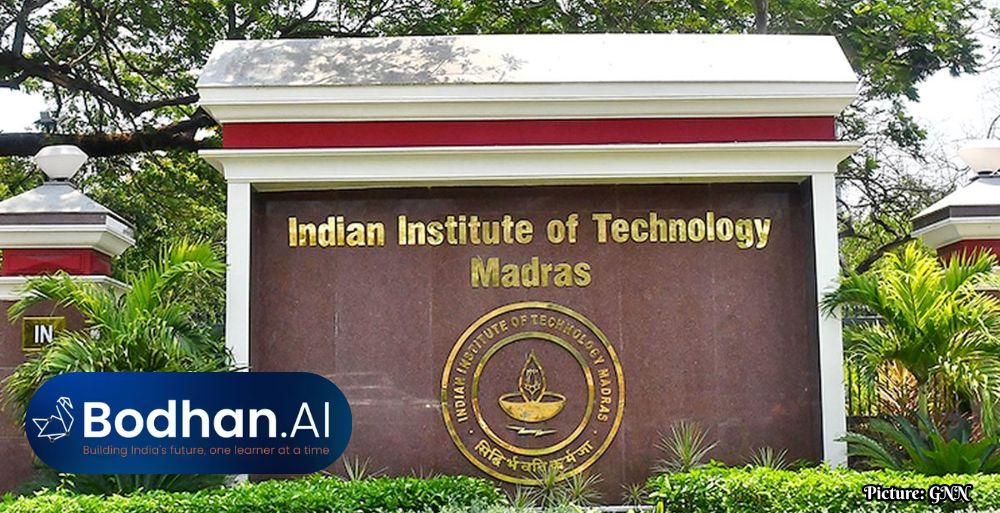
In a significant step toward enhancing education through technology, Bodhan AI, an AI center supported by IIT Madras, has unveiled four advanced AI models aimed at improving educational accessibility and engagement for students and teachers across India.
Bodhan AI, a center of excellence in artificial intelligence (AI) for education incubated at the Indian Institute of Technology (IIT) Madras, has officially launched four AI models designed to facilitate speech recognition, speech generation, machine translation, and optical character recognition (OCR). This initiative, undertaken in collaboration with AI4Bharat, aims to enhance educational opportunities in India’s diverse linguistic landscape.
The models are being released as Digital Public Goods, made available through open-weight models and hosted application programming interfaces (APIs) on a sovereign infrastructure. This initiative is part of the broader Bharat EduAI Stack, which seeks to establish a uniform AI infrastructure layer to support multilingual education across India.
Multilingual Capabilities of the Models
The newly released AI models cover a wide array of languages, including 27 languages for automatic speech recognition (ASR), 23 languages for OCR, 22 languages for machine translation via Bodhan-Translate, and 23 languages for text-to-speech (TTS). These multilingual capabilities aim to address the diverse educational needs of India’s vast population, which speaks over 120 languages.
The models have been trained and optimized using NVIDIA’s Nemotron open models and libraries, employing the NVIDIA NeMo framework for ASR, machine translation, and OCR. Bodhan AI has specifically post-trained the NVIDIA Nemotron 3.5 ASR for Indian languages, accommodating various regional dialects and accents. The deployment of these models leverages NVIDIA’s TensorRT-LLM and vLLM inference microservices, ensuring high performance and responsiveness.
Goals and Vision for Educational Infrastructure
Professor Mitesh Khapra, the Principal Investigator at Bodhan AI, articulated the project’s objective to create a unified infrastructure layer rather than allowing the development of separate AI systems for individual educational institutions. “We built these voice and vision models, and made them accessible as Digital Public Goods on a Digital Public Infrastructure, so that efforts across the country don’t remain fragmented,” Khapra stated.
This infrastructure is intended to empower educational technology (edtech) companies, startups, researchers, universities, and government partners to utilize these models for developing applications tailored to Indian users. The speech recognition model facilitates student interaction with AI tutors through voice in their preferred language, while the TTS model enables AI systems to respond in various Indian languages. The OCR model assists educational systems in processing a range of materials, including textbooks, worksheets, and handwritten responses. Bodhan-Translate provides a mechanism for translating educational content among Indian languages, enhancing accessibility.
Applications for Students and Teachers
Bodhan AI is also leveraging these models in its own educational applications, including the Student TutorBot and Teacher Assistant Bot. The Student TutorBot targets students in Classes 6–12, aligning with the National Council of Educational Research and Training (NCERT) and State Council of Educational Research and Training (SCERT) curricula. This interactive system allows students to engage with content through text or voice across 22 Indian languages, utilizing textbook material to deliver explanations, examples, and assessments, while also guiding students through problems using interactive tools.
The Teacher Assistant Bot aims to support educators in planning, creating, assigning, and assessing classroom activities. Teachers can generate lesson plans, worksheets, quizzes, and other materials by specifying parameters such as grade level, subject, topic, duration, and difficulty. Furthermore, teachers have the option to upload student work for evaluation based on established marking criteria, ensuring that AI-generated outputs remain subject to teacher review and oversight. This approach allows educators to edit, regenerate, or discard outputs as necessary, rather than relying solely on AI for classroom decisions.
Long-term Vision and Collaboration
Professor V. Kamakoti, Director of IIT Madras, underscored the significance of this initiative in broadening access to AI technologies across India’s linguistic diversity. “India’s AI journey cannot be built on technology alone. It must be built on technology that understands India,” Kamakoti remarked.
Additionally, Professor Balaraman Ravindran, Head of the Wadhwani School of Data Science and AI at IIT Madras, emphasized the need for developing AI that comprehends the richness and diversity of India’s languages, contexts, and educational requirements. “Building AI for India requires going beyond adapting existing models to Indian languages. It requires developing foundational capabilities that understand the richness and diversity of our languages, contexts and educational needs,” Ravindran stated.
The AI infrastructure provided by Bodhan AI is also intended for use by government and public institutions for multilingual education and other public-service applications. Edtech companies can integrate these models through APIs without the need to create foundational models independently, while startups and researchers can access the open-weight models for further adaptation and development.
Data Governance and Future Development
The hosted API infrastructure is being designed with a focus on a sovereign deployment approach, incorporating data anonymization protocols and compliance with relevant national education data frameworks. This strategic direction aims to provide institutions and ecosystem partners with enhanced control over deployment while adhering to data governance, privacy, and security requirements.
Furthermore, NVIDIA and Bodhan AI are collaborating on the development of datasets, training methodologies, and evaluation processes for future foundational AI models tailored for Indian languages. AI4Bharat is actively contributing its expertise in Indian-language datasets, tools, models, and applications to this comprehensive initiative.