
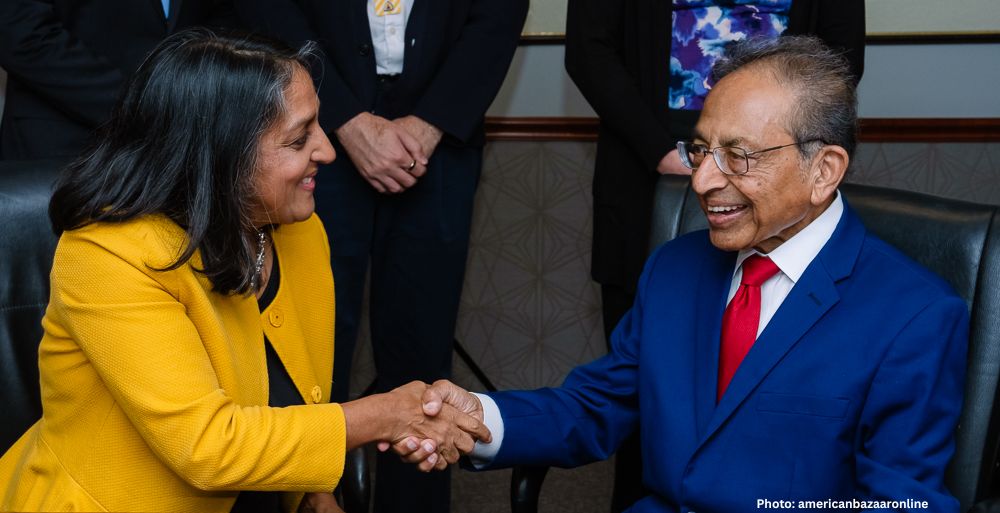
Dr. Navin C. Shah has committed $525,000 to establish the Navin C. Shah Infectious Disease Program at BJ Government Medical College in Pune, aimed at enhancing research, education, and patient care in infectious diseases.
In a significant philanthropic move, Indian American physician and philanthropist Dr. Navin C. Shah has pledged $525,000 to create an infectious disease program at BJ Government Medical College in Pune, Maharashtra. This initiative is the result of a collaborative effort with Johns Hopkins University in Baltimore and aims to bolster research, medical training, faculty exchanges, and patient care, particularly for underserved communities in Pune.
The formal agreement was signed at Johns Hopkins University, with Dr. Shah and Dr. Amita Gupta, the Florence Sabin Professor of Infectious Diseases and director of the Division of Infectious Diseases at Johns Hopkins School of Medicine, participating in the signing ceremony. Dr. Gupta has extensive experience in infectious disease research in India, having worked in the field for over two decades.

The newly established program, named the Navin C. Shah Infectious Disease Program, represents a substantial investment in a long-standing academic partnership between Johns Hopkins and BJ Government Medical College, which is one of the major public medical institutions in Pune.
Objectives of the Program
Dr. Shah, a Potomac, Maryland resident and BJ Government Medical College alumnus, expressed his commitment to enhancing the institution’s capabilities in training and education focused on infectious diseases. “The purpose is to help my medical school in training, education, research and patient care as far as ID (infectious diseases) is concerned,” he stated in an interview following the signing ceremony.
Having grown up in Pune, Dr. Shah views this initiative as both a professional commitment and a personal endeavor to give back to the institution that shaped his medical career. He noted, “It is a win-win situation for me because not only my medical college will be benefited in the training, education, research and patient care, but other people, other hospitals which are treating poor patients in Pune will be benefited.”
Focus on Public Health Challenges
The program will concentrate on addressing infectious diseases that pose significant public health challenges in India, including tuberculosis (TB), HIV, and infections resistant to common antibiotics. Dr. Gupta emphasized the ongoing collaboration between Johns Hopkins researchers and BJ Government Medical College, which has been active since 2003, covering a broad range of infectious disease projects.
“The work that we do includes research to new treatments for TB, HIV, and highly drug-resistant infections in adults, children, and pregnant women,” Dr. Gupta explained. The partnership also encompasses medical education and training for doctors and nurses, as well as exchanges involving students and faculty from both Johns Hopkins and institutions in Pune.
Dr. Gupta highlighted the critical role of BJ Government Medical College in serving economically disadvantaged patients, stating, “BJ Medical College is well known for really being the public hospital taking care of the poorest of the poor in Pune.” The funding from Dr. Shah will help expand activities that may not be sufficiently covered by traditional research grants, including establishing a patient care fund for treatment and related needs.
Strengthening International Collaboration
The program is anticipated to strengthen the exchange of medical expertise between India and the United States. Dr. Shah indicated that the arrangement will involve visits by four Johns Hopkins faculty members to India and two faculty members from BJ Government Medical College to the United States, along with student and medical resident exchanges. An annual seminar is set to launch on December 4, aiming to facilitate knowledge sharing among medical experts from Pune and other regions in India.
Dr. Shah pointed out that BJ Government Medical College’s affiliated hospital has approximately 1,800 beds and serves a large number of patients from economically disadvantaged backgrounds. This initiative is expected to enhance the institution’s capabilities in diagnosing and treating infectious diseases.
Historical Context and Ongoing Collaboration
The new initiative builds upon the existing relationship between Johns Hopkins researchers and medical institutions in Pune, which began with efforts to prevent HIV transmission from mothers to their children. Dr. Gupta recalled her arrival at Johns Hopkins in 2003, motivated by the chance to work in India, and credited Dr. Robert Bollinger, a Johns Hopkins physician, with facilitating early collaborations involving BJ Medical College and India’s National AIDS Research Institute.
Over the years, the partnership has expanded significantly, with research focusing on new TB drugs, TB vaccines, diagnostics, and treatments for HIV, as well as addressing drug-resistant infections. Dr. Gupta noted that this collaboration provides a two-way learning experience, enhancing the expertise of both American and Indian medical professionals.
Dr. Gupta emphasized the importance of philanthropic contributions, which offer flexibility that conventional grant funding often lacks, allowing researchers to explore innovative ideas and expand educational opportunities. “Without the support of philanthropists such as yourself, much of what we do, we go hand to mouth with our grants,” she told Dr. Shah during the ceremony.
Future Implications and Goals
Dr. Shah’s contribution is not only a vital investment in BJ Government Medical College but also a call to action for other alumni and members of the Indian diaspora to contribute to healthcare and education in India. “One of the goals of his gift is to get other alumni from BJ Medical College or those who care about Pune and India to be generous with their philanthropic giving,” Dr. Gupta stated.
For Dr. Shah, this initiative marks a return to his roots and an investment in the institution where his medical journey began. He expressed hope that the program would enhance BJ Government Medical College’s capabilities in infectious disease treatment. He outlined that the funding would be allocated over five years, with an annual contribution of $105,000, and hinted at the possibility of extending support beyond the initial commitment to include other areas such as kidney and lung diseases.
At the signing ceremony, Dr. Shah was accompanied by his daughter, Shefali Shah, and son, Dr. Amit Shah, who is also a physician, highlighting the familial commitment to advancing healthcare education and research.