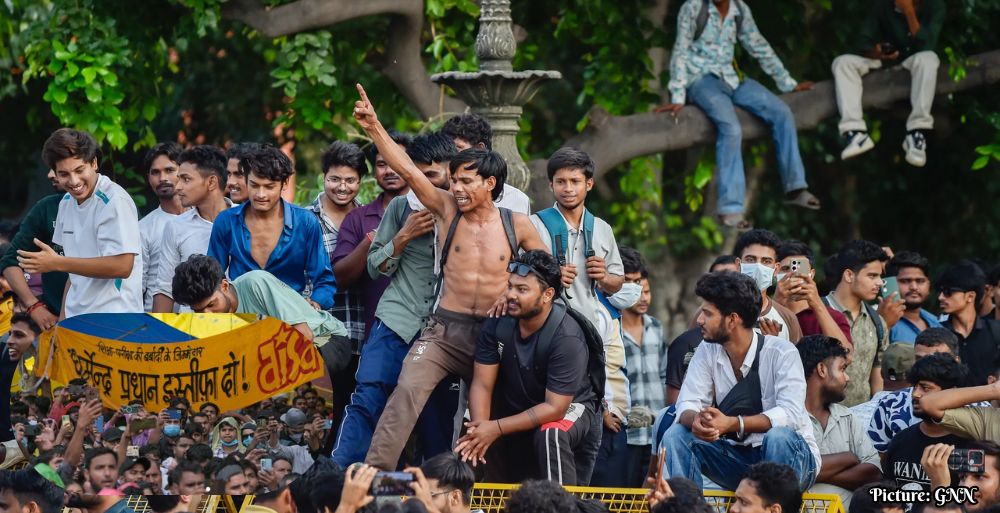
Recent protests led by India’s Gen Z have emerged as a significant challenge to Prime Minister Narendra Modi’s authority, reflecting deep-seated frustrations over unemployment and government failures.
NEW DELHI—In a surprising turn of events, Prime Minister Narendra Modi’s 12-year tenure is being challenged by a new wave of protests led by India’s Gen Z, sparked by comments from India’s Supreme Court Chief Justice that likened the unemployed youth to “cockroaches.” The protests, which have gained momentum since June 2023, highlight the growing discontent among young Indians regarding the state of employment and education in the country.
The protests began on June 1, when Abhijeet Dipke, a 30-year-old student studying in Boston, responded to the Chief Justice Surya Kant’s derogatory remarks by forming the Cockroach Janta Party (CJP). This satirical movement quickly gained traction online, amassing over 20 million followers on Instagram within days, surpassing the following of Modi’s Bharatiya Janata Party (BJP). This online mobilization was a direct response to widespread frustrations over the government’s handling of educational opportunities.
Context of the Protests
India’s youth have faced significant challenges, including a recent scandal involving paper leaks in a medical school entrance exam. The cancellation of the test led to immense pressure on students, with over two million candidates vying for just 140,000 spots. Tragically, reports indicate that at least 20 students committed suicide as a result of the stress and despair stemming from these failures.
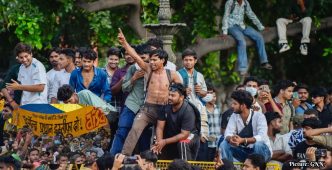
As protests unfolded at Jantar Mantar, a traditional protest site in New Delhi, the movement quickly grew, drawing attention to the issues faced by young people in India. On June 28, the protests escalated when noted activist Sonam Wangchuk joined the hunger strike demanding the resignation of the education minister, further amplifying the movement’s visibility.
Government Response and Escalation
Despite initial assumptions that the Modi administration would ignore or co-opt the protests, the government’s reaction was swift and forceful. On July 18, police violently dispersed the protestors, forcibly removing Wangchuk and others from the site after 20 days of hunger strike. This crackdown led to an outpouring of solidarity, with tens of thousands attending the protests in response to images of police violence spreading rapidly across social media.
The protests attracted individuals from various backgrounds, including Prashantkumar Dhramshibhai Patel, a lawyer whose son tragically took his life due to the pressures associated with the education system. Patel stated, “The system has to change,” reflecting the sentiments of many who feel let down by the current state of affairs.
On July 20, as protestors attempted to march toward the Indian Parliament, they faced police aggression characterized by the use of batons, tear gas, and pellet guns, resulting in injuries to over 100 individuals. These violent confrontations only fueled further public outrage, leading to similar protests in major cities like Kolkata, Mumbai, and Patna, thereby creating a nationwide movement.
Historical and Political Context
Historically, Modi has cultivated a strong political brand rooted in promises of accountability and change, positioning himself as a decisive leader capable of cutting through bureaucratic inefficiencies. However, the recent protests signify a critical shift. While Modi has effectively controlled institutional politics, the emergence of grassroots movements indicates a failure to address the needs of young citizens.
Comparisons have been drawn to previous protest movements, such as the India Against Corruption movement in 2011, which similarly challenged the political status quo. The Gen Z protests are distinct in their use of digital platforms, leveraging social media to create a vibrant alternative public sphere that bypasses traditional media narratives often dominated by pro-government sentiment.
Public Sentiment and the Future
The sentiment among protestors is one of collective frustration, as many young Indians experience a prolonged period of “waithood”—an extended delay between education and employment opportunities. Current statistics reveal that India’s youth unemployment stands at alarming levels; a report from Azim Premji University indicates that graduates constitute 67% of the unemployed in the 20-to-29 age group. This stark reality underscores the disconnect between educational attainment and job availability.
Moreover, the National Crime Records Bureau has reported a troubling rise in student suicides, with over 1,23,000 cases between 2014 and 2024 attributed to academic pressures and familial stress. Amid these statistics, the protests have emerged as a potent symbol of resistance against a system perceived as neglectful and oppressive.
In conclusion, while the protests may not pose an immediate threat to Modi’s government, they have undeniably challenged the narrative of his invincibility. The resilience of India’s youth, fueled by their frustrations and a desire for change, highlights the limitations of Modi’s political control and raises questions about the future direction of his administration.