The Old Farmer’s Almanac has released its highly anticipated long-range weather forecast for the 2026–2027 winter season, predicting a predominantly mild and near-normal climate profile across broad swathes of the United States. While the annual publication anticipates milder baseline temperatures for the majority of the country, it warns that specific geographic pockets—particularly areas impacted by major storm systems last January—may still experience severe cold snaps and elevated snowfall. The release has reignited the enduring divide between centuries-old folklore-based forecasting methodologies and professional meteorologists, who emphasize that late-summer seasonal projections lack scientific predictability due to shifting ocean-atmospheric phenomena such as El Niño.
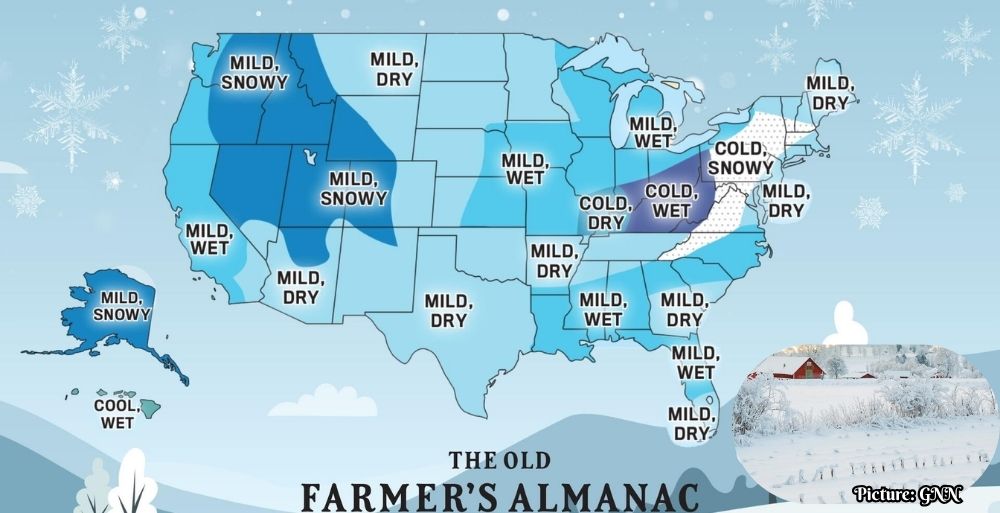
WASHINGTON — The Old Farmer’s Almanac published its annual winter weather outlook on late Friday ahead of its physical newsstand release on Tuesday, Sept. 1. The 234-year-old publication envisions a overall “mostly mild” 2026–2027 winter for a vast majority of the continental United States. However, the forecast cautions that regional variances will be stark, pointing toward heightened precipitation across western states and potential cold snaps for communities still recovering from the historic blizzards that crippled parts of the nation in January.
According to the newly released metrics, a wetter-than-normal winter pattern is anticipated across extensive portions of the American West, extending eastward into regions of the Midwest, the South, and Florida. Conversely, drier conditions are projected for the East Coast, the Great Plains, and the Southwest. Snowfall projections diverge sharply by geography, with above-average accumulation forecasted across the Pacific Northwest, sections of the Intermountain West, Alaska, and elevated terrains along the Northern Appalachians and Northeast.
Scientific Skepticism Meets Tradition
Despite the popular culture surrounding the release of traditional almanacs, professional meteorologists and atmospheric researchers maintain a skeptical distance from long-range seasonal predictions published in late summer. Modern scientific consensus holds that granular weather forecasts produced months in advance rely on secret formulas that cannot be independently peer-reviewed or verified using atmospheric physics.
Addressing the media landscape following the release, Don Day, a veteran meteorologist with Wyoming’s Cowboy State Daily, expressed deep reservation regarding August weather projections. Speaking earlier this month regarding early-season publications, Day criticized the practice of releasing hyper-specific seasonal outlooks before key global climate drivers fully materialize.
“I don’t know what voodoo magic they use to get their forecasts,” Day stated during a press briefing analyzing regional atmospheric trends. “I don’t think we should be talking about any detailed winter forecast till maybe mid to late September. Until then, it’s not helpful for anybody.”
Day noted that previous long-range seasonal projections often fail when unpredicted atmospheric blocking patterns develop. Atmospheric conditions like the Quasi-Biennial Oscillation (QBO) and the exact trajectory of equatorial Pacific sea-surface temperatures are still in flux as late-summer transitions into early autumn.
Divergent Models and Federal Climate Outlooks
While atmospheric scientists advise caution, the Old Farmer’s Almanac’s broad baseline predictions align closely in certain aspects with official government data. The National Oceanic and Atmospheric Administration’s (NOAA) Climate Prediction Center recently released its official three-month probabilistic outlook covering December 2026 through February 2027.
Federal data points to a high probability of equal-to-above-normal temperatures across much of the contiguous United States, mirroring the Almanac’s overarching “mostly mild” narrative. On the precipitation front, NOAA’s models suggest:
- Northern Tier: Normal to below-normal total precipitation across northern states.
- Southern & Eastern Corridors: Above-average precipitation spanning the Southwest, Central Plains, Gulf Coast, Mid-Atlantic, and Northeastern states.
Adding to the competitive landscape of legacy forecasting, the separate publication known as the Farmers’ Almanac (founded in 1818) also issued a winter outline indicating an overall wet season. However, its proprietary methodology foresees quick, volatile bursts of severe cold and rapid snow events across northern regions, alongside complex icy mixes of rain, sleet, and heavy slush throughout the Northeast urban corridor.
Financial and Operational Impacts of Winter Trends
The socioeconomic stakes of winter long-range forecasting remain significant for municipal governments, agricultural operators, energy markets, and transportation sectors. The severe winter storms of January 2026 demonstrated the economic exposure of critical infrastructure, causing widespread power grid disruptions, travel cancellations, and municipal budget strain due to emergency road salting and snow removal costs.
For agricultural producers and municipal planners, early predictions serve as a preliminary, albeit informal, gauge for seasonal resource allocation. Municipal public works departments typically finalize contracts for bulk road salt, de-icing chemicals, and seasonal equipment maintenance between late August and October. Meanwhile, retail supply chains utilize early weather indicators to manage inventory for heating oil, residential snow blowers, and winter apparel.
As global climate dynamics continue to introduce variability into traditional seasonal norms, meteorologists emphasize that long-range almanacs should be viewed primarily as cultural artifacts rather than deterministic planning tools. Official, actionable forecasts will be continuously updated by federal agencies as atmospheric modeling inputs stabilize closer to the onset of meteorological winter in December.