India is poised to launch its first indigenous bullet train service by August 2027, marking a significant advancement in its engineering capabilities and high-speed rail network.
India is set to revolutionize its transportation infrastructure with the anticipated launch of its first indigenous bullet train service, expected to commence operations by August 2027 on the Surat–Bilimora section of the Mumbai-Ahmedabad bullet train project. This initiative signals India’s entry into an elite group of nations with high-speed rail networks, underscoring the country’s ambition to enhance its engineering prowess and manufacturing capabilities.
Investment and Manufacturing Plans
The project is backed by a substantial investment, with a contract worth Rs 866.87 crore awarded to BEML Limited by the Integral Coach Factory (ICF) in Chennai. This contract involves the design, manufacture, and commissioning of two prototype bullet train sets, each comprising eight coaches, designed to reach speeds exceeding 250 km/h. The anticipated design speed for these trains is set at 280 km/h, with plans to eventually develop trains capable of reaching speeds of 350 km/h.
These bullet trains will feature fully air-conditioned chair cars equipped with modern passenger amenities such as advanced infotainment systems, reclining seats, and facilities for differently-abled passengers. A dedicated ‘Aditya’ High-Speed Rail Complex has been established by BEML in Bengaluru to facilitate the manufacturing of these advanced train sets, which are codenamed B-28.
Technological and Engineering Advances
The manufacturing of bullet trains presents distinct challenges compared to traditional Indian Railways coaches. Experts emphasize that building bullet trains requires advanced engineering capabilities that extend beyond simply achieving higher speeds. Key requirements include lightweight yet robust design, sophisticated wheel and suspension systems, and advanced train control systems to ensure safety and passenger comfort during rapid travel.
India’s focus on developing bullet trains involves mastering technologies such as high-performance motors, world-class braking systems, and designs that can efficiently handle aerodynamic pressures. Sudhanshu Mani, a former General Manager of ICF and an architect of the Vande Bharat train, notes that achieving a design for high-speed trains represents an engineering milestone. He highlights the necessity for innovative solutions, such as aerodynamic car body designs and advanced bogie and suspension systems, to ensure ride stability and comfort.
Testing and Development Challenges
A significant hurdle in the development of these trains is the absence of a dedicated high-speed testing track, which is essential to rigorously evaluate the trains before they are put into passenger service. Without such infrastructure, ensuring the safety and reliability of the trains poses a substantial challenge. Despite this setback, experts remain optimistic that India can overcome these obstacles as it gains experience through the bullet train program.
According to Mani, the transition from traditional manufacturing to creating high-speed trains will necessitate comprehensive upgrades to existing facilities and processes. The need for lightweight construction using materials such as aluminum, which would require a different supply chain, further complicates this transition.
Cost Benefits and Export Potential
One of the major advantages of manufacturing bullet trains in India is cost reduction. Experts suggest that indigenous high-speed trains could be priced at less than half the cost of imported equivalents. This cost efficiency could lead to the establishment of a robust local manufacturing ecosystem, creating opportunities for exports to middle-income countries once the technology is proven domestically.
Beyond the financial implications, the successful development and deployment of indigenous bullet trains would significantly elevate India’s global standing in transportation technology. Aniket Dani, Director of Crisil Intelligence, points out that this achievement would position India as a formidable player in high-speed rail technology and open avenues for the export of rolling stock, signaling systems, and engineering services to various regions.
Future Rail Projects
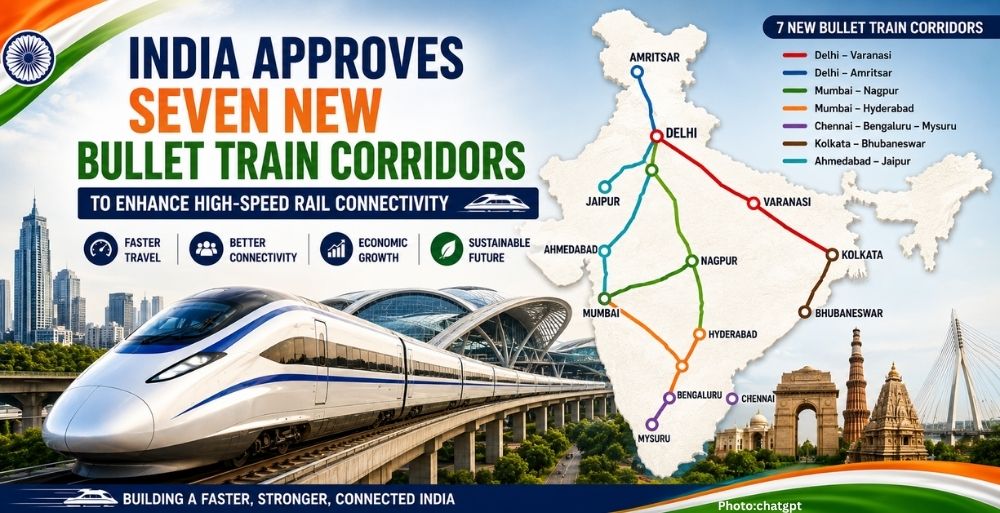
The Mumbai-Ahmedabad bullet train project is just one of several ambitious high-speed rail initiatives being pursued by Indian Railways. The recent budget announcement includes plans for seven additional high-speed rail corridors, which, if developed, would further enhance India’s transportation infrastructure and demand for locally manufactured rolling stock.
The proposed corridors span several key routes, including Mumbai-Pune, Pune-Hyderabad, and Chennai-Bengaluru, among others. As the Indian Railways continues to innovate with projects like the Vande Bharat Express, the forthcoming bullet trains promise to enhance passenger convenience and usher in a new era of advanced engineering capabilities in the country’s rail network.
Broader Implications for India’s Technological Sovereignty
Achieving success in bullet train manufacturing would not only signify an engineering leap but also bolster India’s broader technological sovereignty in transport infrastructure. Countries such as Japan and China have established themselves as leaders in high-speed rail, and India’s entry into this domain could strengthen its geopolitical standing and soft power on the global stage.
Experts believe that the engineering knowledge gained through this project will likely benefit other sectors, such as aerospace and defense, which demand similar technological expertise. According to Dani, the capabilities cultivated through high-speed rail manufacturing could significantly reduce lifecycle costs as maintenance, spare parts, and future fleet expansions become less dependent on foreign suppliers.
Conclusion
In conclusion, India’s ambitious plan to develop its bullet train capabilities embodies a transformative vision for its transportation sector. It stands to not only enhance domestic travel experiences but also position India as a competitive player in the global rail manufacturing market. If successful, this initiative could pave the way for a new era of high-speed rail travel that balances modernity with the unique demands of the Indian environment.