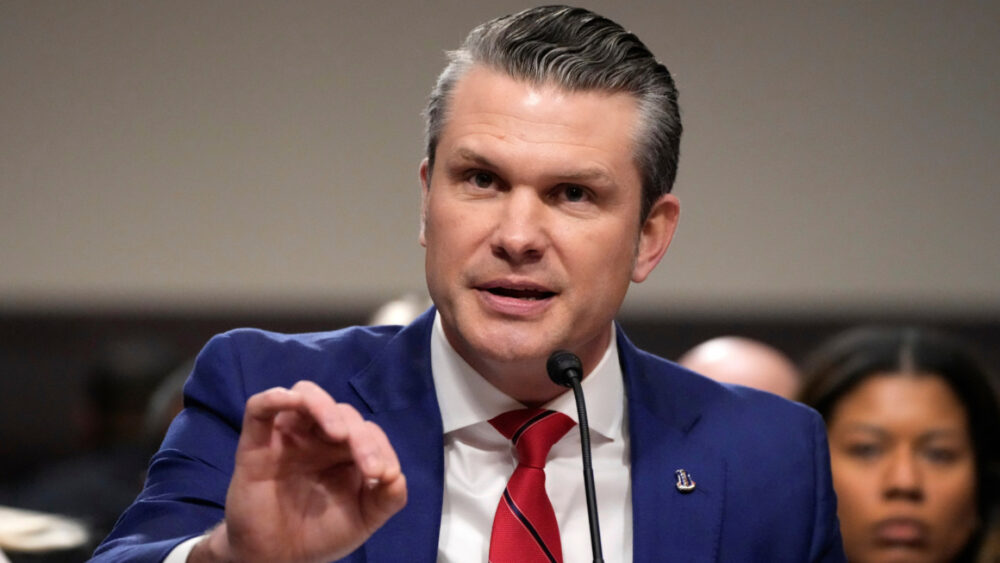
SINGAPORE — U.S. Defense Secretary Pete Hegseth strongly defended American defense policy in the Indo-Pacific on Saturday during a high-stakes address at the Shangri-La Dialogue in Singapore. Responding to mounting anxieties from regional allies, Hegseth rejected assertions that the ongoing military conflict with Iran has forced Washington to deprioritize its strategic commitments in Asia. Despite the recent, highly controversial suspension of a $14 billion munitions package to Taiwan—a measure enacted to preserve stockpiles for the Middle Eastern theater—Hegseth maintained that the United States possesses the industrial capacity to manage multiple global obligations simultaneously. The defense secretary coupled these reassurances with a sharp challenge to Asian partners, demanding they elevate their domestic defense spending to a minimum threshold of 3.5% of Gross Domestic Product (GDP). His remarks drew a mixed reception at the summit, exposing a widening philosophical divide between Washington’s emphasis on “combat power” and the region’s preference for diplomatic neutrality.
Addressing the Dual-Front Strategic Challenge at the Shangri-La Dialogue
SINGAPORE — Speaking before a plenary session of defense ministers, military commanders, and intelligence chiefs at the annual Shangri-La Dialogue—organized by the International Institute for Strategic Studies (IISS) think tank—U.S. Defense Secretary Pete Hegseth sought to dismantle growing international concerns regarding the dilution of American military power in the Pacific.
The security summit occurred against a backdrop of heightened global instability, as the United States navigates an active, resource-intensive war with Iran while attempting to maintain its traditional deterrence posture against China’s expanding military footprint in the South China Sea and Taiwan Strait.
The core of the regional anxiety was articulated directly during the Saturday morning session by Japanese Defense Minister Shinjiro Koizumi. In a structured question-and-answer period, Koizumi pointedly asked Hegseth to address underlying worries that Washington’s resources are being stretched past their limits. Koizumi warned the forum that certain adversarial nations might “underestimate” the current level of American commitment to its Asian security pacts, seeking to actively “drive a wedge” between the United States and its regional allies during a period of geopolitical distraction.
Hegseth rejected the premise that the United States is withdrawing or shifting its focus away from the Pacific command theater. Standing before the delegation, Hegseth asserted that the fundamental pillars of the U.S. National Defense Strategy remain explicitly tied to long-range power projection in the Pacific and deep operational integration with allied forces.
“People want to conflate that we have global obligations with the turning of our backs to this region,” Hegseth stated, maintaining a firm, deliberate cadence. “We can do two things at one time. We are quietly but very strongly working with allies with a substantive, serious approach to the Pacific, while maintaining global obligations to ensure that, say, Iran doesn’t get a nuclear weapon.”
The Taiwan Arms Suspension and Munitions Production Realities
The primary flashpoint of the dialogue centered on the practical logistics of American military aid. A participant at the forum challenged Hegseth over the White House’s recent decision to freeze a finalized $14 billion (£10 billion) foreign military sales package to Taiwan. The administration had suspended the transfer of advanced anti-ship missiles, artillery, and air defense systems to conserve critical munitions reserves for active operations in the Iranian theater. Critics have argued the freeze sends a dangerous signal to Beijing regarding the reliability of American defense supply lines.
Hegseth sought to decouple the suspension from long-term U.S. strategic reliability, asserting that America’s broader defense industrial base remains fundamentally secure. He argued that current manufacturing trajectories and defense stockpiles place the nation in a highly resilient position.
“I would very much decouple the two issues,” Hegseth responded, downplaying concerns regarding a broader logistics shortfall. He insisted that the United States remains in a “very strong position” regarding its total munitions inventory and possesses the scalability to accelerate manufacturing pipelines to meet outstanding allied requests.
Throughout his formal address, Hegseth contrasted what he characterized as the administration’s “strong, quiet, and clear” defense posture against traditional diplomatic conventions. He invoked an updated iteration of Theodore Roosevelt’s foreign policy doctrine, describing Washington’s current strategy as an intention to wield a “big stick” while intentionally speaking softly.
In a notable departure from previous administrations, Hegseth explicitly dismissed what he termed “empty globalist rhetoric about the rules-based international order,” drawing a sharp murmur from the assembled diplomatic corps.
“Rules are great, but if you can’t back them up with hard power, the rules are not worth the paper they are written on,” Hegseth said, gesturing toward the audience. “We don’t need more conferences, we need more combat power… less Shangri-La Dialogue, more ships and more subs.”
The defense secretary’s direct critique of multilateral diplomatic forums occurred just hours after Vietnamese President To Lam delivered the summit’s keynote address. Lam had utilized his platform to issue an earnest call for enhanced multilateral dialogue, institutional diplomacy, and adherence to international law as the sole viable mechanisms to resolve escalating territorial frictions in the South China Sea.
Budgetary Demands and the “Freeloader” Debate
A central objective of Hegseth’s regional tour was the enforcement of stricter defense burden-sharing metrics among Indo-Pacific partners. Replicating a policy demand deployed during the prior year’s summit, Hegseth explicitly called on Asian allies to aggressively scale up their domestic defense allocations, establishing a firm target of 3.5% of their national GDP.
The defense secretary praised a select group of allied nations that have executed recent, measurable expansions in their military budgets and joint operational training exercises with U.S. Indo-Pacific Command. He specifically acknowledged the defense trajectories of South Korea, Japan, Australia, and the Philippines, noting their increased willingness to anchor regional deterrence frameworks.
However, the tone of the session shifted dramatically during a subsequent press exchange when Hegseth criticized nations he deemed delinquent in their fiscal commitments, categorizing New Zealand as a “freeloader” under current spending metrics. He expanded his critique globally, warning that “Europe and NATO have some big decisions to make” regarding their baseline defense contributions.
The public reprimand prompted an immediate, defensive rebuttal from Wellington. In an interview with the BBC conducted shortly after the plenary adjourned, New Zealand’s Defense Minister rejected Hegseth’s characterization.
“New Zealand is not a freeloader,” the defense minister stated, pointing to recent policy changes designed to reverse “historic under-investment” by systematically elevating defense outlays toward a target of 2% of GDP. The exchange highlighted the ongoing friction between Washington’s aggressive fiscal expectations and the domestic budgetary constraints of its smaller partners.
Shifting Rhetoric on Beijing Following the Trump-Xi Summit
Despite his aggressive stance on hard power and defense spending, Hegseth’s specific rhetorical treatment of China was noticeably altered compared to his previous international appearances. The shift occurred just weeks after U.S. President Donald Trump engaged in extensive bilateral talks with Chinese President Xi Jinping during a high-profile state visit to Beijing. During that summit, President Xi had explicitly reiterated that the status of Taiwan remains the absolute “red line” and the most critical structural flashpoint in U.S.-China bilateral relations.
In a marked contrast to his address at the 2025 Shangri-La Dialogue—where he openly accused Beijing of posing an “imminent military threat” to Taiwan—Hegseth’s 2026 remarks avoided direct provocations. He did not explicitly mention Taiwan during his prepared speech, only addressing the island democracy when directly pushed by the forum’s participants during the open panel.
Hegseth acknowledged that while there remains a “rightful alarm regarding China’s historic military buildup,” Washington recognizes that its partners across Asia do not favor an atmosphere of perpetual escalation.
“Our allies do not seek constant escalation,” Hegseth noted, adopting a more measured, analytical tone. “Instead, they desire a balance of power in which no state, including China, can impose its hegemony.”
He stated that the ultimate goal of U.S. regional policy is to preserve a “genuinely stable equilibrium” that protects the foundational conditions underwriting long-term economic prosperity and peace in Asia. “We do not approach this challenge with needless confrontation,” Hegseth concluded, “but with the posture of measured and deliberate strength.”
Regional Security Experts Weigh the Impact of “The Language of War”
The Shangri-La Dialogue has historically functioned as a premier, neutral arena where Washington and Beijing directly negotiate and debate security frameworks before a regional audience. However, for the second consecutive year, China declined to send its Minister of National Defense to the summit, electing instead to deploy a lower-level, non-cabinet military delegation.
Strategic analysts divided over the meaning of the reduced presence. Some Western observers interpreted the lower-level delegation as a deliberate snub of the Western-backed forum. Conversely, regional diplomatic sources suggested that Beijing was intentionally lowering the profile of its delegation to avoid a highly public, adversarial showdown with the United States at a time when both superpowers are engaged in delicate economic and diplomatic recalibrations following the Trump-Xi summit.
The reception of Hegseth’s hard-power doctrine among Southeast Asian nations remained highly cautious. Security analysts noted that the defense secretary’s rhetoric may clash with the entrenched diplomatic culture of the Association of Southeast Asian Nations (ASEAN), which prioritizes institutional neutrality and consensus-based diplomacy over military bloc alignment.
Muhammad Faizal Bin Abdul Rahman, a prominent regional security expert and research fellow at Singapore’s S. Rajaratnam School of International Studies (RSIS), expressed skepticism regarding the long-term efficacy of Washington’s current messaging strategy.
“It is uncertain if Hegseth’s language of war will resonate well with Asian countries that fundamentally favor peace and neutrality,” Rahman noted in an analytical brief following the session. He emphasized that Hegseth’s insistence on absolute U.S. military dominance suggests a regional architecture optimized exclusively for American strategic advantage.
“This unilateral framework worked effectively in the past, but it faces severe structural resistance today when a rising power, China, operates as a genuine near-peer adversary,” Rahman added. He warned that the persistent threat of U.S.-China competition transforming into an open military confrontation will continue to sustain deep-seated anxieties among Asian capitals caught between their security reliance on Washington and their economic interdependence with Beijing.