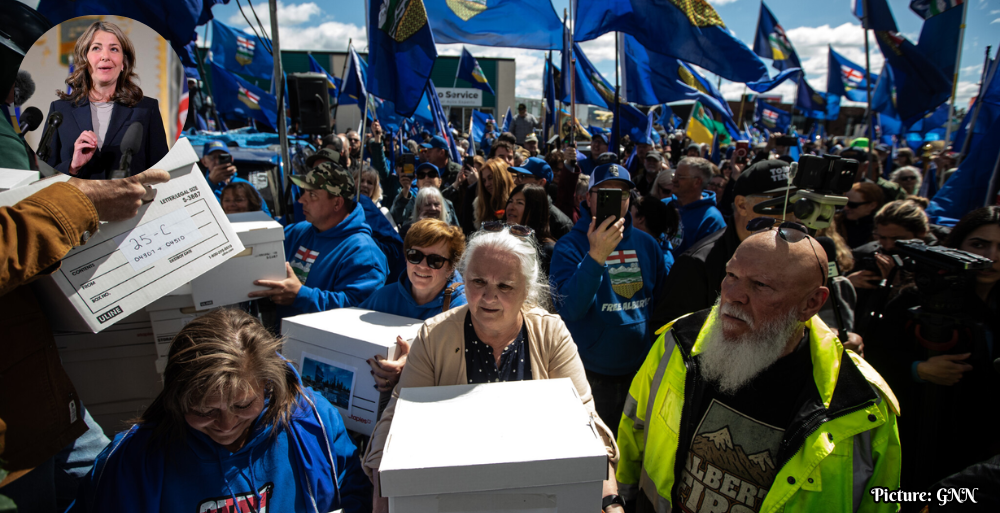
Alberta will conduct a referendum on October 19, 2023, to determine whether the province should remain part of Canada or initiate a process to separate, following significant public support for both independence and unity petitions.
In a landmark decision, Alberta Premier Danielle Smith announced on Thursday that the province will hold a referendum on whether to remain a part of Canada or to proceed with a second binding vote on independence. This announcement marks a significant moment in Canadian politics, as it tests the unity of the country decades after similar sentiments were expressed in Quebec.
The referendum is scheduled for October 19, 2023, and follows a citizen-led petition that garnered over 300,000 signatures advocating for separation, alongside another petition that collected more than 400,000 signatures in favor of remaining in Canada. The growing separatist movement in Alberta has been fueled by a longstanding belief among many Albertans that their province is often overlooked by federal decision-makers in Ottawa.
Public Opinion and Political Context
Despite the significant number of signatures on both sides, opinion polls indicate that a majority of Albertans would likely vote against separation. In her televised address, Premier Smith stated the question on the ballot will be: “Should Alberta remain a province of Canada or should the Government of Alberta commence the legal process required under the Canadian Constitution to hold a binding provincial referendum on whether or not Alberta should separate from Canada?” Smith emphasized her personal position, asserting, “That is how I would vote on separation in a provincial referendum, and that is also the position of my government and my caucus.”
However, the premier expressed concern regarding a recent court ruling that dismissed a petition for a referendum on separation. The judge ruled that Indigenous First Nations groups had not been adequately consulted, infringing on their rights. This ruling halted the verification of the signature collection for the separation petition, casting uncertainty over the referendum process. Smith asserted, “As Premier, I will not have a legal mistake by a single judge silence the voices of hundreds of thousands of Albertans. Alberta’s future will be decided by Albertans, not the courts.”
Historical Precedents
Canada’s history with separatist movements is notably marked by Quebec’s two referendums on independence, the most recent being in 1995, which resulted in a narrow defeat for the pro-independence side with a vote of 50.58% against separation and 49.22% in favor. In the aftermath, the Canadian government established the Clarity Act, which outlines the legal framework for any province seeking to separate. The Act stipulates that any referendum must provide a clear question and that a “clear majority” of voters must be in favor for it to be considered valid.
Prime Minister Mark Carney has reiterated that any attempt by Alberta to separate must adhere to the Clarity Act’s guidelines. If separation were to occur, it would initiate a complex negotiation process with the federal government to finalize the terms of the divorce. Smith acknowledged the rising tensions between Alberta and Ottawa, pointing to long-standing frustrations over resource management and perceived federal overreach in provincial affairs.
Current Political Dynamics
The sentiment for independence has been fueled by perceptions that Alberta, rich in oil and gas resources, contributes more to the federal government than it receives in return. Many Albertans feel that federal policies, particularly those aimed at climate change, have hindered the province’s resource development. Smith voiced these concerns, stating, “I categorically reject Ottawa’s attempts to move towards a more centralized American-style system and call on all provincial leaders and MPs to undo the extensive damage that centralization of power in Ottawa has done to our country economically and with respect to national unity.”
In recent months, Premier Smith has collaborated with Prime Minister Carney on initiatives aimed at addressing these grievances, including plans for a long-sought oil pipeline to the Pacific coast. This partnership led to the announcement of a climate and energy deal earlier this month, which could pave the way for construction to begin as early as next year.
Reactions and Future Implications
The announcement of the referendum has elicited varied reactions across the political spectrum. Dominic Leblanc, Canada’s Minister of Internal Trade, expressed the Liberal government’s commitment to collaboration, stating, “The interests of Albertans and all Canadians are best served when we work together.” Conversely, Conservative leader Pierre Poilievre, who hails from Alberta, emphasized a commitment to national unity, asserting that his party would work tirelessly to unify the country.
As the referendum date approaches, the implications of this vote extend beyond Alberta, potentially reshaping the landscape of Canadian federalism. With the separatist movement gaining traction, the outcome of the referendum could have lasting effects on the relationship between Alberta and the federal government, as well as on the broader question of provincial autonomy across Canada.