Valérie Messika has launched a unique necklace showcasing Botswana’s largest blue diamond, known as the Okavango Blue, a collaboration that emphasizes both extraordinary craftsmanship and the significance of natural diamonds.
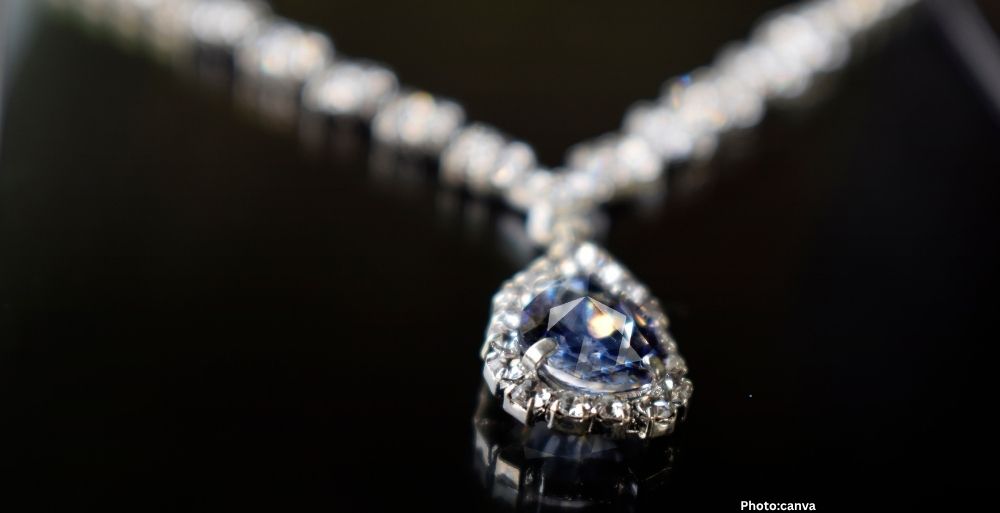
In a notable development within the luxury jewelry sector, Valérie Messika has unveiled a stunning necklace that features the Okavango Blue Diamond, the largest and rarest blue diamond ever discovered in Botswana. This remarkable gem was unearthed in 2019 from the Orapa mine, initially presenting itself as a rough stone weighing 41.11 carats. After an intricate process of cutting and polishing, it was transformed into a Fancy Deep Blue VVS2 Type IIb diamond weighing 20.46 carats.
The government of Botswana retains ownership of the diamond and enlisted Valérie Messika, the founder of her eponymous jewelry brand, to create a piece that would honor and highlight the stone’s stunning beauty. The resulting pendant necklace is adorned with over 500 diamonds, framing the oval-cut Okavango Blue Diamond in a design that evokes a vintage aesthetic. “I tried to let the diamond speak by itself,” Messika explained in an interview. “I had so much respect for the beauty of the stones that I wanted it to be the central part.” This thoughtful design approach illustrates Messika’s intent to showcase the unique qualities of the diamond while enhancing its visual impact.
The Legacy of Messika’s Craftsmanship
Valérie Messika’s reputation as a leading jewelry designer is deeply rooted in her family’s legacy in the diamond industry. Her father, André Messika, is a well-respected diamond dealer with a long-standing history in the field. Following the establishment of her company in 2005, Valérie has emerged as a significant figure on Place Vendôme, the prestigious hub for luxury jewelry in Paris. Her innovative designs, notably the Move collection, which features floating diamonds, have attracted a diverse clientele, particularly appealing to a younger demographic.
Despite the allure of this exquisite piece, it is essential to highlight that the necklace and the diamond are not for sale. Messika emphasized that this project is a tribute to natural diamonds, underscoring its uniqueness and her honor in being the first—and currently the only—designer to create a jewelry piece featuring this exceptional stone. “This project is, for me, a tribute to natural diamonds,” she stated. “It’s one of a kind and it’s a time in my career that I can work with such an amazing rare stone.” This perspective reflects not only her respect for the craft but also her commitment to the heritage of natural diamond jewelry.
Investment in Artistry and Craftsmanship
When asked about the extensive resources and time dedicated to designing a non-commercial piece, Messika expressed that the notion of the necklace being unsold never crossed her mind. “Everybody focused on this stone for such a long time—all the craftsmanship, all the design people—but for me, I saw it also like a kind of tribute to my expertise as a diamond jeweler,” she shared. This sentiment underscores the notion that the creation of fine jewelry transcends mere commercial transactions, reflecting a deeper connection to artistry and heritage.
A Continuing Relationship with Botswana
This is not Messika’s first collaboration involving rare African stones. In 2019, she designed a piece around a D-flawless 33-carat diamond sourced from the Lucara mine in north-central Botswana. Her ongoing relationship with Botswana highlights her commitment to promoting the natural beauty of the country’s diamonds and the extraordinary craftsmanship involved in their production. “It’s important to put in light the magic of natural diamonds,” Messika emphasized, contrasting these natural gems with lab-created alternatives, which she described as “kind of like a photocopy from a laboratory.” This comparison serves to elevate the perceived value of natural diamonds, particularly in a market increasingly filled with synthetic options.
The Rare Nature of the Okavango Blue Diamond
The rarity of the Okavango Blue Diamond is further emphasized by Messika, who remarked, “It’s the first time in my whole life [to see a diamond like this], and I’m not sure I will see a second…it’s very, very, very rare. I think only 0.01% of the world’s diamonds can be blue.” Such statements underscore the extraordinary nature of the stone, reinforcing its significance not just as a piece of jewelry, but as a symbol of natural beauty and rarity within the global diamond market.
For now, the necklace stands as a singular creation, representing a significant intersection between fine jewelry and the irreplaceable allure of natural diamonds. In an industry often driven by commercial trends and the pursuit of the next big thing, the Okavango Blue serves as a poignant reminder that some treasures are not meant to be replicated or bought, but rather cherished for their unique beauty and the rich stories they represent. This extraordinary piece not only highlights the skill and vision of Valérie Messika but also acts as a testament to the enduring legacy of Botswana’s diamond heritage.