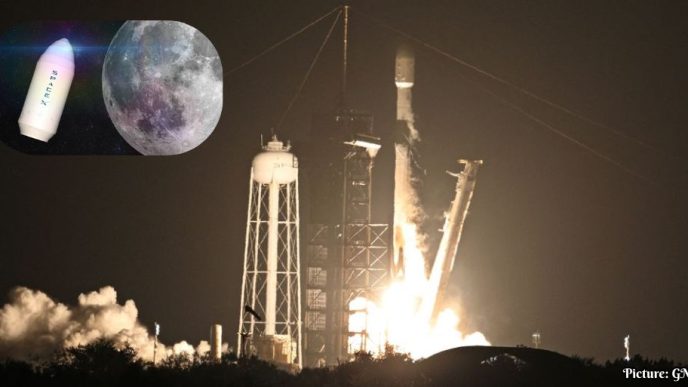
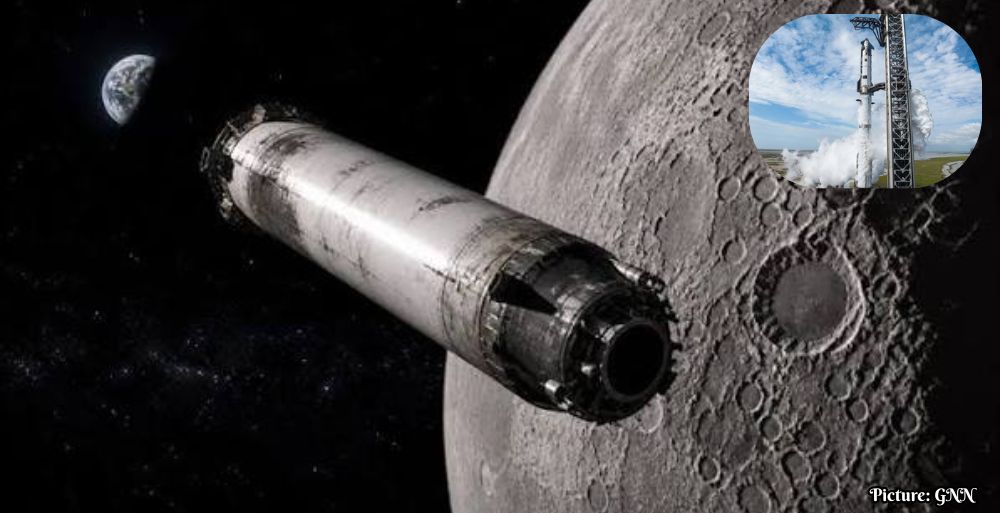
A SpaceX rocket’s upper stage is on a collision course with the moon, set to impact near Einstein Crater, raising awareness about the growing issue of space debris.
CAPE CANAVERAL, Fla. (AP) — A piece of a SpaceX rocket is expected to collide with the moon on Wednesday, March 4, 2025, after its launch over a year ago. This unintentional impact is anticipated to create a new crater and produce observable dust and rubble, exciting scientists and astronomy enthusiasts alike.
According to space tracking expert Bill Gray, the upper stage of the rocket is projected to hit the lunar surface at speeds of approximately 5,400 mph (8,700 kph), which is about seven times the speed of sound. The impact is predicted to occur near the sunlit western limb of the moon, close to the Einstein Crater. Observers in the eastern parts of the United States and Canada, as well as much of South America, will likely have the best viewing conditions during the early morning hours.
While the incident is not expected to pose a significant threat, it underscores the increasingly crowded nature of Earth’s orbit. “Things are getting crowded up there,” said Gray, who plans to witness the aftermath from New Brunswick, Canada. The intention was never for this piece of space infrastructure to collide with the moon; however, experts have indicated that the upper stage could have been redirected into a solar orbit to avoid such a mishap.
This event marks the second known instance of a rocket accidentally crashing into the moon. In 2022, a segment of a Chinese rocket created craters on the far side of the lunar surface. The upcoming impact is particularly fortuitous for astronomers, as it will take place on the moon’s near side, where the energy released upon impact is expected to be equivalent to three tons of TNT.
Despite the potential for a significant impact, experts believe the flash generated will be too faint to be seen with the naked eye. However, the resulting plume of ejected material could extend several miles into space, remaining visible to telescopes for up to tens of minutes following the impact. Benjamin Fernando, a scientist at Los Alamos National Laboratory, noted, “The gravity on the moon is low and there is no wind to blow the dust away,” which may enhance the visibility of the debris.
Fernando further emphasized the scientific interest in this event, stating that understanding the hazards posed by space debris is crucial for the safety of future astronauts. He anticipates the creation of an impact crater approximately 90 feet across and 16 feet deep (27 meters across and 5 meters deep), although this crater will be too small to observe from Earth. However, it will be documented by spacecraft, including NASA’s Lunar Reconnaissance Orbiter and South Korea’s Danuri lunar orbiter, which will take before-and-after images of the site. Notably, Danuri will pass within a couple of miles of the rocket just two minutes before the impact.
The abandoned rocket segment, measuring around 40 feet (12 meters) and weighing approximately 10,000 pounds (4,500 kilograms), was responsible for launching two private lunar landers on January 15, 2025. One of these landers, Firefly Aerospace’s Blue Ghost, successfully achieved a historic lunar touchdown, while the other, developed by Japan-based ispace, unfortunately failed.
Scientists assert that by studying tracked impacts such as this, they can glean important insights into the risks posed by natural meteoroids, which typically offer little warning before impacting the moon. NASA previously conducted similar experiments during the Apollo era, deliberately crashing rocket stages and lunar modules into the moon for seismic research. More recently, in 2009, NASA’s LCROSS mission intentionally crashed its spacecraft and upper stage to search for ice at the lunar south pole.
As the moon garners renewed interest as a destination for exploration, experts stress the need for improved monitoring of space debris and traffic management. The United States and China are both competing to land astronauts on the moon in the coming years, while private companies like SpaceX and Blue Origin are vying to provide landers for NASA’s upcoming Artemis missions, which aim to return humans to the lunar surface.
Retired astrophysicist Jonathan McDowell commented on the significance of the event, stating, “This impact will not be a problem. But in a future where there are long-term bases on the moon, similar impacts would be an issue and we need to not leave rocket stages in chaotic orbits of this kind.”