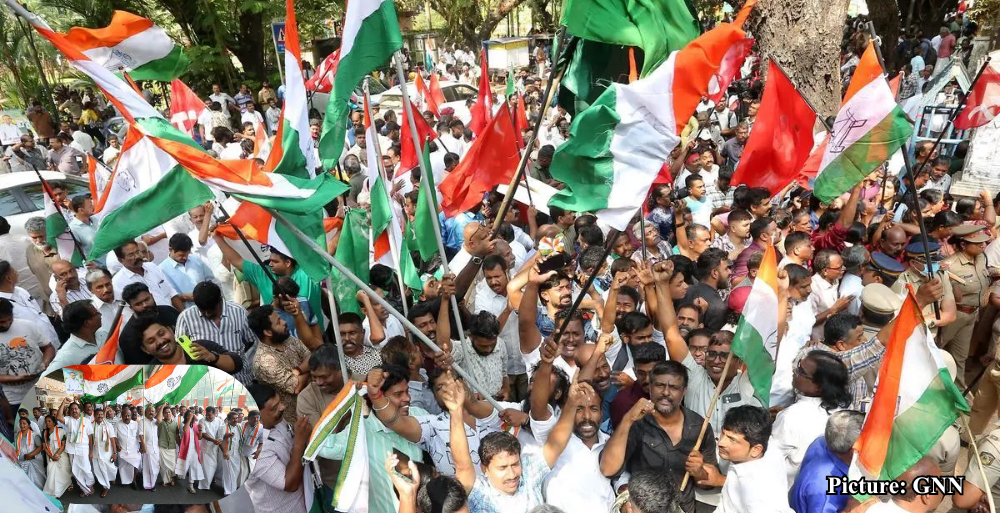
The Congress-led United Democratic Front (UDF) has secured a historic victory in the Kerala Assembly elections, ending a decade of governance by the Left Democratic Front (LDF) and marking a significant political shift in the state.
Thiruvananthapuram, Kerala – In a remarkable turnaround, the Congress-led United Democratic Front (UDF) has decisively triumphed in the Kerala Assembly elections held on April 9, 2026. Officially declared on May 4, 2026, the results indicate a resounding rejection of the LDF’s decade-long rule, with the UDF winning 102 of the 140 Assembly seats, while the LDF’s representation dwindled to just 35 seats.
The UDF’s success was largely attributed to widespread anti-incumbency sentiments among voters, who voiced their dissatisfaction with the LDF’s governance over the previous ten years. The UDF’s vote share stood at 44.19%, surpassing the LDF’s 32.82%. This victory marks a significant rebound for the UDF, which suffered substantial losses in the 2016 and 2021 Assembly elections, where it was all but wiped out.
Political Landscape and Historical Context
Historically, Kerala’s political landscape has been dominated by a bipolar contest between the UDF and the LDF. The recent election results reflect a growing desire among the electorate for a change in leadership and governance styles. Chief Minister Pinarayi Vijayan, the face of the LDF, resigned following the electoral defeat, a move that was formally accepted by Governor Rajendra Vishwanath Arlekar. Vijayan has been asked to serve as caretaker chief minister until a new government is established, highlighting the immediate transitional phase in Kerala politics.
The UDF coalition, which consists primarily of the Indian National Congress (INC) and the Indian Union Muslim League (IUML), saw the INC winning 63 seats while the IUML secured 22. Other allied parties contributed additional victories to the coalition’s tally. The BJP, traditionally a minor player in Kerala, marked a breakthrough by winning three seats in constituencies such as Nemom, Kazhakuttam, and Chathannoor, indicating a potential shift in voter alignment.
Key Election Outcomes and Shifts
Among the notable victories for the UDF was Chandy Oommen, who retained the Puthuppally seat with a staggering margin of 52,907 votes. Ramesh Chennithala also achieved a significant win in Haripad, defeating his nearest rival by over 23,000 votes, further solidifying the UDF’s support across various constituencies. These results reflect a robust endorsement of UDF candidates and a repudiation of LDF incumbents.
The elections also revealed a troubling trend for the LDF, with 13 of the 21 cabinet ministers, including prominent figures like Health Minister Veena George and Minister for Excise and Local Self-Government M.B. Rajesh, losing their seats. This substantial turnover among key leadership figures underscores the depth of voter discontent with the LDF’s performance.
In a surprising outcome, veteran CPI(M) leader G. Sudhakaran, who ran as an independent candidate, defeated his former party colleague in the Ambalappuzha constituency by nearly 28,000 votes. This victory not only highlights a fracture within the LDF’s traditional base but also signals changing political allegiances among the electorate.
Emerging Trends and Future Governance
The newly elected 16th Kerala Legislative Assembly will comprise 11 women MLAs, a slight decrease from the previous assembly. Notably, Fathima Thahiliya from the IUML made history as the first woman MLA from her party, winning in Perambra. This development marks a significant step forward for women’s representation in Kerala’s political domain, reflecting broader societal changes.
The UDF leadership is expected to convene shortly to discuss the formation of the new government and the selection of the chief minister. V.D. Satheesan, the Leader of the Opposition, expressed confidence in the party’s direction, indicating that consultations would take place among elected legislators to arrive at a consensus regarding the chief ministerial candidate.
As the UDF moves to establish its governance, leaders like Rahul Gandhi have emphasized the need for a government that harnesses Kerala’s potential and responds effectively to the electorate’s pressing needs. Gandhi’s statement, “Keralam has the talent, Keralam has the potential, and now Keralam has a UDF government with a vision,” encapsulates the party’s aspirations for the next five years.
In conclusion, the 2026 Kerala Assembly elections not only signify a substantial shift in government but also reflect the evolving political landscape in the state. Voters have sought new leadership and accountability from their elected representatives, and the UDF’s return to power is viewed as a mandate for change. The upcoming term presents an opportunity for the UDF to address the challenges facing the state and to fulfill the expectations of a diverse and dynamic electorate.