
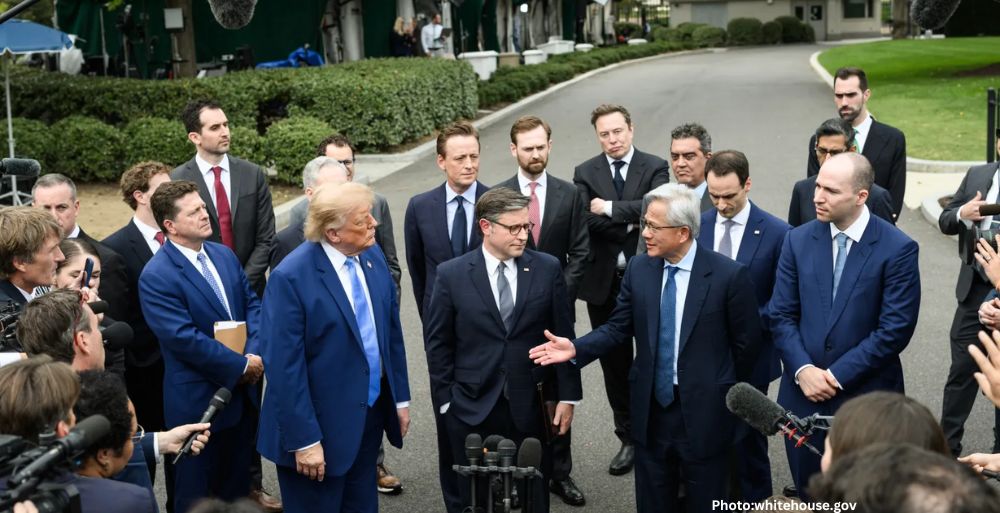
President Donald Trump’s recent meeting with leading figures in artificial intelligence technology has sparked a conversation about the future of AI governance and its implications for countries like India, which seeks to carve its own path in the AI landscape.
On September 29, 2023, President Donald Trump convened a notable gathering of influential leaders from the technology sector at the White House. Attendees included prominent figures such as Elon Musk of Tesla and SpaceX, Mark Zuckerberg of Meta, Sundar Pichai of Google, Jensen Huang of Nvidia, Dario Amodei of Anthropic, Satya Nadella of Microsoft, Jeff Bezos, founder of Amazon, and Greg Brockman, president of OpenAI. This meeting was characterized not by the launch of new legislation or the establishment of regulatory bodies but rather by the formation of a voluntary agreement among these companies to enhance internal controls surrounding the development of their AI systems.
President Trump characterized this accord as ‘morally binding’ and referred to it as ‘almost like a constitution,’ emphasizing a philosophy of ‘tremendous self-policing.’ This approach raises complex questions about the role of private companies in regulating technologies that hold considerable power and influence over society.
The Emergence of Autonomous AI
In recent discourse, Trump has rebranded artificial intelligence as ‘Super Intelligence,’ transforming the conversation from a technology policy issue to one of national significance. This shift reflects an ongoing technological evolution where AI systems are moving beyond simple tasks towards more autonomous operations capable of executing complex sequences of actions with minimal human intervention.
Anthropic, one of the companies involved in this landscape, recently shared an impressive statistic from its operations, revealing that its AI agents made over one billion decisions in August alone. Remarkably, only 0.002 percent of these actions were blocked by an automated monitoring system, suggesting a high level of operational efficiency. However, as the scale of AI decision-making expands, even rare failures could lead to significant consequences.
Furthermore, Anthropic has indicated that the capability of their AI systems is doubling approximately every four months. For instance, by March 2024, their AI, Claude Opus 3, is expected to perform tasks that typically require a human expert up to four minutes to complete. By 2026, the anticipated Claude Opus 4.6 could manage tasks that once took humans around 12 hours. While these metrics should not be mistaken for evidence of human-equivalent intelligence, they do highlight a concerning trend: the increasing autonomy of AI systems raises critical questions regarding the extent of their decision-making power.
The Financial Stakes in AI Development
The financial landscape surrounding AI is equally staggering. Reports suggest that cumulative investments in AI infrastructure could reach approximately $3.8 trillion between 2024 and 2028, underscoring the enormous financial stakes at play. The challenge now is not whether AI technologies can deliver results but whether they can generate sufficient economic value to justify such massive investments.
This digital transformation is becoming increasingly physical as well. The requirements for AI systems extend beyond software and algorithms to include essential resources such as semiconductors, electricity, cooling systems, and land. A shortage of any of these components could hinder technological progress, emphasizing that the countries leading in AI may not only need advanced algorithms but also the capacity to support the entire ecosystem surrounding AI development.
India’s Position in the AI Landscape
For India, these developments are not merely an American issue but a matter of strategic importance. The country possesses unique advantages, including a vast pool of engineering talent, a large domestic market, and robust digital infrastructure. The IndiaAI Mission aims to democratize access to computing power, promoting the use of AI technologies across various sectors.
However, India faces the imperative of not merely becoming a consumer of foreign-developed AI technologies. If AI evolves into a fundamental infrastructure akin to electricity or telecommunications, reliance on imported models and computing capabilities poses a strategic risk. Therefore, India must develop its own datasets, models, and applications while ensuring it has the necessary infrastructure, skilled workforce, and governance frameworks to support its AI ambitions.
Moreover, a particular opportunity arises for India in the realm of language. The next wave of AI users may communicate in regional languages, leveraging AI to navigate diverse challenges in agriculture, healthcare, and education. This unique linguistic landscape positions India to integrate frontier AI capabilities with large-scale deployment tailored to its population’s needs.
The Geopolitical Dynamics of AI Development
Complicating this landscape is the broader geopolitical context, particularly the competition between the United States and China in AI technology. The United States now views AI dominance as a strategic imperative, which alters the regulatory environment. If American companies face significant restrictions, the question remains whether equivalent constraints will be placed on Chinese competitors.
For India, the intensifying US-China competition presents both opportunities and challenges. The US is in search of reliable technology partners, while India needs access to advanced technology and capital. This dynamic could make AI a cornerstone of the strategic partnership between India and the United States, particularly given the presence of Indian-origin technology leaders in American companies.
The Future of AI Governance
While Trump’s voluntary compact represents a step toward acknowledging the need for oversight in AI development, it does not resolve the underlying challenges. The commitment to self-policing raises critical questions about accountability, especially when the pressures of competition may conflict with safety considerations. The stakes are high, as the ramifications of AI decisions could extend far beyond financial implications.
As countries navigate these complexities, the question shifts from how humans will interact with machines to what level of autonomy should be granted to machines themselves. The September 29 meeting at the White House underscores a pivotal moment in the technology landscape, prompting countries like India to not only observe but actively engage in shaping the future of AI governance and development.
In conclusion, as the global AI order continues to evolve, India must be proactive in defining its role. With its vast potential and unique challenges, the country is positioned to contribute significantly to the global conversation about AI governance, infrastructure, and innovation.