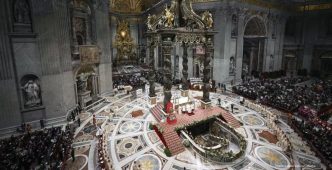

The 400th anniversary of St. Peter’s Basilica underscores its lasting impact as a beacon of Catholic faith and architectural brilliance.
VATICAN CITY – St. Peter’s Basilica, often referred to as the “parish church of the whole world,” commemorated its 400th anniversary of dedication on February 18, 2026. The milestone was celebrated with a significant homily delivered by Pope Leo XIV, who articulated the Basilica’s monumental importance within the Catholic Church and its central role as a spiritual home for millions worldwide.
Pope Leo opened his address by expressing profound admiration for the Basilica, calling it “one of the most celebrated monuments in the whole world, at the heart of Catholicism.” He emphasized the emotional resonance that a visit to this grand edifice can evoke, stating, “We are filled with awe, stirred by the sacredness of faith, the power of history, and the beauty of art.” He noted that this sense of wonder is rooted in the presence of the humble tomb of St. Peter, the apostle and first pope, believed to be interred beneath the Basilica’s main altar.
Historical Context and Significance
The current St. Peter’s Basilica was consecrated in 1626, replacing an earlier structure that had served as a spiritual center for over 1,200 years. The initiative to construct a new basilica was undertaken by Pope Julius II, who laid the cornerstone in 1506. This monumental project unfolded over the course of more than a century and was significantly influenced by the socio-religious upheavals of the Protestant Reformation, which highlighted the urgent need for reform within the Catholic Church.
Pope Leo, during his homily, highlighted the architectural and spiritual significance of the Basilica, noting that the main altar is positioned directly above St. Peter’s tomb. Above this sacred site, the dome is inscribed with the words spoken by Jesus to Simon Peter: “You are Peter, and upon this rock I will build my Church.” This inscription not only serves as a theological cornerstone but also as a reminder of St. Peter’s foundational role in the establishment of the Church.
Reflections on Faith and Leadership
In his address, Pope Leo drew from the reflections of past popes, notably invoking the words of Blessed Fulton Sheen, who once remarked, “Now that I come before Your Holiness, I see the Church personalized.” This notion of personalization extends beyond the papal office and is evident in the lives of individuals who embody the Church’s mission, including the selfless contributions of figures such as Mother Teresa and the spiritual journeys of pilgrims from around the world.
Pope Leo articulated that the Basilica transcends being merely a place of worship; it is an architectural representation of the Petrine office. He stated, “The whole Basilica therefore echoes the question that Christ put to his disciples: ‘But who do you say that I am?’” This pivotal question invites pilgrims from diverse backgrounds to unite in their faith, collectively acknowledging Jesus as “the Messiah, the Son of the living God.”
Continued Relevance and Spiritual Life
St. Peter’s Basilica remains an active church, serving as a vibrant space for worship, reflection, and confession. It stands as a site where pilgrims can engage in the sacrament of reconciliation, with confessors available in multiple languages, reflecting the Basilica’s enduring mission as a place for spiritual rejuvenation and conversion. This ongoing activity underscores the Basilica’s purpose as a living testament to the Catholic faith’s vitality.
Pope Leo emphasized the Eucharist as the Church’s greatest “masterpiece,” asserting that whether celebrated in the grand setting of St. Peter’s or in a simple chapel, the Eucharist remains central to Catholic worship. The Basilica houses significant inscriptions connecting its history to the institution of the Eucharist, including a notable passage from Luke 22:31-32, where Jesus reassures Peter of his faith amid impending trials, stating, “I have prayed for you that your faith may not fail; and when you have turned again, strengthen your brethren.”
Architectural Symbolism and Artistic Legacy
The architecture of St. Peter’s Basilica serves not only as a visual marvel but also as a profound spiritual symbol. The vastness of the structure, coupled with its soaring façade and expansive square, invites all who enter to experience a sense of divine presence. Pope Leo spoke of the colonnade designed by Gian Lorenzo Bernini, describing it as an embrace that welcomes individuals to approach the tomb of Peter and join in the profession of faith in Christ. This architectural design, with its spiraling columns reaching upwards, symbolizes the connection between the earthly realm and the heavenly Communion of Saints.
Moreover, the Basilica’s rich artistic legacy includes contributions from some of history’s greatest artists, further enhancing its role as a center of faith and culture. The various sculptures, mosaics, and paintings within its walls collectively narrate the story of salvation and invite contemplation on the mysteries of faith.
Conclusion: A Living Testimony of Faith
As St. Peter’s Basilica embarks on its next century, it continues to embody the spirit of faith and conversion that has characterized the Catholic Church for centuries. It stands not only as an architectural masterpiece but also as a vibrant living space where the legacy of St. Peter and the universal Church continue to thrive. The Basilica remains a powerful symbol of hope and faith, inviting believers and seekers alike to deepen their relationship with Christ, thereby affirming its status as a key landmark of spirituality and history in the heart of Vatican City.